It’s All In The Tag

I was surprised when Jonathan pointed out in my tutorial that the most frequently used words in my tag cloud were ‘mother’ and ‘drawing’.

I thought that it would be words like ‘death’, ‘emotion’ etc – I feel that I’ve written enough about them. So, I’ve been through all of my posts and checked that I’ve categorised and tagged them correctly. I haven’t. I’ve failed to use more general terms – words like ‘resentment’ and ‘loss’ appeared but not the umbrella term of ‘emotion’. It’s important moving forward that I keep on top of this as the tag cloud will be integral in determining what is important to me.

Having completed that exercise, the words of the moment are ‘emotion’ and ‘process’. That sounds about right…

Doing Lines

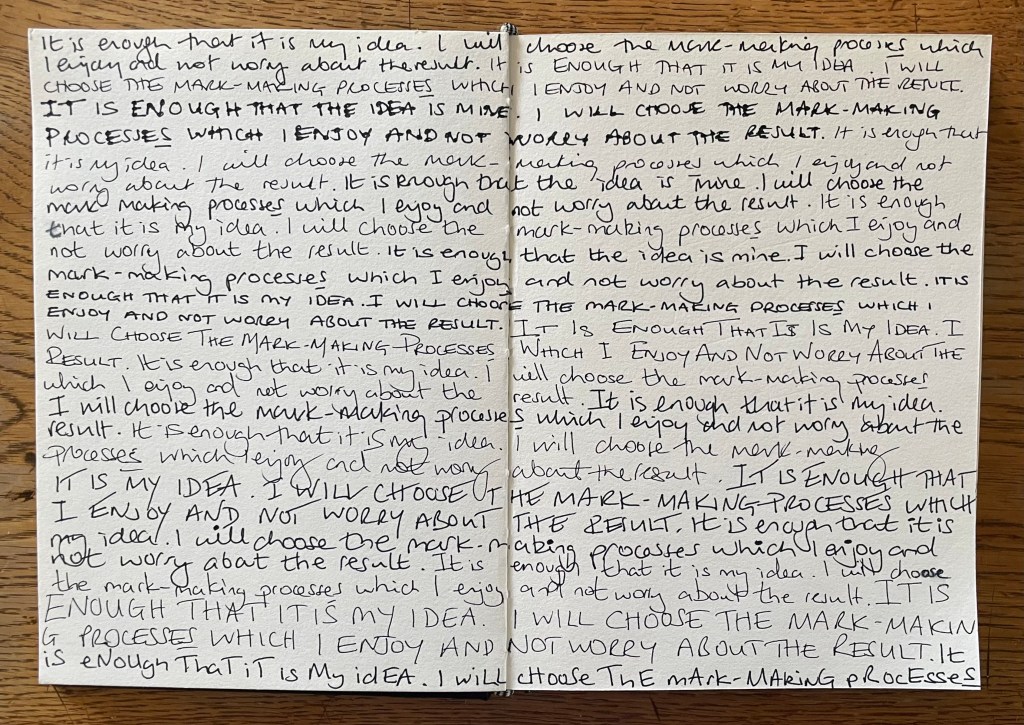
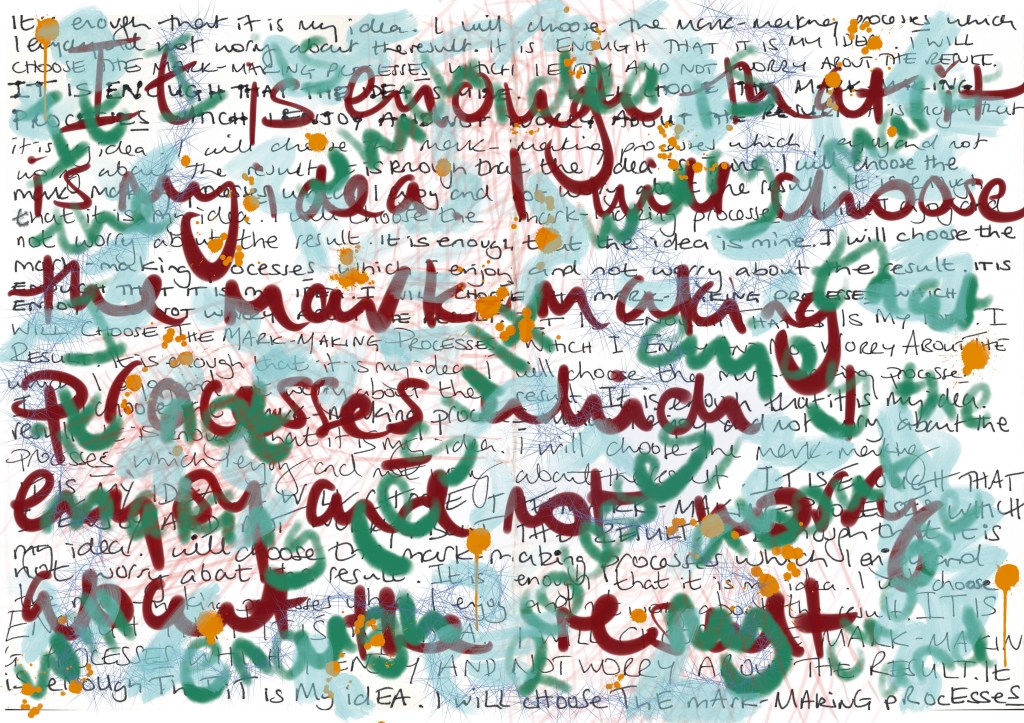
Following my tutorial with Jonathan, I decided to test the theory that if you say something to yourself enough times, you’ll start to believe it. So, I’ve been doing lines. To be honest I didn’t have to do lines as a punishment at school: I was a conformist.

We make marks everyday in one way or another. An obvious one is our handwriting. I learnt handwriting at school in the same way as every other child, in the book with the lines which indicated where the top and bottom of your letters should go, and the line in the middle indicating the height of the small letters. Once we had mastered the basics, we were allowed to go free range, first with a pencil, and then with a pen, as a reward for continued neatness, and perfection. Those were the days when everyone was taught to write with their right hand; left-handedness was not tolerated. But the need to express ourselves in how we write the words, not just with the words we choose, will always out.

Our handwriting reveals things about us, from the tilt, the size, the pressure, the failure to close our loops. I’ve never had consistent handwriting. It changes depending on my mood. I wonder what that says about me. Maybe I’ve never found a style which says to me: yes, this is you. And maybe that’s the point – I’m forever changing. Or maybe I just haven’t found my mark-making processes. It doesn’t really bother me, but at times I do feel jealous of the beautifully formed letters of others. I think – yes, you’ve got it together; you know who you are.

Doing Lines I

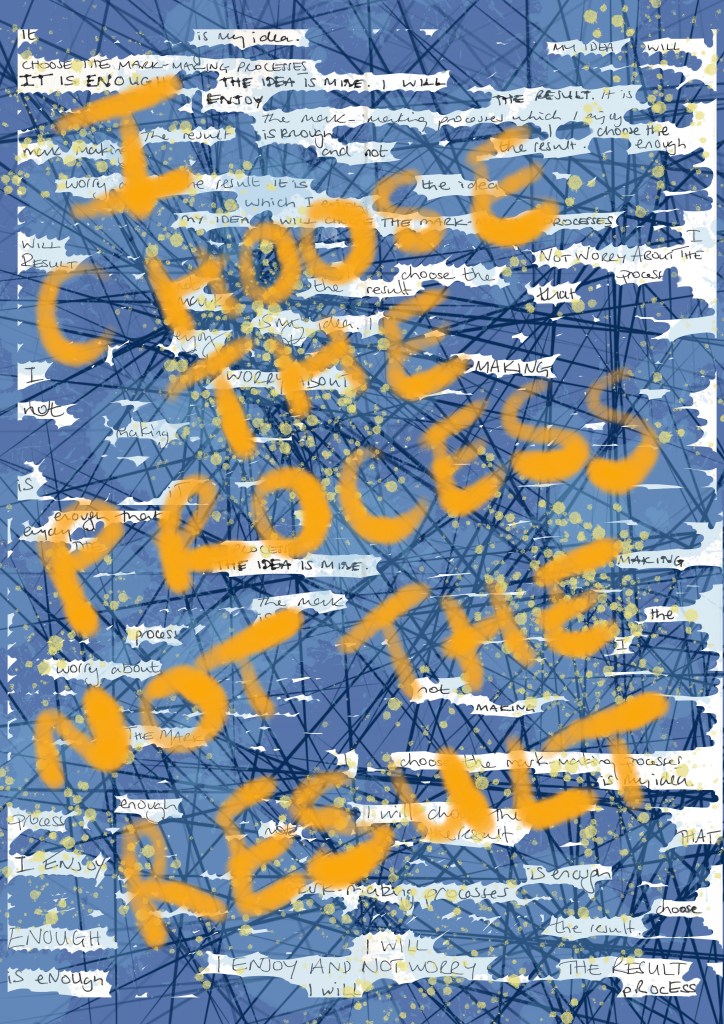
I like that the redaction is scruffy and that there are jagged edges. When I was doing it I wasn’t aware how scruffy it was because I was doing it against a white background, and so it just looked like the redacted words were disappearing. Surprisingly, I didn’t even have the urge to tidy it up once it revealed itself to me. As I was going through the words trying to make different phrases each time, there was a section in the middle which became a bit negative. It’s quite difficult to find different phrases from the same words in the same order. Phrases like ‘I worry about not making’, ‘Is it enough that I enjoy the process’ and ‘I worry about not making the mark’ started to pop up.

Doing Lines II

Well, I’ve written the words that many times, that if they haven’t sunk in by now, they never will.

It seems to have all been about words recently. What are words worth? That’s what the Tom Tom Club asked in their rather bizarre new wave hit from the early eighties, Wordy Rappinghood. You have to be of a certain age to remember this one. I rather like the artwork.

Dialogue I

I’ve been thinking about what I can do for my submission to the Summer Exhibition.

One thing is for certain, the resource of time over the next two weeks is extremely limited, what with the deadlines for my study statement, curation of my blog and something for the interim show in March, all of which take precedence. In previous years I’ve given a lot of thought and time to my entry and got precisely nowhere, so this year I’m going to do something different. It will be interesting to see whether rejection feels different depending on how much time has been invested. I’m going to follow the philosophy of Gino D’Acampo – minimum effort, maximum satisfaction – have a bit of an experiment and not get too hung up about it.

I’ve put my initial thoughts into a mind map although, to be honest, when I’ve been round the exhibition in previous years, I’ve struggled to see the relevance of some works to the theme.

There are quite a few ideas to consider:

  • I quite like the idea that ‘dialogue’ literally means ‘through words’ – words in the work itself/ posing a question?
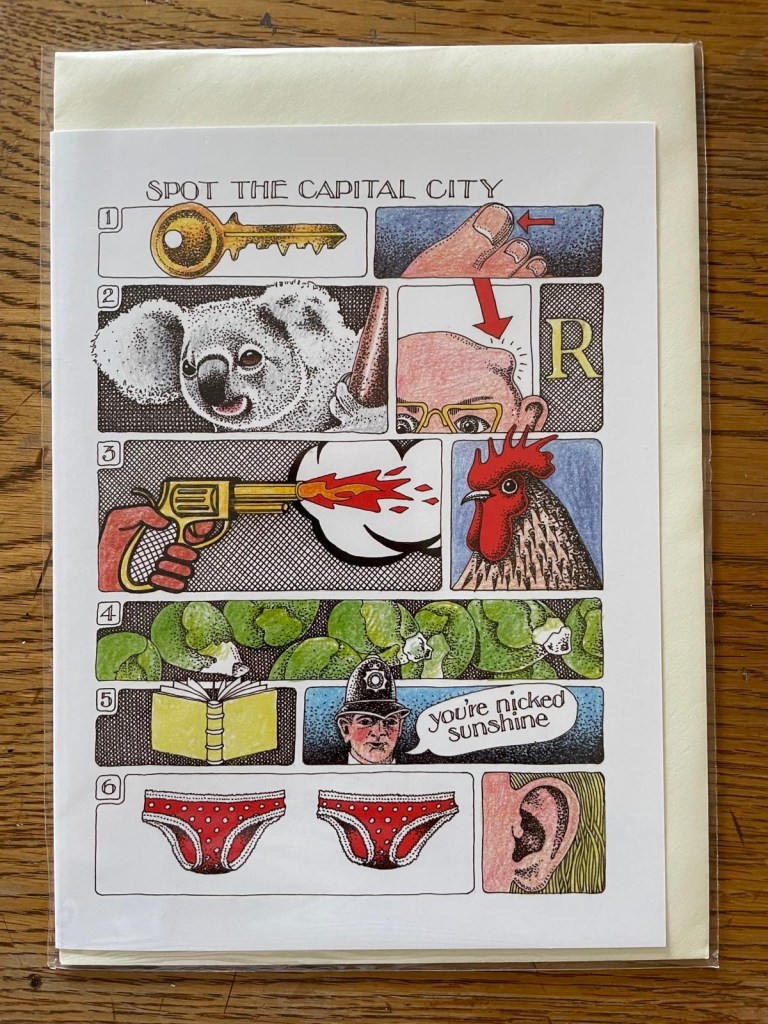
  • What about the ability of images to convey phrases and words? One of my favourite TV programmes when I was a teenager was Catchphrase, in which contestants had to guess the phrases being represented by a short animation. Those were the days when it was hosted by Roy Walker – much better than the revival hosted by Stephen Mulhern. A while ago I was looking for a birthday card, and I came across this one. It took me ages to get out of the shop – I tried to solve the clues, the women behind the counter had been trying to solve them all morning, it seemed everyone in the shop wanted to have a go.
  • Exchange – does a dialogue have to be continuous or can there be pauses eg written dialogue in letters, email etc? Can it be in different forms eg verbal met with non-verbal response?
  • Dialogue between the viewer and the work?

Anyway, I’m going to have a quick look to see how other artists have dealt with the subject of dialogue, whilst giving it all some further thought.

Arty-farty

In the hope of finding some inspiration, I sorted out my art bookcase and came across the exhibition handout to the Michael Craig-Martin exhibition at the Royal Academy. This quote caught my attention:

I dislike jargon intensely and cannot stand people who think that complex ideas need to be expressed in a way that is obscure or rarified… The great minds whom I have admired … are precise and economic in their use of simple language.”

Michael Craig- Martin, “On Being An Artist

I have to agree with him. I’m very much an advocate of the Plain English campaign. Maybe it’s because I don’t have the necessary range of vocabulary to achieve such verbal smoke and mirrors, or the attention span.

Clarity of language is what made reading Will Gompertz’s ‘Think Like An Artist…’ such a breath of fresh air. He cuts through all the jargon and makes his points in such a way that someone who doesn’t have an ounce of art knowledge would be able to understand and appreciate them.

As Craig-Martin says, it’s not about having very complex ideas: ideas which challenge are good but, if we want art to be accessible to all, why use convoluted and, frankly, nonsensical language to explain and critique it? Is it to maintain an air of mystery, of intellectual superiority? And who is responsible? The artists, the critics, the galleries or curators, or all of them?

Thinking back to our first sessions when we introduced ourselves and our work, I can’t think of a single instance when I didn’t understand the ideas being expressed. There was just authenticity.

This year’s Summer Exhibition is dedicated to art’s capacity to forge dialogues but, how can art ever hope to change things if people just don’t get it? It goes back to the idea of ‘connection’ in my previous post: without a connection, however small, there can’t be engagement, and without engagement there can’t be a dialogue.

When I started this course a friend asked me whether I was going to become all arty-farty. I said I hope not but, if I ever come across that way, she should give me good slap!