The Power of Ugly Art

I was watching a YouTube video yesterday morning and happened to look at the list of related videos on the right hand side: The Power of Ugly Art – Creativity Exercise for Dealing with your Inner Critic In Your Sketchbook, Marie-Noëlle Wurm, caught my eye.

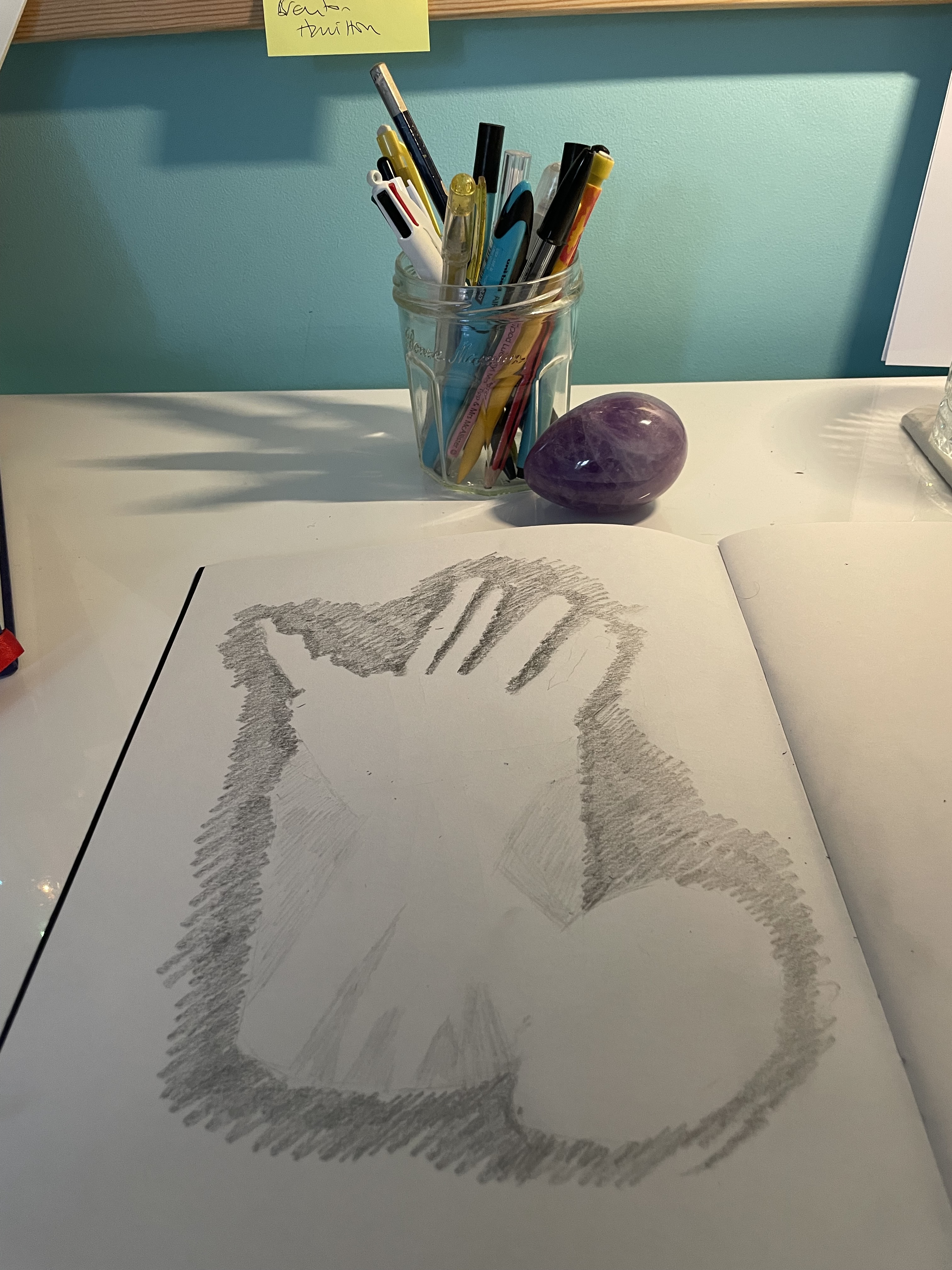
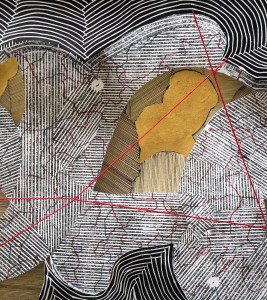
During our critique session on Tuesday afternoon, whilst talking about my experimental digital collage, I mentioned that I feel particularly drawn to the process and that I have some ideas as to how I can use it to express my feelings on motherhood, in particular, in relation to the quote in Hearts and Lino about the heart walking around outside the body. I commented that it might be a bit gruesome, reflecting that actually that didn’t matter as sometimes art has to be ugly to convey what it needs to; it doesn’t always have to be aesthetically pleasing.

I mentioned N’s reference, in her introduction to her artistic practice, to Louise Fletcher’s course in which she actively encourages the creation of ugly art, which I have also watched. This is what Wurm encourages – an artist’s fear is creating ugly art, so lean into the fear instead of running way from it. Creating beautiful art is an expectation and she suggests detailing the expectations we may have as artists, and then expressing them in our sketchbooks. By letting our expectations exist, instead of pushing them away, we give them space to exist within our art practice, which will lead to more powerful art, growth and compassion for ourselves.

I’m going to give her exercises a go in my sketchbook, ordinarily a safe place for no one’s eyes but my own.

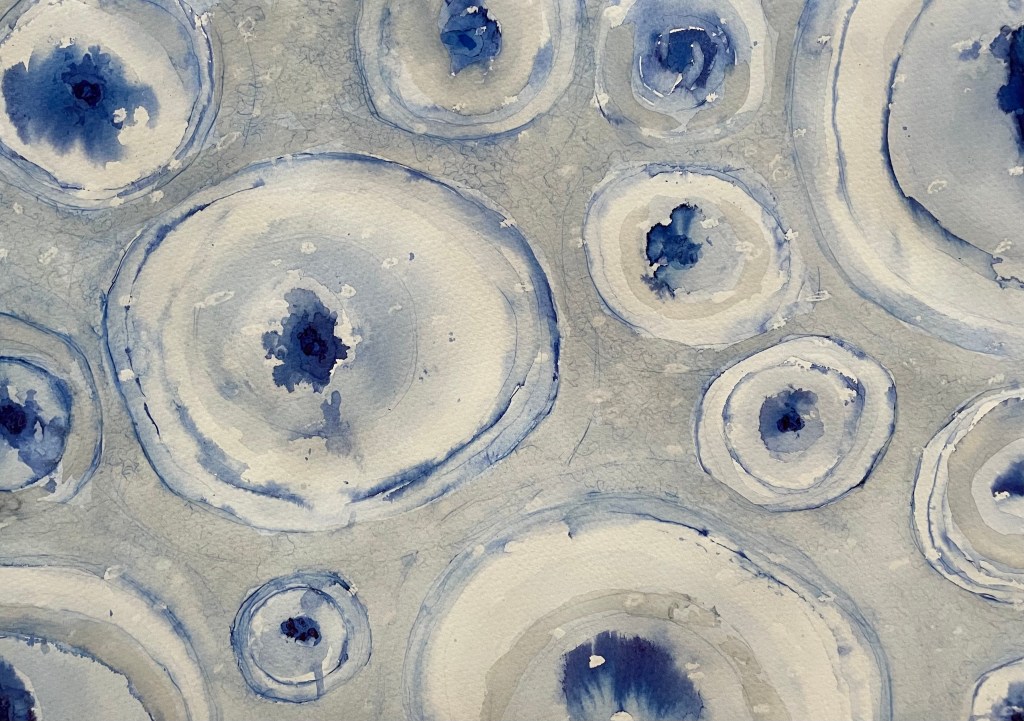
Blot

Messing with ink.

There’s not a lot to say about these images. Apart from the middle one, which was influenced by thoughts on cells and became all too contrived, there’s something very liberating about putting water on paper and watching the ink do its thing.

I’m beginning to think that maybe I should be getting on and producing some actual work.

Hearts and Lino

”Making the decision to have a child – it is momentous. It is to decide forever to have your heart go walking around outside your body.”

This quote from Elizabeth Stone (I’m yet to fathom out who she is!) is apparently well-known, but I only heard it recently when someone, I think it was an actor, was being interviewed about becoming a parent.

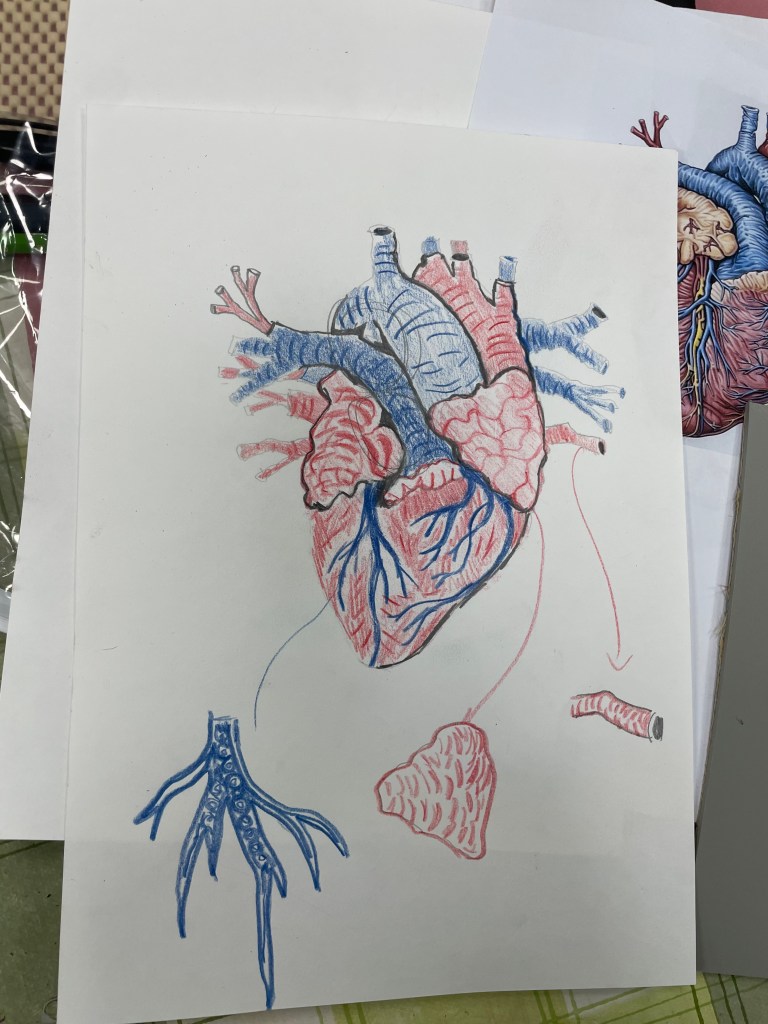
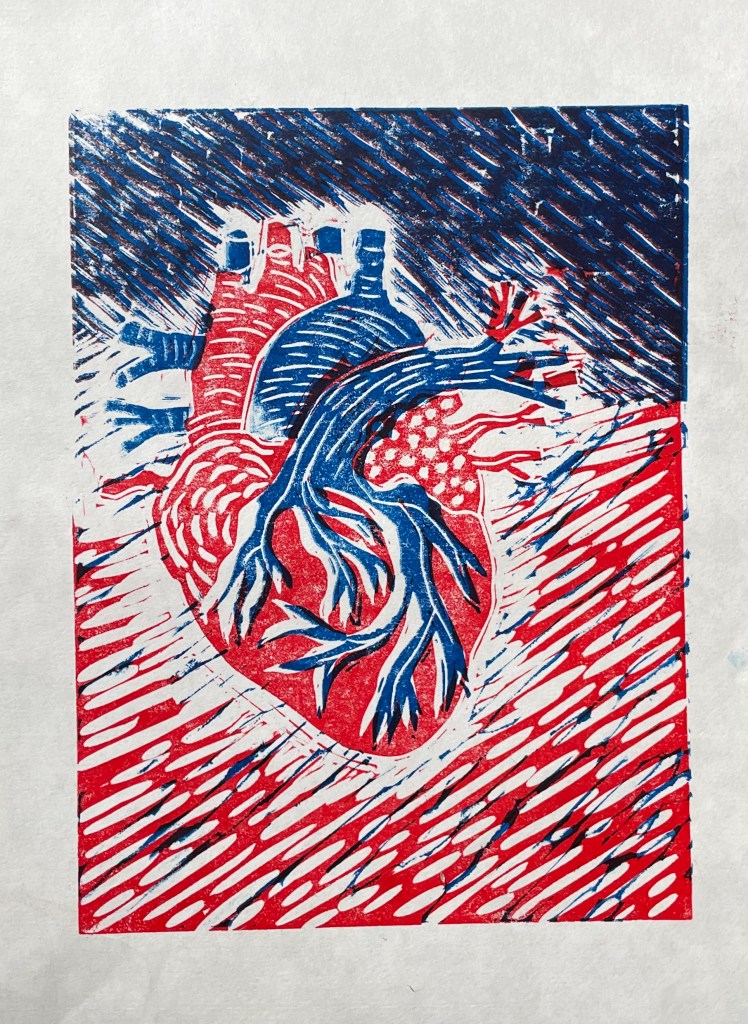
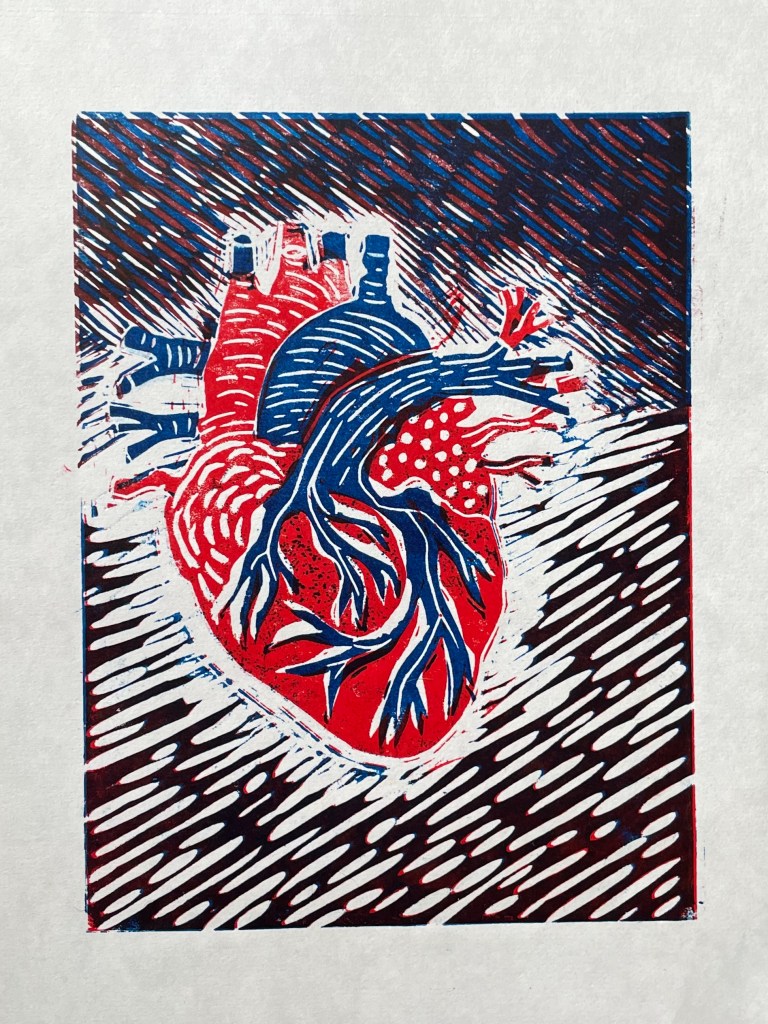
I think it sums up brilliantly the utter overwhelming sense of vulnerability and responsibility that I felt on becoming a mother. With this in mind, I attended a workshop on Saturday and Sunday on linocut led by Lisa Takahashi. Whilst everyone else started working on their images of sea urchins, birds, landscapes and flowers, I sat there, initially reluctant to reveal my chosen image of an anatomical diagram of a heart – it seemed particularly grisly and gruesome in this environment of natural loveliness. I suspect a few eyebrows were raised, on the side!

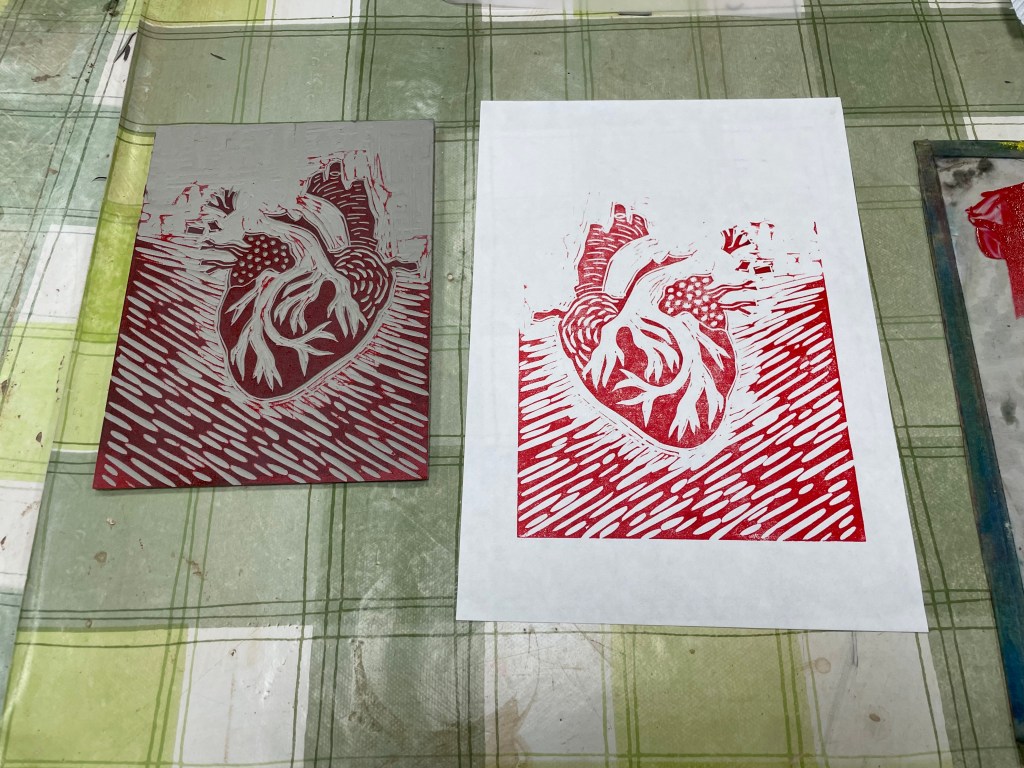
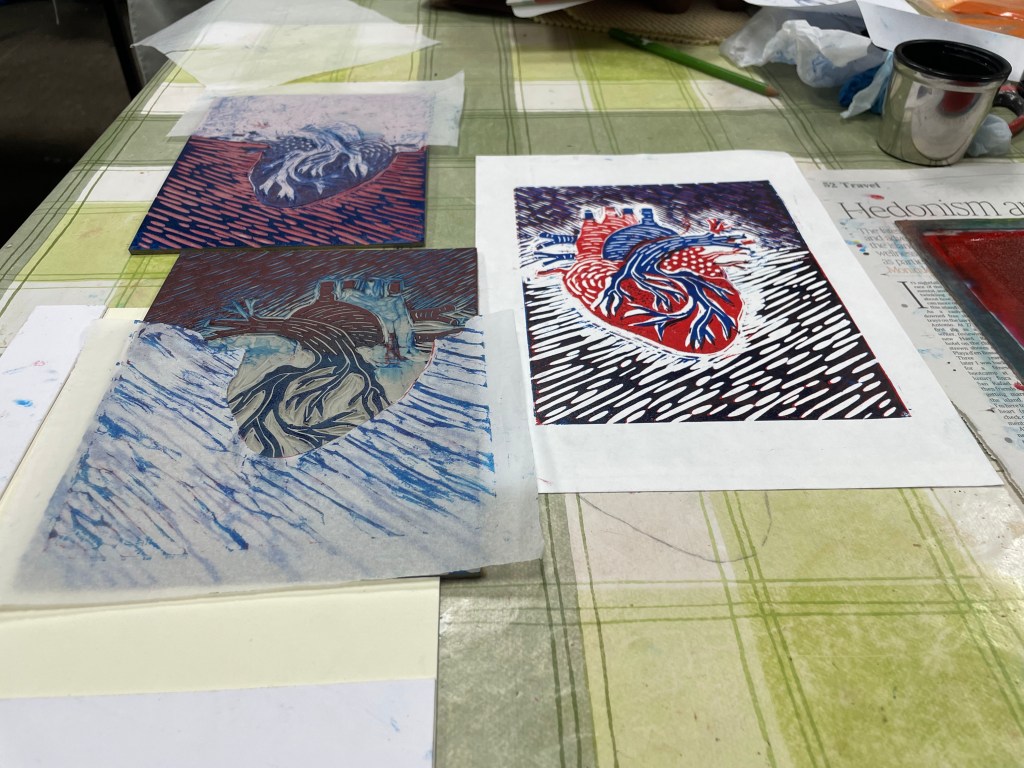
The workshop was on multiple-block linocut, a process in which you use separate blocks of lino to print individual colours, as opposed to reductive linocut where the colours are printed from the same block. I’ve only ever done a basic linocut with a single colour, so the process of working out what areas to cut for each colour meddled with my head a bit. Also, because you use separate blocks you can reprint in different colourways, although there is more room for error in terms of cutting and registration when printing, which can lead to unintended gaps and overlaps which add to the feeling of it being handmade, apparently! Also, as with all linocuts, you can sometimes get marks from ridges of lino which have inadvertently picked up the ink, particularly in large areas which have been cleared out, and this is called “chatter”, which is a lovely term.

We were limited to two colours, which effectively means that there can be up to four colours in the print: the two chosen colours, their resultant mix, and the white of the paper. I chose red and blue as they were the colours on the diagram.

Well, the prints are a bit rough and ready. I’m not keen on the white area around the heart – originally the background was also red and so I wanted some differentiation between the two, but later on I decided that I preferred the darker background. Having said that, I think it does give the image some dynamism, as if the heart is beating and pulsating.

Background Effects

I’m starting to feel excited about a trip I’ve booked to Vienna in December. I’m planning to binge on Schiele and Klimt, as well as Sachertorte (if I can find one that is definitely nut free)!

I love Klimt, in particular the way in which his figures disappear into, or emerge out of, his highly patterned and decorative backgrounds.

Portrait of Adele Bloch-Bauer I, 1907

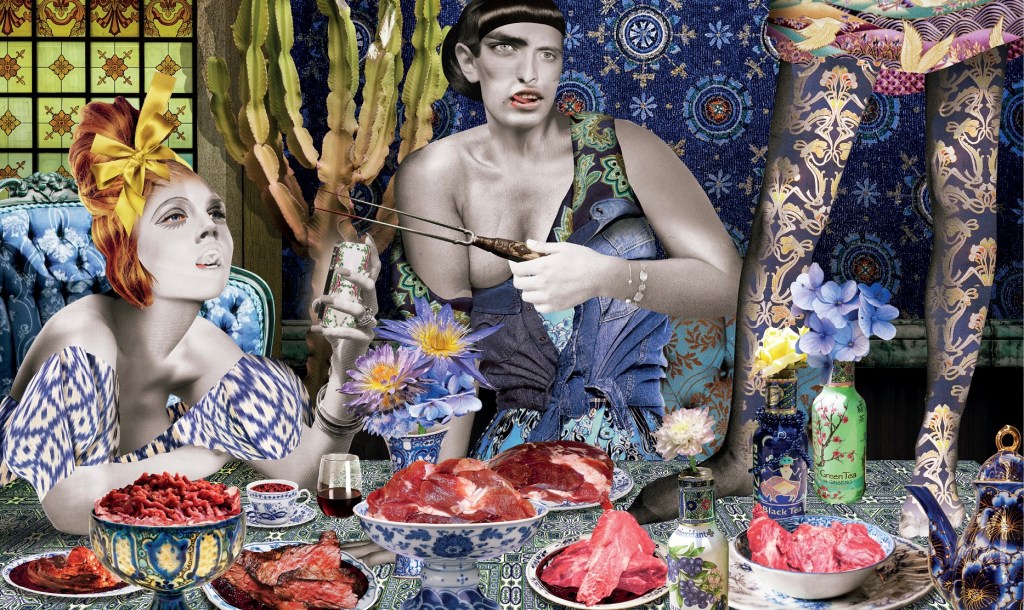
I’ve only recently discovered a Berlin collage artist, Kathrin Kuhn, who produced a series called Housewives.

” The Housewives project began as an experiment. In the Natural Science Museum I started thinking about animals tricks to make themselves invisible, a camouflage strategy called somatolysis. Butterflies for example use confusing patterns to melt into their environment to disappear from enemies eyes.

I started to apply that effect to my images, melting peoples clothes with the wallpaper patterns, mixing them up in the most bewildering way. I called the project Housewives because I found it a good metaphor for the way women were living in the past decades as housewives; being one with their homes, being connected with their domestic tasks so closely that it becomes an identity, even having a decorative function. The women in the pictures could use their patterns to disappear in their established setting, or leave it, to stand out in the most striking way in another environment.”

Housewives VII, Kathrin Kuhn

Am I a part of my background, or is it part of me?

“Oh Betty!”

Sometimes it’s good to go back to basics, so I signed up for Chris Koning’s online workshops on drawing – admittedly today’s on negative space was the first one I’ve been able to attend as I’ve had all sorts of IT issues.

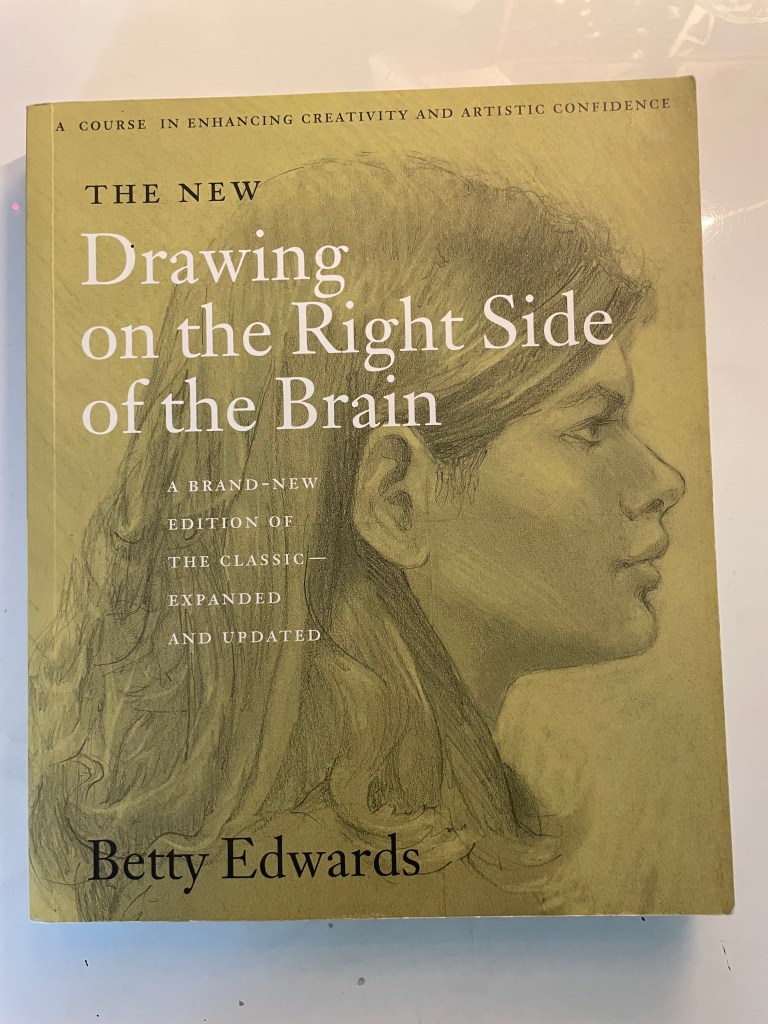
They are based on Betty Edward’s tome – Drawing on the Right Side of the Brain.

A friend bought me this book many years ago, so today’s workshop has motivated me to get on and finish reading it (I’ve suddenly got so much reading to do!). The book’s message is that if we understand how to perceive something, we’ll be able to draw it and, in this respect, there are five perceptual skills of drawing:

  • The perception of edges
  • The perception of spaces
  • The perception of relationships
  • The perception of light and shadow
  • The perception of the whole

It’s all about how we see, and it’s always good to review how we perceive things, as we might end up noticing something different.

The Invasive Sibling

My daughter turns 21 next year and my husband and I have decided to throw a bash not only to celebrate her birthday but also some milestone ones of our own which have gone by not properly celebrated.

I was chatting to my daughter the other day about the fact that my brother, who lives in Belgium, has declined the invitation. I explained to her that I felt really quite upset because the last time I had seen him was when we interred my mother’s ashes in April this year and before that, at her funeral in May last year.

My daughter is not one to get into emotional discussions, despite (or maybe because) she is studying for a psychology degree, and in response she informed me that I shouldn’t worry about not seeing him because he’s inside me. Inside me? Yes, she informed me as I tried to quell the rising tide of nausea – when he was born he left some of his DNA behind in the womb and that then ended up in me.

Microchimerism, it’s called – I looked it up. It means the presence of a small number of cells in an individual that have originated from another individual and are, therefore, genetically distinct.

As I understand it, on my very limited research, when a baby is in the womb the umbilical cord can act as a two-way street – the mother’s cells travel to the baby, and vice versa, so that some foetal cells can remain in the mother, even if the baby is not subsequently born. As they are effectively stem cells they can travel to parts of the mother’s body and grow as other cells eg cardiac cells (so the baby is forever part of the mother’s heart) or they can hang around and become part of future offspring. From what I can tell, the research has mainly been in terms of cells left by male babies, as it is easier to distinguish rogue Y chromosomes in the mother’s body, however, it is generally thought that it equally applies to female cells and that female babies may leave more cells behind than male babies. This process can play a part in autoimmune diseases and also the sex of the baby may influence the development of Parkinson’s and Alzheimer’s. All exciting stuff!

I was talking to my sister about it and the possibility of expressing this by making something akin to a set of Russian dolls with her as the outside one, and my brother and me on the inside – she wasn’t keen. I fear that our conversation may have been a contributing factor to her dream that night in which she was being chased by an artist who wanted to possess her body!

Caught In A Paradox

I’m typing this just as I’ve finished my tutorial with Jonathan, whilst I can still remember what we discussed – I did start taking notes at the beginning but ditched them as the act of note-taking became too intrusive. Consequently, I will probably forget bits, but this is the gist.

I explained that I’m feeling really positive about the course – just to be in the process is enough, and anything over and above is a bonus. Jonathan asked me what I wanted to get out of the course. What I would like is to find out who I am, which is a bit of a cliché, and to develop a rhythm of working so that art becomes a major part of my life: up until now I have had to carve out time to spend making art.

Jonathan asked me what my life is like in terms of whether it is ordered: no, it’s totally disordered with no real routine, fire-fighting issues and dealing with lots of things at the same time. Jonathan commented that the idea of spinning plates has its own rhythm. It has, but I feel that I need to develop a discipline in my artistic practice – I have no real self-discipline in many areas of my life.

Jonathan then asked me what my strength is. It’s getting things done: I can be determined, persistent and I don’t give up. The downside to this is that I’m goal driven (which causes issues in terms of concentrating on the end product, rather than the process), and I tend to jump right in. Thinking about it now as I write, not giving up can result in me being relentless and not knowing when to walk away and leave something – my mother used to describe me as a terrier.

Jonathan mentioned the story on my blog about my shopping habits: the act of wandering from shop to shop contradicts the idea of jumping in. I agreed that actually I should shop more like my husband in terms of reaching a goal, and that the act of wandering is not enjoyable but full of pressure: to find something which meets the criteria by the deadline. Not buying the first thing I see which would suffice, may indicate a reluctance to commit before exploring all the options.

What does it feel like to be working at my best? I lose all sense of time. I’m lost in time. Nothing else matters. I can look up and find that it’s dark and it’s 9.30pm and the dogs and my family haven’t eaten. But then I can look at what I’ve done and, if I’m not happy with it , think how I’ve wasted those hours of my life which I’ll never get back and which I could have spent doing something more productive. Jonathan commented that there was a paradox in terms of being lost in time and losing time. He asked me to describe the sense of loss of time: it’s huge and full of resentment in the moment, but then dissipates as everyday life starts to take over again, until it eventually disappears.

We talked about some of the things that I’ve been trying out, and I explained that I’ve been purposely not viewing things as good or bad (although I did on my last post!) or as a success or failure. You can only fail if you have an expectation and that every experience, whether good or bad, is a valuable learning experience. Jonathan agreed and commented that the purpose of the act of mark-making is to tell us what to do next and if it does this, then it’s done its job, even if it is to tell us not to carry on. He sensed a real frustration in my experiments with the iPad. I did feel frustrated but even though I had reached the view that it wasn’t something for me in terms of producing a final piece of work, I did appreciate its usefulness for preparatory work. Jonathan mentioned that a lot of artists use it for this purpose in terms of working things out, like composition, and referred to Justin Mortimer who produces large oil paintings.

I explained that I have been doing a lot of thinking recently and have a lot of ideas inside my head – In fact, I can’t stop thinking about it. I’ve also been getting a lot of inspiration as to how to express these ideas in terms of producing work. If we had had this tutorial a few days ago I would have been excited and energised, but I now seem to be less so, as I feel a resistance to attempt to translate the ideas into actual work. It’s not a fear of failure as such, but a reluctance, or maybe a fear that once I try to capture the idea it won’t be as good as it is in my head. I would usually jump straight in and, more often than not, end up feeling frustrated or disappointed. I’ve recently found that thinking about and planning a work results in less dissatisfaction in the end result, but it seems that the act of stopping and thinking creates a barrier, an inertia, to moving forward. It’s a bit like how I would imagine doing a parachute jump: I check that I have everything I need in order to jump safely, but I still can’t get myself out of the plane. The other side of me would just jump. I mentioned the blog: I’m not on social media and I like to keep myself to myself and fly under the radar, yet I enjoy the process of writing the blog and this is fine as long as I don’t think too much about it ie that it’s public (as an aside whilst I’m writing this, I have actually searched for it on Google and it doesn’t come up so that makes me feel better!).

I then told Jonathan about a proof-reading distance learning course I signed up for many years ago, as I thought it could be something I could do whilst my daughter was young. I received the first couple of modules in the post and did the first assignment. The feedback was good but finished with a reminder that the marks from all subsequent assignments would count towards the final mark. That was it for me, I couldn’t carry on. We discussed why this might have been the case. I think it was because I hadn’t done perfectly on my first assignment and that I might not even do as well in future assignments. When I was young I would come home from school eager to tell my mother how I had done in a test – then she would ask me how everyone else had done – I didn’t understand at the time, why she couldn’t just be pleased with my result, like I was. I grew up to be a perfectionist, with a view that if you are going to do something, you should do it to the best of your abilities – I have since realised that what is your best can be influenced by the circumstances at the time. Jonathan reassured me that that is why the course is the way it is – there is no assessment of a final work or comparative approach for the very reason that it would cause students to freeze up.

Jonathan commented that my perceived weaknesses are actually also strengths in that the tendency to rush in, would deal with this issue. He observed that I had mentioned the word ‘fear’ quite a lot and asked me to describe the fear. It’s like a barrier in front of me but it’s not insurmountable and it’s transparent in that I can see beyond it, to where I need to get to. Having said that it clearly wasn’t insurmountable in terms of the proof-reading episode, but that was a long time ago! To get past it I need to act, and in this respect, Jonathan said that’s where I need to draw on my strength of jumping right in without thinking about it.

We concluded that there were many paradoxes in what we had discussed and that perhaps the solution is to try and combine the two sides of me in terms of moving forward in my art practice. I commented that perhaps the paradoxes are caused by me thinking that I’m one version of me when actually the real me is someone else, which is what I want to explore. Is the real me the baby who was born, or the person I now am with all the baggage I’ve collected along the way? I recognise that my strength of getting things done is probably as a result of my career. Jonathan commented that it is the question of nature and nurture and who they are is something artists ask themselves, so it’s far from being a cliché, it is actually what art is all about.

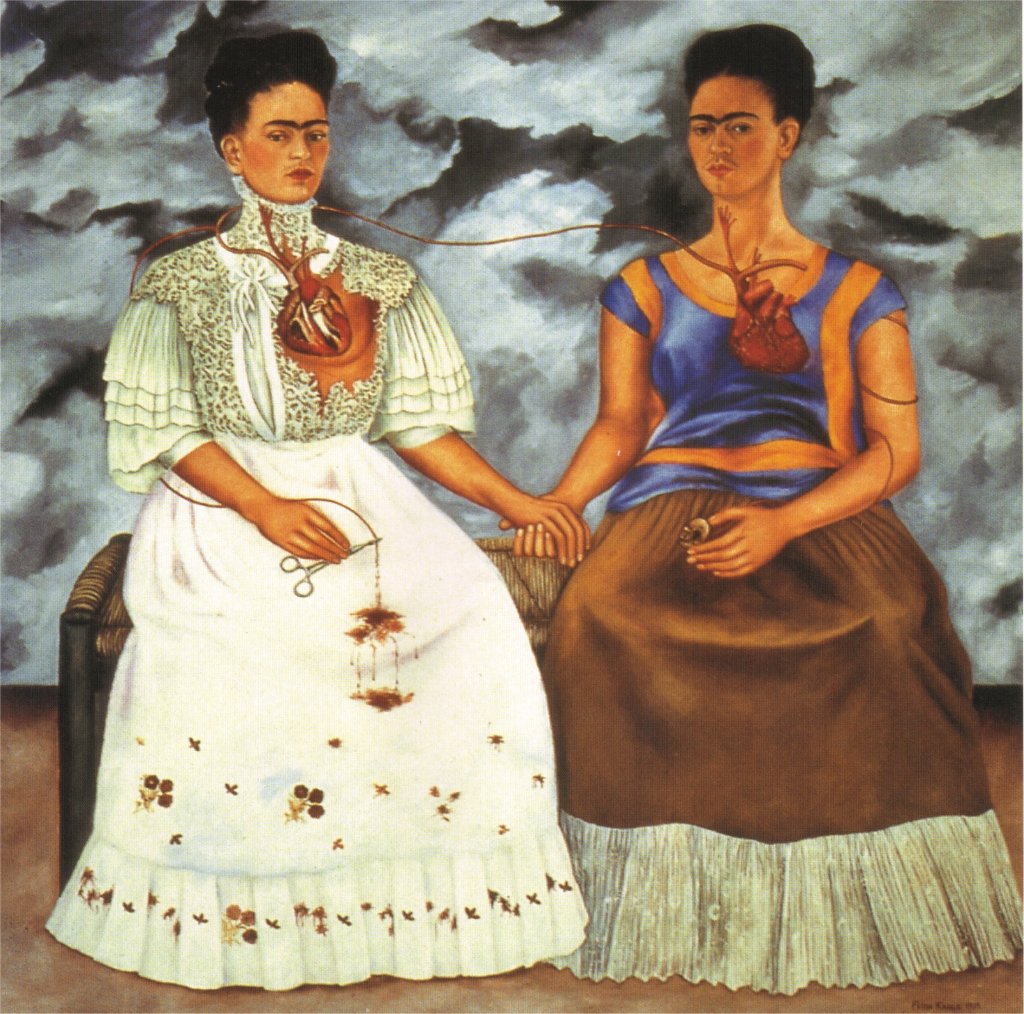
I then asked Jonathan about something which has been niggling at me: I draw inspiration from various sources to help me see ways to express my thoughts in work. I gave the example of the Two Fridas and the passage I had come across in a book I had seen in Waterstones about siblings and the primal connection through umbilical cords. In drawing on these sources, am I creating anything new, unique, or will someone just look at it and think ‘that reminds me of the Two Fridas’? Is it enough that it is coming from me and about how I feel? Jonathan assured me that it is ok to draw inspiration from others – the Two Fridas was personal to Kahlo and painted 80 years ago – I would be making it now, in 2024, and it would be personal to me.

What will I do for the next hour? Go away and write up my note of the tutorial before I forget it, which will be a useful process to consider what we discussed. Jonathan pointed out that at the beginning I had said that I had wanted to make art a bigger part of my life and that during our chat I had said that I couldn’t stop thinking about it, so I’m on my way and I should just keep doing what I’m doing.

I’m still feeling positive, and I would venture to say, even more so. I need to cogitate on what we discussed to move forward, but for the moment, everything is all ok.
Sisters

“A sister is not a friend. Who can explain the urge to take a relationship as primal and complex as a sibling and reduce it to something as replaceable, as banal as a friend? Yet this status is used again and again to connote the highest intimacy. My mother is my best friend. My husband is my best friend. No. True sisterhood, the kind where you grew fingernails in the same womb, were pushed screaming through identical birth canals, is not the same as friendship. You don’t choose each other, and there’s no furtive period of getting to know the other. You’re part of each other, right from the start. Look at an umbilical cord – tough, sinuous, unlovely, yet essential – and compare it to a friendship bracelet of brightly woven thread. That is the difference between a sister and a friend.”

‘Blue Sisters’, by Coco Mellors

I stumbled across this passage whilst I was having a mooch in Waterstones on Saturday. It cuts right to the heart of what it is to be a sibling. I find the imagery particularly strong – the inhabited space of the womb, growth and development, umbilical cord, connection. Lots of food for thought.

‘The Two Fridas’, Frida Kahlo 1939 (oil on canvas)

On the subject of thinking, this image above has been floating around in the back of my head whilst I’ve been contemplating my role as a sibling, and as a mother, but more on the latter some other time. In this painting, Kahlo’s traditional identity is connected by an artery from her complete heart to the heart of her modern identity which has been torn apart by her divorce from Diego Rivera. I find it a very powerful image: full of pain and conflict, but, at the same time, resilience. It’s already informing some ideas for a piece of work.

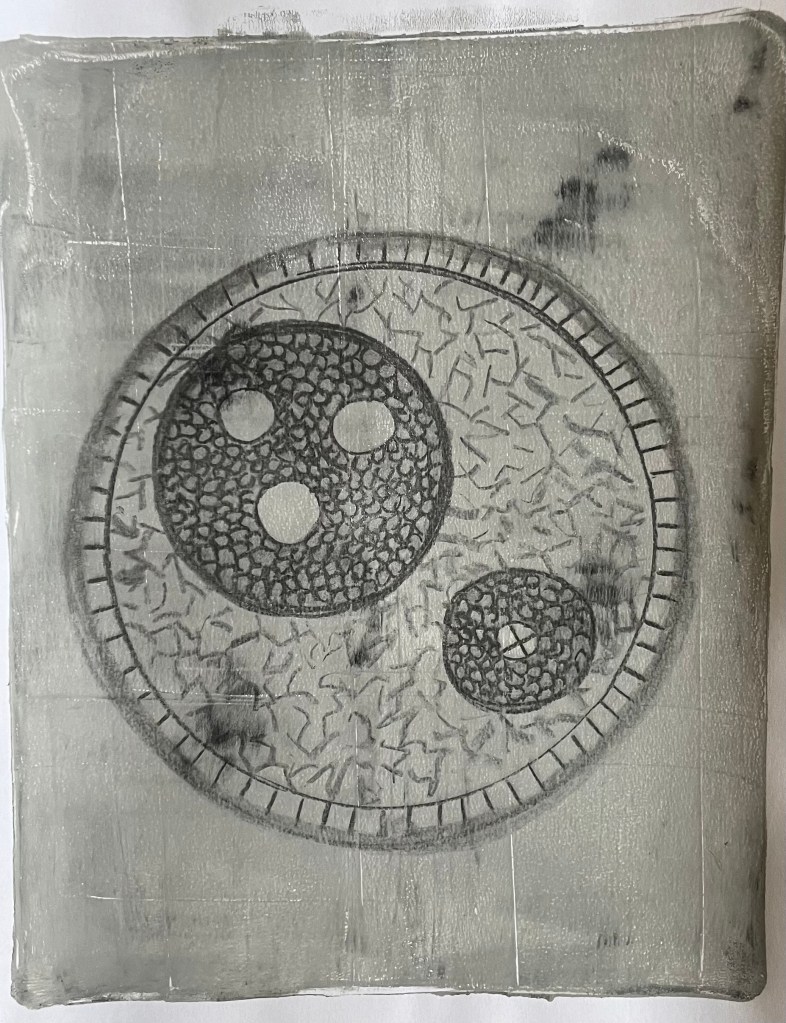
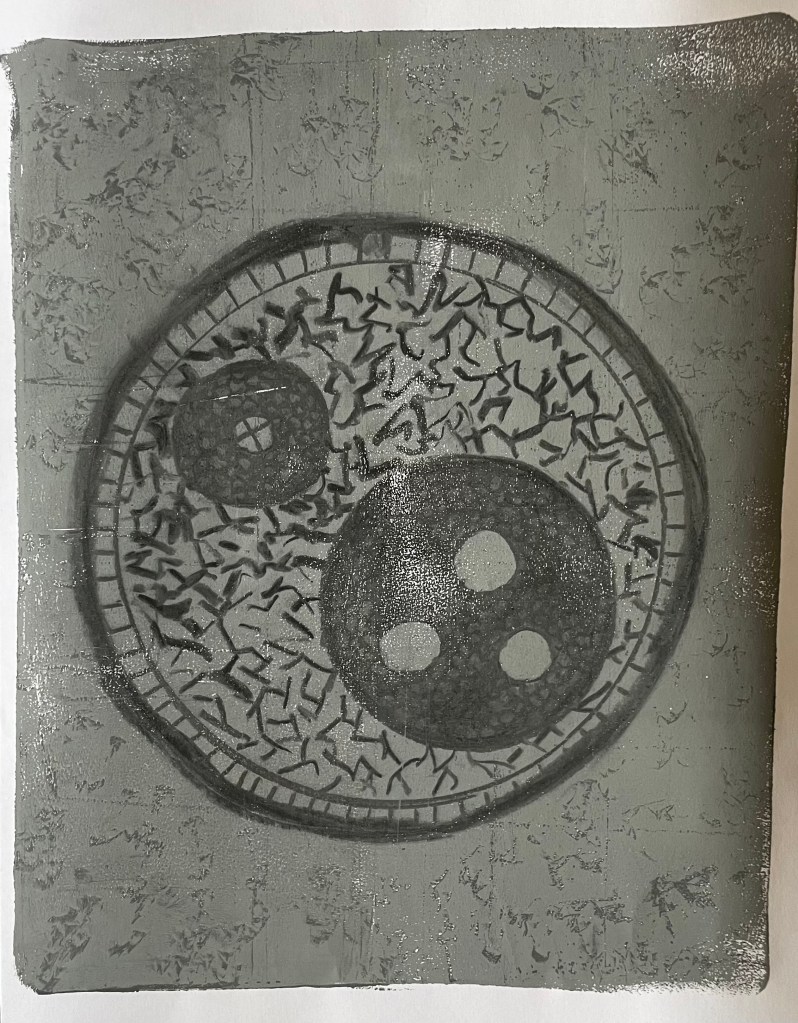
I’ve been experimenting with pressing charcoal drawings onto a gelatine plate and then printing – the archival quality it produces is interesting – and also applying paint onto the plate randomly. It was all done in a bit of a rush as I suddenly thought: less thinking, more doing. I didn’t find the process satisfying: the colours are really unappealing and murky – in fact they are just varying shades of grey. I’ve been meaning to try this process for sometime now, since I saw it on a facebook reel, so I was really quite excited at the outset but I ended up feeling underwhelmed – the subtleties inherent in charcoal are totally lost. Maybe starting with a cross-section of an unlovely umbilical cord inadvertently set the tone, but my quickie self-portrait certainly expresses how I felt!

So, here’s the bad and the ugly…

If You See It, Just Buy It.

This post has been sitting in draft for a while now. I’m not sure why I’ve been delaying in publishing it – maybe a reticence to commit in case something better comes along. Rather like the way I shop: I like to browse in every single shop to see all the available options, and for the most part end up going back to the first shop, several hours later. My husband, on the other hand, sets out with a list and buys the first item which fits the bill – his advice to me is that if I see it, I should just buy it, and save myself the aggravation. So what if I do have a better idea further down the line? That’s part of the process isn’t it? To reflect, adapt and recognise the need for a change of direction.

I’ve been giving further thought to what I would like to explore over the next couple of years. I’m afraid it’s not a laugh a minute, but it’s something that’s been on my mind for a while.

Not to be egocentric about it, but it’s ME! Then again that’s not a surprise as everything I make, even within the constraints of my art class, is subconsciously about me in one way or another: how I see the world; what matters to me; what interests me; about me; my experiences.

I remember sitting in the back of the family car as a child, probably on one of those Sunday afternoon drives in the Black Forest my parents used to like, with my brother on the back seat playing my dad’s favourite Elvis Presley and James Last songs on his double deck cassette player and thinking to myself: Who am I? This is me. Here. Right now. I almost tried to climb inside myself which messed with my head a bit. I must have been about 7 years old.

Who am I, as a person, as an artist? Hopefully by the end of the next two years I might have a better idea.

I’m particularly interested in my identity in the sense of nature and nurture: who is the authentic me – the one that drew its first breath? As Z recently mused on her blog ‘we will never be as unmarked as when we were born’. How has that version of me been influenced by my life experience, in particular, the roles I have had in my life?

This line of thought was prompted by the death of my mother in 2023. As my father had passed away in 2013, she was my lone parent. It struck me that my role as a daughter was coming to an end. Arguably it had gone on hiatus sometime earlier when I started to care for her following her cancer diagnosis, whereupon my role became that of carer. Some roles in life are mutually exclusive and in my case this was more or less true of my roles as daughter and carer – maybe it was a coping mechanism. As a result, I have issues in processing that brief, but cataclysmic, period of my life.

My mother’s death also made me consider my role as a sibling and the subsequent sense of estrangement I feel from my brother and, conversely, the closeness I have with my sister as a result of our shared experience of caring: sometimes only someone who has gone through the same experience can truly understand how it feels.

What effect does the ending of a role have on identity? What if I feel that I have failed in some roles? What if others think that I have failed? What if my roles conflict or were not mine by choice?

In being a mother I reflected on my experiences as a daughter to try and be the best mother I could be, and so the cycle will continue, perhaps. I’ve been a career woman, a homemaker and, still am a wife. At some stage I have lost the sense of the real me, if there is one: some roles allowed others to prosper whilst I took a back seat. Words which particularly resonate with me are from Deborah Levy’s The Cost of Living :

“It requires skill, time, dedication and empathy to create a home that everyone enjoys and that functions well. Above all else, it is an act of immense generosity to be the architect of everyone else’s well-being.”

In my head I’ve been Norman Foster.