Wayfinding

I think that I’m finally getting some clarity. Or maybe I’m seeing connections and signs where perhaps there aren’t any, but it seems to make sense, in my head anyway. In my second tutorial, Jonathan commented that he had a sense that it was all leading to something (the first sign).

So far during this course, trite as it may be (although Jonathan has assured me that it is essentially what art is about), I have been concerned with understanding myself and my place in the world as a practising artist. I’ve been working from memories, guiding me like a compass on my exploration, probably slightly off kilter, as well as my day to day life, thoughts and feelings. I have been trying to concentrate on the process as opposed to the result (a sign), experimenting along the way, and producing very few finished pieces of work. I did feel uneasy about the lack of finalised output, but no longer. I’ve been on a dérive (our session on Guy Debord being another sign).

In my Study Statement I question whether it is actually possible to ‘find myself’. Kierkegaard thinks not, in the sense of a static and unified concept, for the self is constantly being formed not just by reflecting on the past but also by engaging with the present; it is in a state of becoming, in a state of flux, something I have said I feel on several occasions in this blog (a sign). I accept in my Study Statement that I can only hope to know myself as at a certain point in time, and that reflection is something which will have to be a continuing process. Something else I have mentioned on several occasions in this blog, to fellow course mates and to Jonathan, is that I feel like I am a different person to the one that started the course back in October last year (a sign); I have changed and I will continue to change – to become.

Recently, I’ve become interested in the subject of maps – the comment in my Unit One feedback that I seem to be engaging in a process of mapping jumped out at me (a sign). That led me to start thinking about maps and the process of mapping and map-making, experimenting with cartographic symbols and mark-making. The subject of maps is a huge one but during my research I came across the philosopher, Korzybski, the father of general semantics, a central principle of which is that the map is not the territory (rather like the image is not the thing: Magritte’s Ceci n’est pas une pipe (I used this idea with my red telephone at the Interim Show (yes, another sign)). In short, our models of the world are abstracts of reality, and do not represent it. This is a principle I’ve been trying to be more mindful of since I read about it – my map of the world is not the same as everyone else’s, so we can be in the same situation or look at the same photograph but have our own very different experiences and interpretations of it (our sessions with the photographs being another sign). Something which is blindingly obvious, but which I don’t always appreciate.

This then led to the notion that geographical maps themselves do not reflect the territory in the sense that there is abstraction and subjectivity in the production of all maps: the size of countries and borders can be manipulated for political and social ends, the purpose for which a map is intended can determine what is included and what is left out, viewpoint and projection can distort the world view.

Mercator Projection

Authagraph Projection

The Authagraph Projection is considered to be the most accurate flat representation of the world. It highlights the distortion caused by the traditional Mercator projection in terms of the size of Africa, South America and Greenland, amongst others.

I have been reading a lot about cartographic theory, a discipline which has only become a thing relatively recently. There is lots of disagreement about what a map is and the separation between the artefact of the map and the process of mapmaking and mapping. Post-representational cartographic theory does what it says on the tin – it argues that maps are not the territory but actually create the territory, are in a state of flux and are constantly changing, and theorists have moved away from the idea of a map as an artefact, but as being performative and processual, and always in a state of becoming.

Whilst working, I have been reflecting on past events and experiences, but whilst doing so I have been conscious that my recollections are probably my version of the truth; that I am my own unreliable narrator. I have been interested in memory for a while, particularly as to its probable unreliability and its potential to be manipulated. The way memories are formed and retrieved means that they are not fixed archives, but are constantly being formed and reformed with each retrieval; they are in a state of becoming.

The link between selfhood, mapping and memory is the concept of the state of becoming: ontogenesis. In my research paper I want to explore ontogenesis in the context of autobiographical artistic practice because it is the essence of what I am trying to do. In my experimentation and production of unfinished work I am engaging in the process of mapping, changing and becoming, relying on my memories which are also in a state of becoming but how can I represent this in a visual form which is also in a state of becoming? Hopefully, by the end of the research paper, I will have a better understanding as to how it can be achieved, if at all.

That’s the plan for now anyway, although I may change my mind, in my state of becoming.

Hand Map

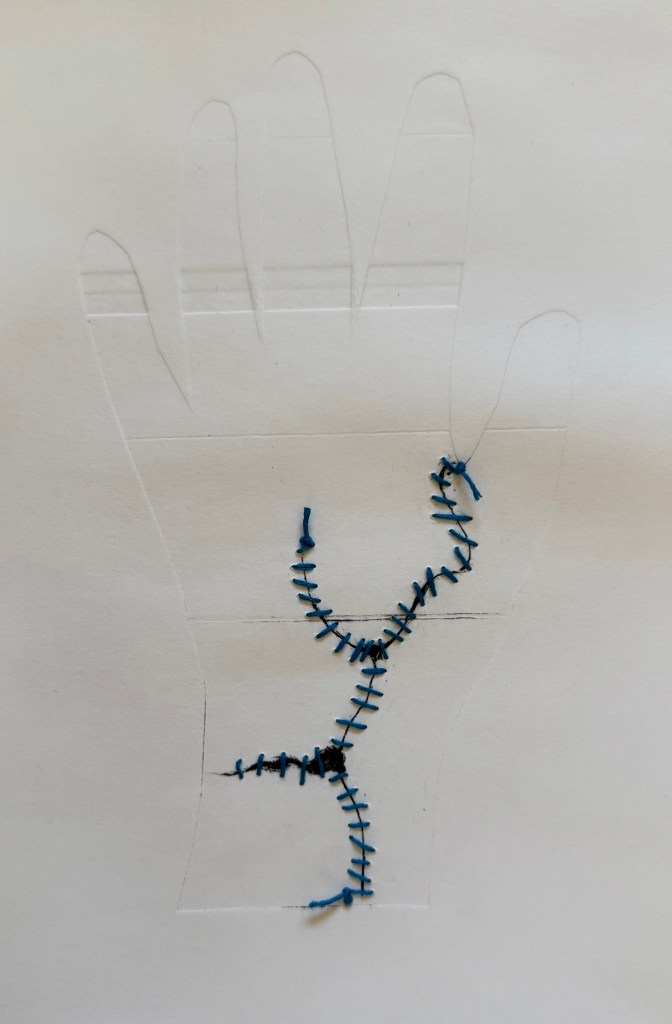
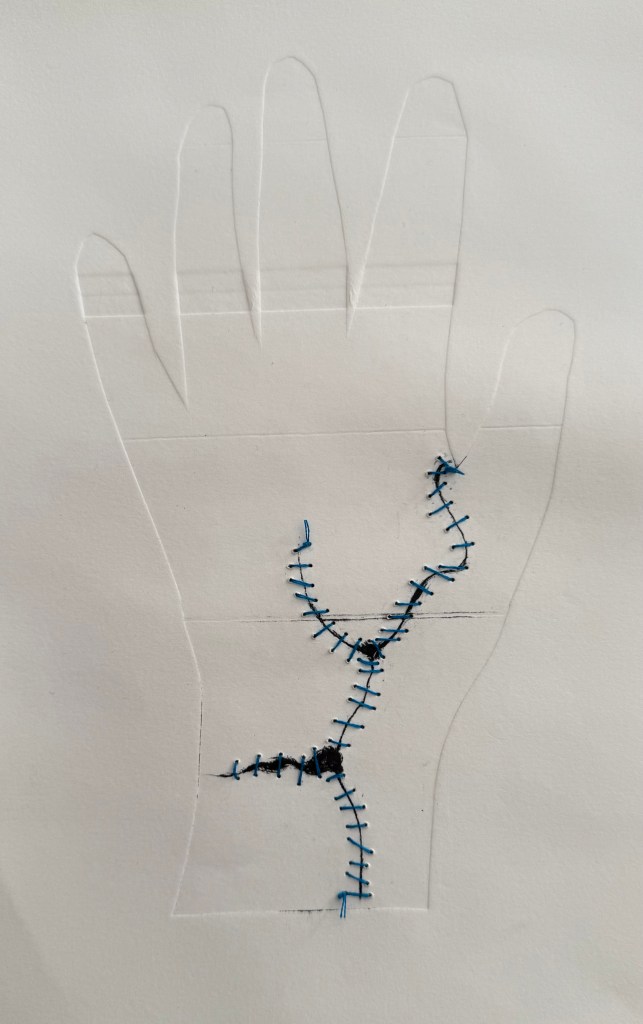
In the accident, a 2 inch piece of glass managed to find its way into my daughter’s thumb via the underside of her wrist (luckily missing her artery) severing the main nerve and two tendons in her dominant right hand. Fortunately, she was taken to Salisbury Hospital, the regional centre for plastics. We make the 2 hour round trip every week for dressing changes and physiotherapy. Every week I take a photograph of her wound, mapping its healing, but also so that she can look at it when we get back home – she can’t look at her hand in the moment. It’s important that she reconnects her brain to her hand otherwise the hand map in her brain will be lost, as will any chance of recovering as much sensation as possible. Whilst some of the physio has been physical exercises to rehabilitate movement in the tendons, the majority of it is brain training: visualisation and mirroring exercises, analysing touch and sensation, using the good hand to teach the injured hand how things feel, teaching the brain the new language with which the hand is trying to communicate.

So, we decided that we would make something. I’ve been meaning to try out some tetrapak printing for a while. The process of incising seemed appropriate. I feel some responsibility – if I hadn’t suggested that she leave earlier, perhaps it wouldn’t have happened. The act of sewing, holding things together, helping things to heal.

I like that the wound is the subject, that the hand is suggested by the embossing. I debated whether to add more detail, more variety of tone but for once went with the less is more option. I used ordinary cotton thread but we decided that the colour wasn’t right so we went for embroidery thread – a brighter blue. As I was sewing I knew that it was too thick, that I should have separated it, but I just kept going. I knew it was wrong; she said it was wrong because now she couldn’t see the wound – I had obliterated the very thing that we were supposed to be embracing. I tried a couple more times until we decided that it was right. By then the holes were quite large but that in itself doesn’t matter – it reinforces the idea that often we have to endure further harm or pain in order to heal.

Leave The Party Whilst You’re Still Having Fun

My mother always used to tell me to leave the party whilst I was still having fun.

Fortunately, we were able to make sure that Monty left the party whilst he was still having some fun. And, as I was sitting there in the garden with the sun on my back, stroking him as his heart stopped beating and his last breaths left his body, I thought to myself, not for the first time, why can’t we do this for people?

My mother would have wanted to have had the choice to leave the party while she was still having fun, but she couldn’t, and so she turned to face the corner and disengaged from the party until the bitter end.

I don’t think that I am afraid of death. But I am petrified as to the manner of it. Best to go quickly without warning. If that’s not possible, then I’d like the choice to leave the party whilst I’m still having fun. Who knows? When the time comes to face it, I may decide, what the hell, let’s party until dawn, mine sweep all the half empty glasses and wake up with the mother of all hangovers face down in a puddle of who knows what. But at least it will have been my choice.

Carbon Dating

During my tutorial Jonathan mentioned carbon paper.

It brings back memories of a time when it was the only way to make copies, of secretaries putting a sheet between the top and bottom copies when they typed. Those were the days when the most technologically advanced piece of equipment in the office was a fax machine, which would regularly spew out reams of documents on thin, shiny paper, the print fading away to nothingness over time, thus requiring photocopies to be made, just like some present day shop receipts, so I’ve discovered.

So what to do with it? Recently, I have been reading about map-making and the act of mapping, considering the difference between the two. Contemporary cartographic theorists consider the process of mapping to be of paramount of importance, the creation of the artifact of the map being just one step in the process. In particular, psychogeographic mapping seeks to represent how individuals feel about the place they are in, a process in which subjective experience is prioritised over factual accuracy. Artist, Christian Nold, who uses a bio-mapping device to record individuals’ changes in emotional state, creates emotional maps of places, and one I’m particularly interested in is Brentford Biopsy because I used to live next door in Chiswick before I moved out of London. The project was undertaken in 2008 before areas of Brentford were redeveloped, and it’s really interesting to see how people felt about the area: it reveals so much more information than you would get by simply looking at a map: a map details the historic buildings and the riverside, but not how people respond to them, their view as to how they should be dealt with in future development, and how it actually feels to be there.

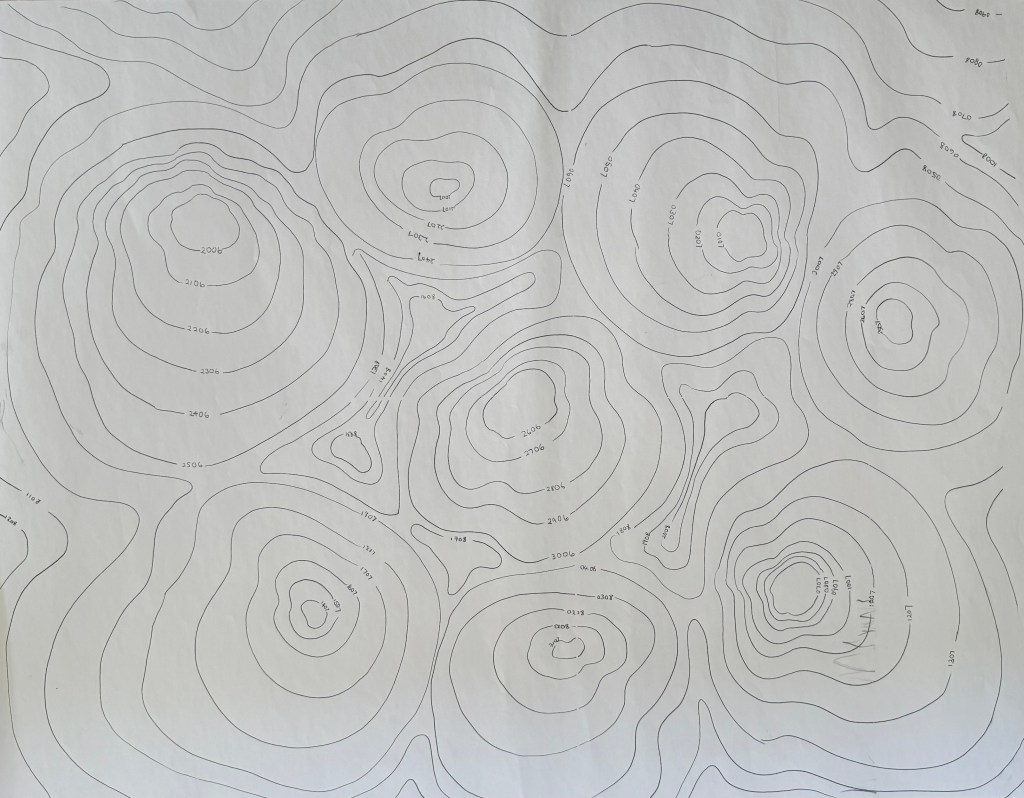
So, I’ve decided to embark on some emotional mapping of my own, not in relation to a sense of place (that may come later when I revisit my grandmother’s village) but of my day to day life. The bonus is that it means that I have to make a line everyday which will hopefully lead me to doing other making. I have drawn the contour lines using carbon paper (I‘m currently thinking that they may be too dark and overpowering, but we’ll see how it goes; it’s an experiment after all) and each one relates to an individual day.

I’ve already started, and it should take me up to the 12th of August. I’ve had to invoke some rules. There are three colours which represent three emotional states which I assess at the end of the day; green represents a neutral emotional state, orange positive and blue negative. Obviously within the generalised emotional states is a whole range of different specific emotions, but I decided just to keep it simple. Each line starts from the contour of the day in question and ends by going off the sheet otherwise it may be associated with more than one day. I draw each line for no longer than two minutes. I had thought about allowing myself however long I felt I needed and varying the intensity of the line depending on how I felt, but decided that would over-complicate things. The map will give an indication of how often I was in each emotional state over a period of time. I’m now thinking that I should have had another map on the go at the same time; not just to depict frequency but also depth of emotion. Maybe next time, if this works out.

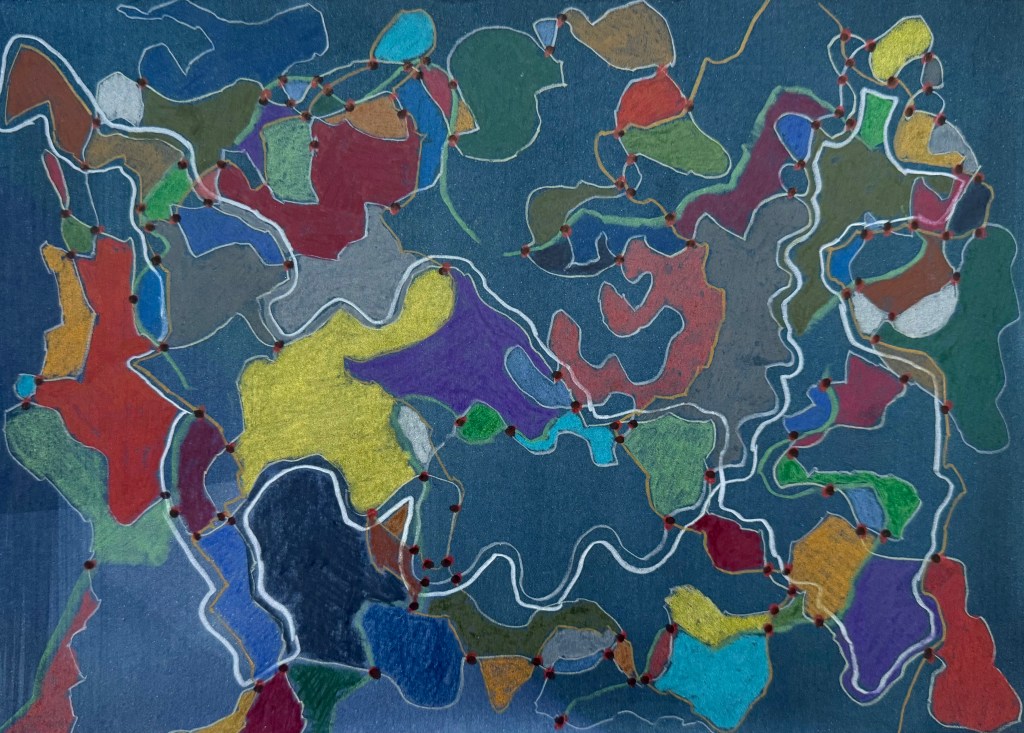
I also found some watercolour paper which I had used for an unsuccessful cyanotype and experimented with it. I like the intensity of the colour against the blue background, and the way the coloured in areas look like countries on a map of the world.

The groupings of colours also remind me in a way of the Art Emotions Map which has been produced by Google Arts & Culture and the University of California, Berkeley, which I’ve spent a bit of time exploring and which reminds me of one of our Miro boards. My husband suggested that I could do something similar relating to life experiences, with getting married to him falling within ‘Wonder & Awe’. Oh, he does have a sense of humour!

Late Night Ramblings

It was a long day at the hospital yesterday and once everything was sorted and my daughter was settled in bed, I needed to do something to switch off.

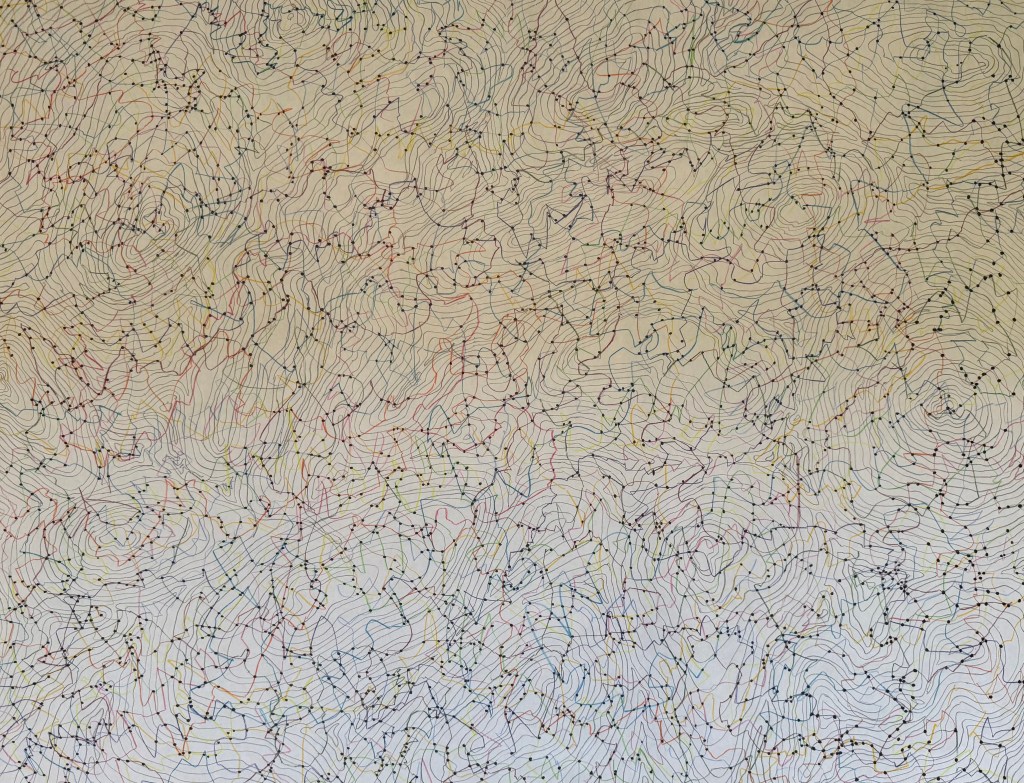
Some wandering lines in different colours on flip chart paper – I quite like the flimsy quality to it. Then dotting the connections, many of which I’ve missed I’m sure but my eyes were getting tired. It was brainless activity, but incredibly soothing. That done, I decided to incorporate some of the contour-like lines I have previously used in my doodles.

Add in some grid lines and the result is something akin to a map. But what to do next? How can I incorporate this into something else or develop it further? I decided to leave it for now, whilst I still like it, before I do something I’ll undoubtedly regret but which is all part of the experimental process.

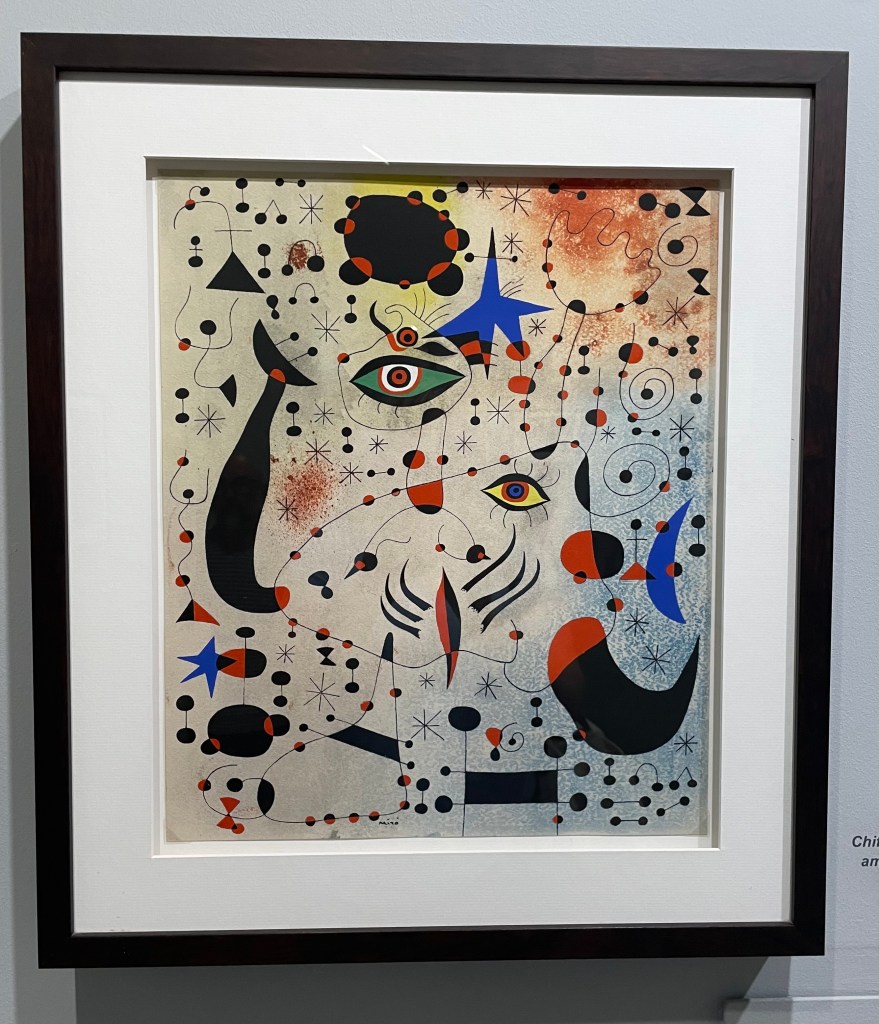
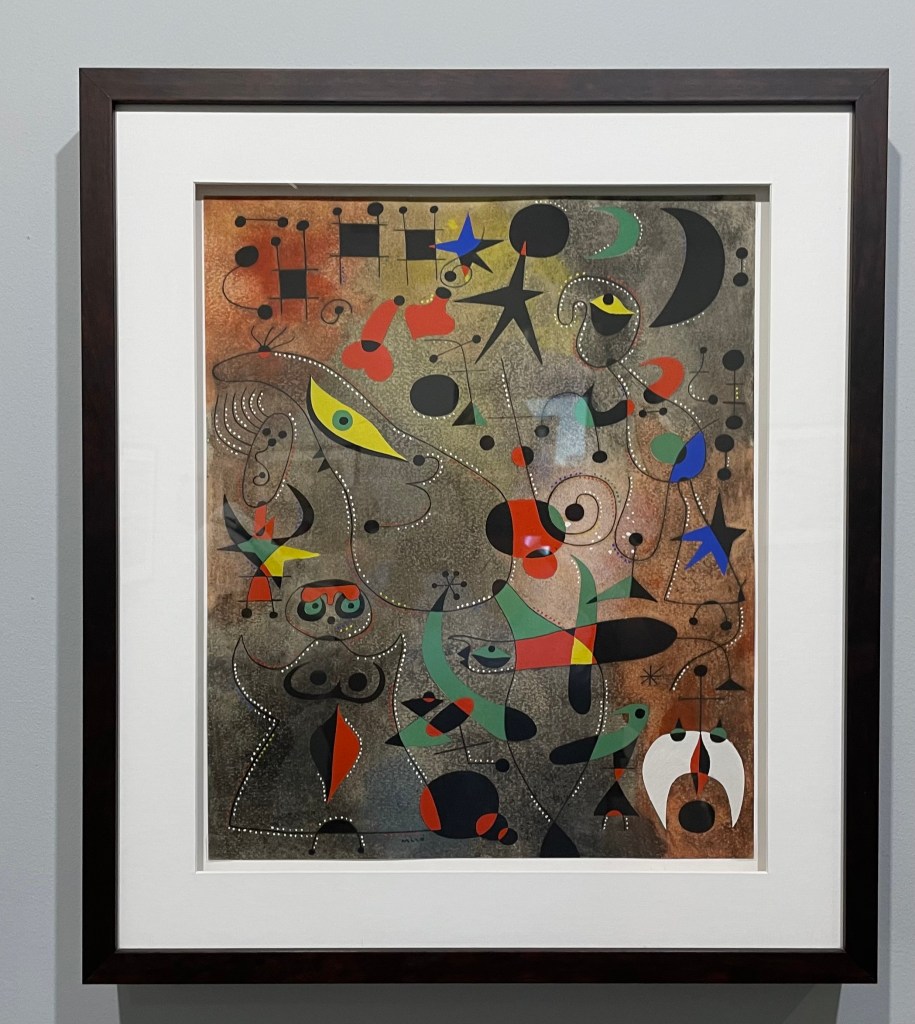
I’ve reflected on it further today – I had a look at some ordnance survey maps (incidentally OS is half an hour down the road from me in Southampton) to think about symbols. I remembered last year in Mallorca and the Miró/ Picasso exhibition at Sóller train station. There was a key showing the symbols Miró used and their meanings.

I didn’t think that I liked Miró, but then I hadn’t seen any of his work in the flesh. They were extraordinary and thinking about it now full of map like qualities; symbols in a spatial relationship, a visual expression of his inner world. Which now makes sense, considering these ones are part of his ‘Constellation’ series!

The Kindness Of Strangers

Yesterday lunchtime, my daughter phoned me, but it wasn’t her who spoke when I answered the call.

Instead it was a member of the public, who, with his daughter, had been taking it in turns to hold my daughter’s head, keeping her company whilst they waited for the emergency services, and later, whilst she was being cut out of the car.

We made it to the hospital before she did. Probably the worst moment of my life, waiting and not knowing, not wanting to imagine the possibilities.

A near head-on collision at 40mph. Everyone said she was incredibly lucky. We thought so, she didn’t want to entertain the thought, and still doesn’t want to think about it. Broken bones and a small operation tomorrow. She’ll be ok, physically anyway.

I can only hope to be able to repay the kindness to someone else’s loved one, of being there when they are alone and afraid. In the meantime, I’ve been in touch with him and he was equally relieved to hear how she is, looking forward to speaking to her when she feels up to it.

Puts it all into perspective.

Computer Says ‘No’

If I were a laptop I would say that at the moment I have no RAM, my processor is kaput and my operating system doesn’t support updates.

I’m not in the right headspace to have to think about a research paper. The more I think about it the more I just want to make, but my chunking approach to life means that I have to deal with this before I can entertain anything else.

At the end of the day, it’s just a draft – a draft is inherently subject to change.

What intrigues me? Initially it was the fallibility of memory. Then it was maps and the act of mapping. But do either of these interest me that much or are they just a passing fad? Is there anything which will make this exercise a pleasure and not the chore I suspect it will be? I’ve decided that I have the attention span of a gnat, that I am fickle in that I am interested in something intensely for a period of time and then I get bored and move on, that I am impatient and probably at times a bit lazy – isn’t life too short to have to work at making sense of academic writings which seem to have been written in such a way as to make them inaccessible to anyone but the most ardent of readers? I’m increasingly of the view that if you want me to do something, make it easy for me; that’s the approach I adopt with others.

The Paradox Of Choice

Choice = Freedom + Power

Or does it?

Just recently I’ve been running away. Fight or flight. Apparently flight is an underrated stress response.

At the moment, I feel like I’ve got a lot on my mind; too much. More times than not, I just get on with it in a resilient effort, and other times I indulge in some escapism and don’t deal with anything, waiting for something to blow up and become urgent, preferring to lose myself streaming box sets. But, of course, that’s just prolonging the inevitable.

Anyway, I met a friend the other day. I mentioned the research paper to her. I explained that I feel the need to think of all the possible options to make sure that what I choose is the right decision. She said that I shouldn’t worry about making the right choice, I should just make a choice and make it right.

Apparently, it’s called choice overload, and it’s an evil of the modern world. Whilst choice brings freedom and a sense of empowerment, too much choice can cause anxiety; a paralysis which results in no decision being made at at all; higher expectations of making the right decision by virtue of the sheer number of available choices; and consequently an increased probability of dissatisfaction with the final decision. I’m what’s termed a maximiser – someone who has to consider all the options before making an informed decision which in essence is a good thing but in a world of infinite choices can lead to choice overload. I need to become more of a satisficer, someone who is content with good, rather than the best and who, as a result, doesn’t feel the need to research every option and consequently manages to avoid the paradox of choice.

In short, I need to shop more like my husband.

Raita Bitless

Not only did I not get the obvious joke with the placeholder name of ‘Noah Bitmore’ until half-way into the session on Tacit Agency with Prof Paul Haywood, but I didn’t really get the session itself at first.

I think part of my problem was that I came into it with a preconception from the title. My understanding of tacit agency is a legal one. It turned out to be about the relationship between who I am and where I am – an individual’s sense of connectedness with their physical and social environment.

The exercise of describing an important place without naming it was a revelation. I wrote white railings, the smell of coal fires, lemon curd tarts in a Family Circle tin. I was describing staying with my grandmother. I’ve previously mentioned that visiting my grandmothers is a strong childhood memory and one which evokes a feeling of constancy. We mostly stayed with my mother’s mother. I recently came across some glasses on eBay and ended up buying them because they were very similar to the ones she had, out of which I had my pop, usually dandelion and burdock, or sometimes shandy, poured out of a glass bottle for which you would get some money if you returned it, which was stored on the floor in her pantry.

I love a pantry. Shelves full of interesting things like bottles of Camp coffee, and biscuit tins of jam and lemon curd tarts, packets of crisps and jars of marmalade.

She’d ask me to shell peas from her garden for dinner (I’d eat most of them), the outside loo with the wooden seat, housecoats, woolly hats and Victory V sweets on the ‘buz’ to Derby sitting next to her on the front seat on the top deck so that I felt like I was flying as we went over Swarkestone Bridge, walking down to the village shop where she’d buy me cola bottles and Swizzels double lollipops, going past the pub on the way and breathing in the hoppy aroma, stodgy Yorkshire pudding whilst we watched Emmerdale Farm, the seersucker checked table cloths, the cupboard full of Woman’s Own and People’s Friend magazines from which I used to read the serialised stories, sometimes annoyingly having to miss an instalment because she hadn’t bought that week’s issue, going to Swad and having a cream doughnut, spending hours making mud pies and selling them from my shop in her front porch, the tops of her hold ups visible as she bent over to clean out the grate in the morning and lay and light a new fire – she must have had asbestos fingers – with her horse brasses hanging either side of the fireplace and her ornamental carthorses on the mantlepiece, climbing up the stairs at night into a freezing cold bedroom, shivering under the counterpane until I warmed up, memorising the Lord’s Prayer from the framed embroidery on the wall, watching horse racing and wrestling on the TV with her on Saturdays, hours of country walks pretending to be a horse, and many hours of playing with her plastic cowboy horse in the front room, playing cards and going up the passageway to visit Uncle Walter who would slip me 50p and Auntie Tamar with her slightly greasy hair who never seemed to move from her chair beside her 3 bar electric fire, but most of all, the white railings – a flutter of excitement because we were almost there.

As for my father’s mother, not so many memories. Although we visited her a lot, we rarely stayed with her as she didn’t live far from my other grandmother. The garden shed where I used to spend a lot of time lost in my imagination, I loved the smell, I loved the greenhouse, the smell of tomatoes, when I smell that smell I’m right back there, I saw a candle in Sainsbury’s the other day which was supposed to smell of tomato plants, but I’m not sure, searching for frogs on her rockery at the bottom of the garden, jumping over her decorative white fencing, yes, pretending to be a horse, being fascinated with her dressing table, glass containers and hairbrushes with tortoiseshell, the plastic pink powder container with a puff and her stone Westie doorstop I used to pretend was a real dog, Battenberg cake, her taking exception to me repeatedly playing my Growing Up With Wally Whyton record which I had got as a Christmas present one year, which included the lyrics:

Oh you canny shove your granny off a bus, oh you canny shove your granny off a bus, oh you canny shove your granny for she’s your mammy’s mammy, oh you canny shove your granny off a bus. You can shove your other granny off a bus, you can shove your other granny off a bus, you can shove your other granny for she’s your daddy’s mammy, you can shove your other granny off a bus.

Visiting her in the nursing home with my father and the patch on her forehead she kept on scratching, her limp arm and having to go with her when she wanted to go to the loo, watching her eat a slice of bread and butter with her cup of tea whilst she told us about the old man who kept going AWOL, told off by my father for not singing at her funeral, and the bracelet and the ring that she left me.

In my Unit One feedback there was a question: Beyond the photographs you are using, are you channelling memories through your practical experimentation in other ways – how might you explore more of this? Might you introduce more conversational elements – your voice is already present in your work, but would it feel relevant or interesting to explore recordings in text or sound? What would happen if you were to layer those recordings over animated/ simple stop-frame slide sequences of your cyanotypes and prints?

I’d been thinking of exploring using video before the feedback, and having just written this post I think that these childhood memories are so rooted in the sense of place that I need to go back there and make some mud pies.

By the way I dislike my voice, it sounds totally different to how it does in my head, and that’s why I resorted to using Siri on the recorded message on my red telephone, which is one more thing that I’ve yet to progress…

In the meantime, in the words of Kazimir Malevich,

Swim! The free white sea, infinity, lies before you.