Rebecca recommended a series of short videos on YouTube about elderly artists living in New York made by Joshua Charow.
In one of them, the artist, John Willenbecker, comments that he thinks that he could be a really great artist if he didn’t care about anything else except his work. He quotes Ad Reinhardt as saying that ‘one paints when there is nothing else to do. After everything is done, has been taken care of, one can take up the brush. After all the human social needs, pressures are accounted for. Only then can we be free to work.’
Try being a female artist with a family, I thought to myself.
April is a strange month. On the one hand lighter nights, Spring, and so many birthdays, including my daughter’s. On the other, my mother’s birthday and the third anniversary of her death. It’s not surprising that she’s been on my mind.
My thoughts have turned back to microchimerism. I’ve mentioned this before, mainly in the context of siblings in The Invasive Sibling. In that post I also refer to the mother’s cells travelling into the baby via the two-way street that is the umbilical chord, something that I didn’t really think about any further at the time. I was doomscrolling on Instagram earlier, and came across a post which was about this very thing. It took me aback in the moment, and its profundity made me suddenly feel really emotional.
In general terms, it’s a difficult one to get my head around – the mother is inside the child, which in turn is inside the mother.
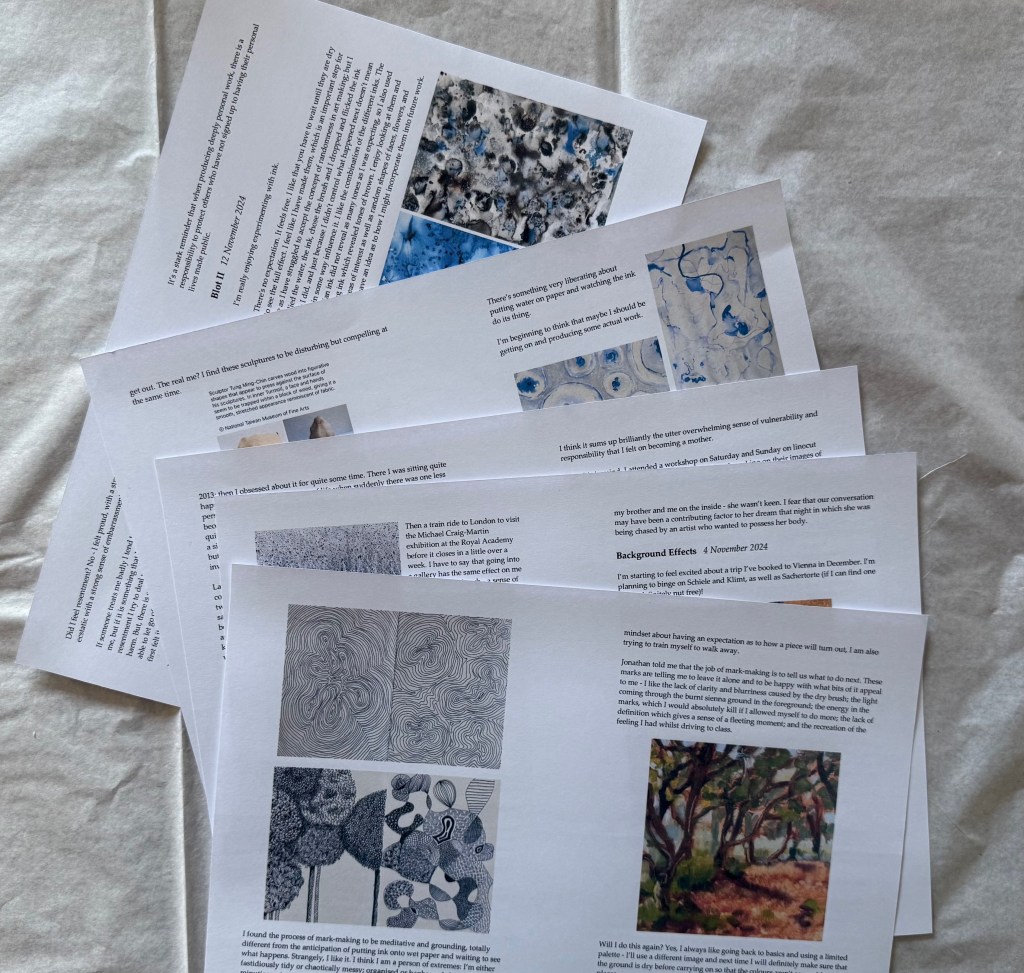
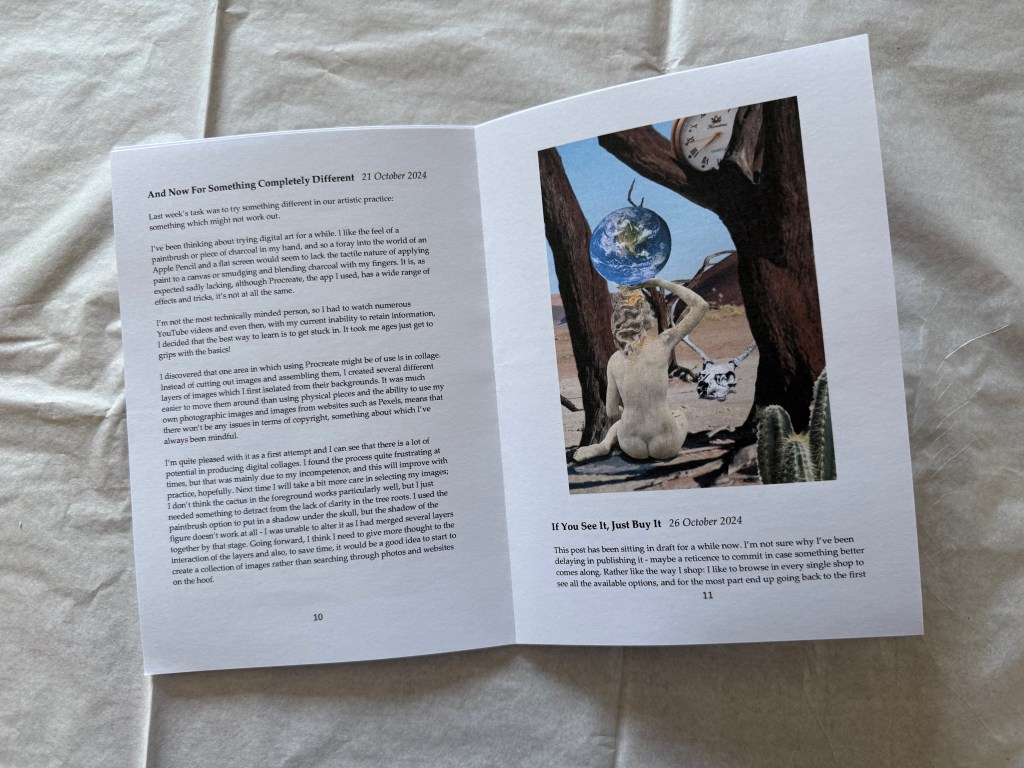
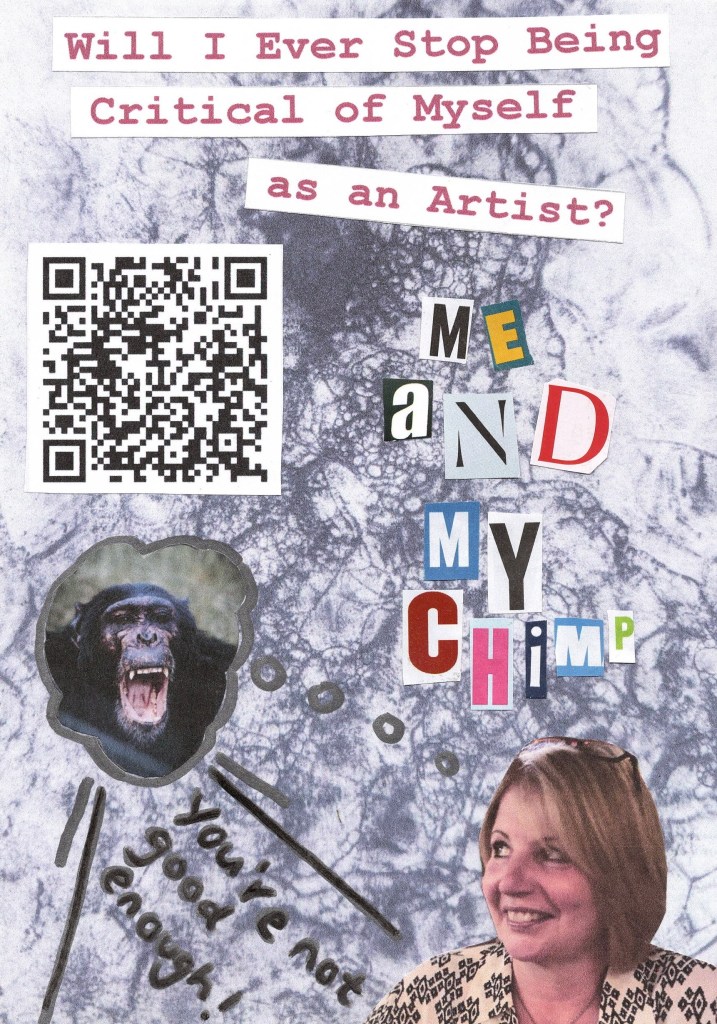
I’ve spent the last few days chained to my laptop copying and pasting most of my 195 blog posts (now plus one!) into a word document. Am I regretting my decision to make a book out of my blog? No, because it feels like it’s ticking a big box somewhere inside of me – it’s keeping my chimp happy – I’m making something that evidences the last two years. It will leave me free to experiment with something else.
That said, I have already reminded myself that I have never made a book before and so the process is very much an experiment, and that I should have no expectations as to the result.
I have formulated a plan though. The book is going to be in A5 format as that avoids the need to deal with things like columns. I’m going to print it in a series of booklets – signatures – of 5 sheets of A4 which equates to 20 pages. These will then be stitched together – I’m currently thinking no more than 10 in a single volume and then covered with a hardback cover. I am thinking that I may use some canvas that I have knocking around which I could paint, draw, print and stitch onto. Alternatively, I could try sheer fabric, cotton or linen. I’ll need to experiment. Even the end papers could be pieces in themselves.
I have already formatted and printed off a couple of signatures. It’s definitely going to run to more than a single volume, so I think that I’ll format and print off the first 10 signatures and make a single book just to see how it goes, rather than spending time formatting and printing out all of the blog.
Thus far the process has revealed a couple of things. Firstly, I need to be mindful that future posts will have to be included, so it may be an idea to limit posts going forward – but who am I kidding? Secondly, in carrying out the exercise I have relived the past two years and it has been helpful to note ideas that I have had along the way and which I could develop in the future, as well as discovering some draft posts which I didn’t publish, perhaps because I wasn’t quite ready. This is an example of part of one which was on the subject of perfectionism:
‘But old habits die hard and when my mother became ill I couldn’t process it on an emotional level and so I became the best carer that I could be, which now I regret because at times it meant that I wasn’t the best daughter that I could have been. To this day I can’t understand why, when she said she fancied a gin and tonic, I told her that she couldn’t have it because she was taking morphine. She was dying, what did it matter? It is one of my biggest regrets. And when she didn’t eat one of the many offerings I had made for her, it was because I was a failure, because I wasn’t able to find that one thing that she would want to eat.
I had the same thought this evening as Monty, the dog, only had a few little bits of meat which he had been quite happily eating yesterday. What am I doing wrong? What is it that he wants that I’m not offering him?
And, of course, the answer is nothing. I can only do what I can do in the circumstances. If he was hungry he would eat. If my mother had been hungry she would have eaten. Even if they did eat, it’s not really enough to make any significant difference. I’m not responsible for them not eating. There is nothing that I can do on a practical level anymore to avoid having to deal with the inevitable outcome. ‘
I suppose that it’s only natural to pause and reflect on the fact that there are only 10 weeks left: 10 more Tuesday sessions with everyone, 1 more tutorial. Maybe it’s because I’m feeling as if time is slipping through my fingers like sand, that it seems like a blink of an eye since we started, temporally that is because I know that I have undergone enormous change in the interim. When I think back to the session in which we had to introduce ourselves and our work, I find it difficult to reconcile myself to the person I was back then. I now see, think and make differently.
I feel sad.
But all good things must come to an end. I’m trying to subdue that part of me that is panicking that I haven’t made the most out of the last 2 years. But I know that I have; what I’m feeling is the knowledge that there is so much more that I want to try and to experiment with, and that this is not the end, but the next step. So mingled with the melancholy is a flicker of excitement at what the future may bring.
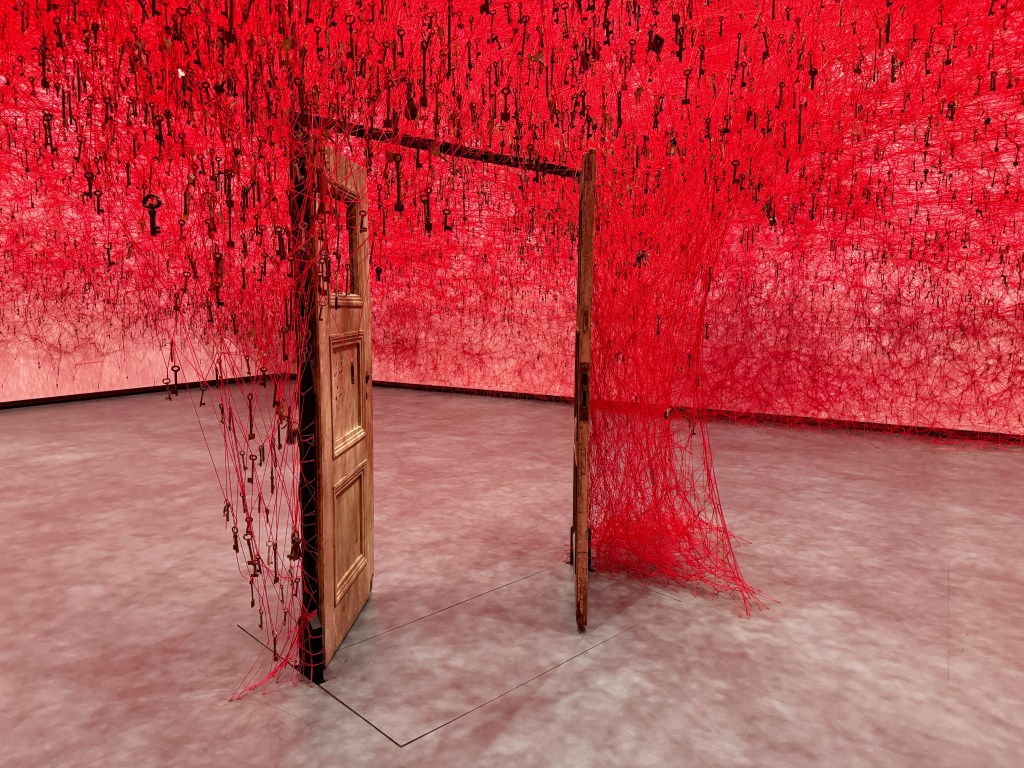
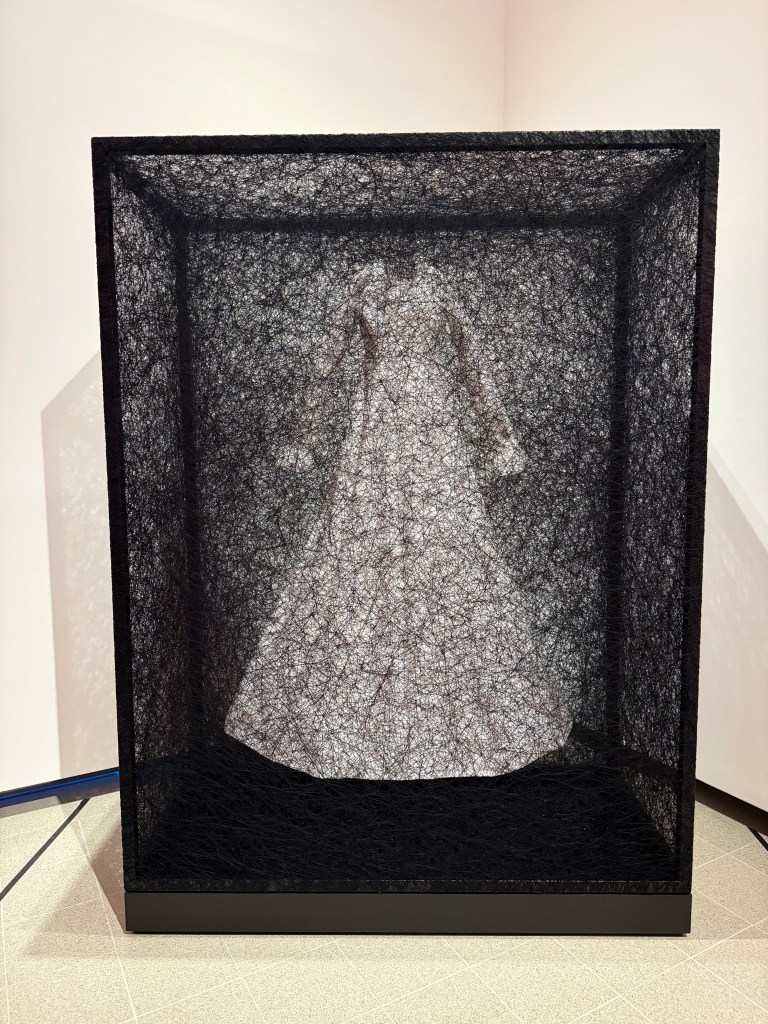
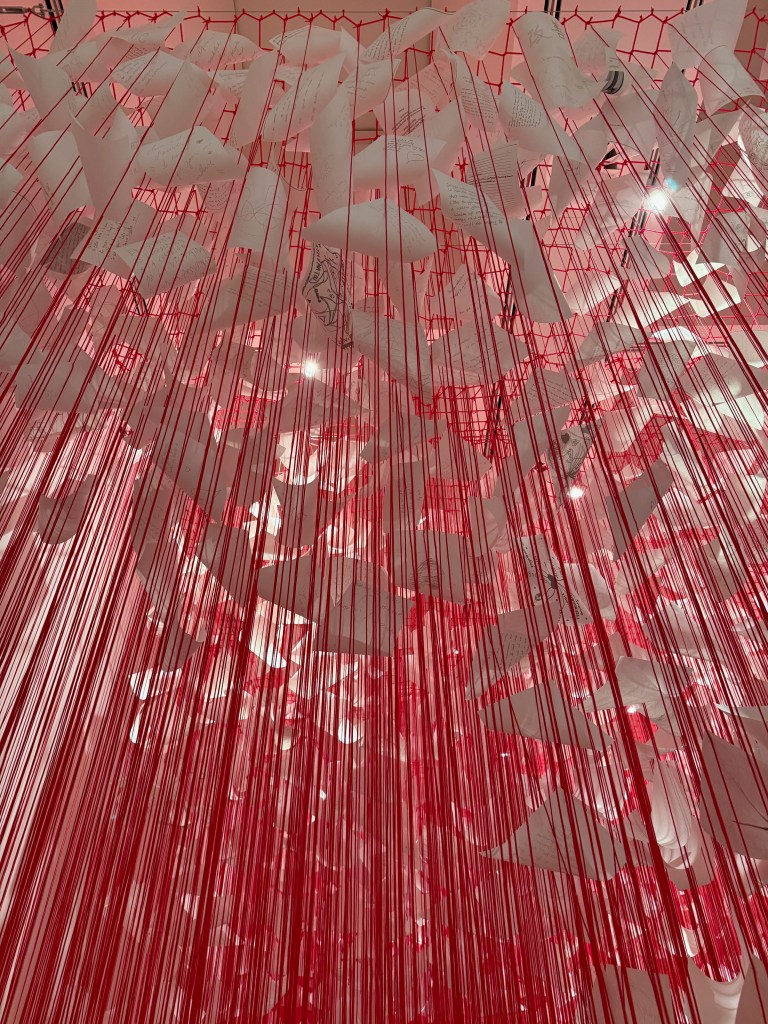
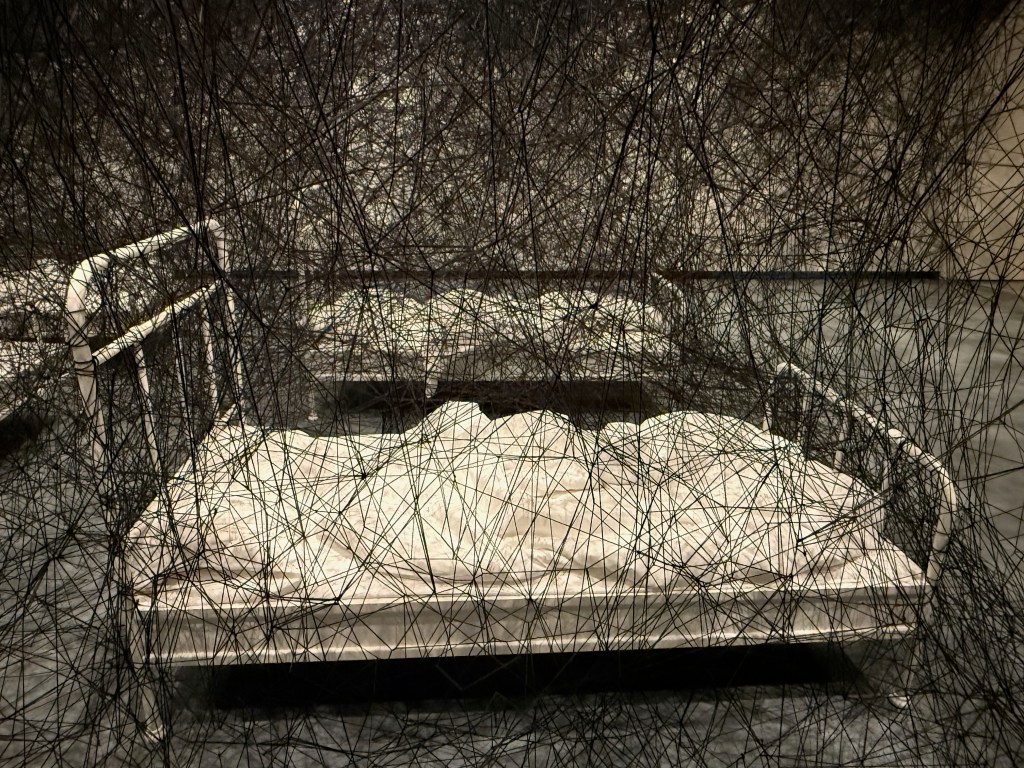
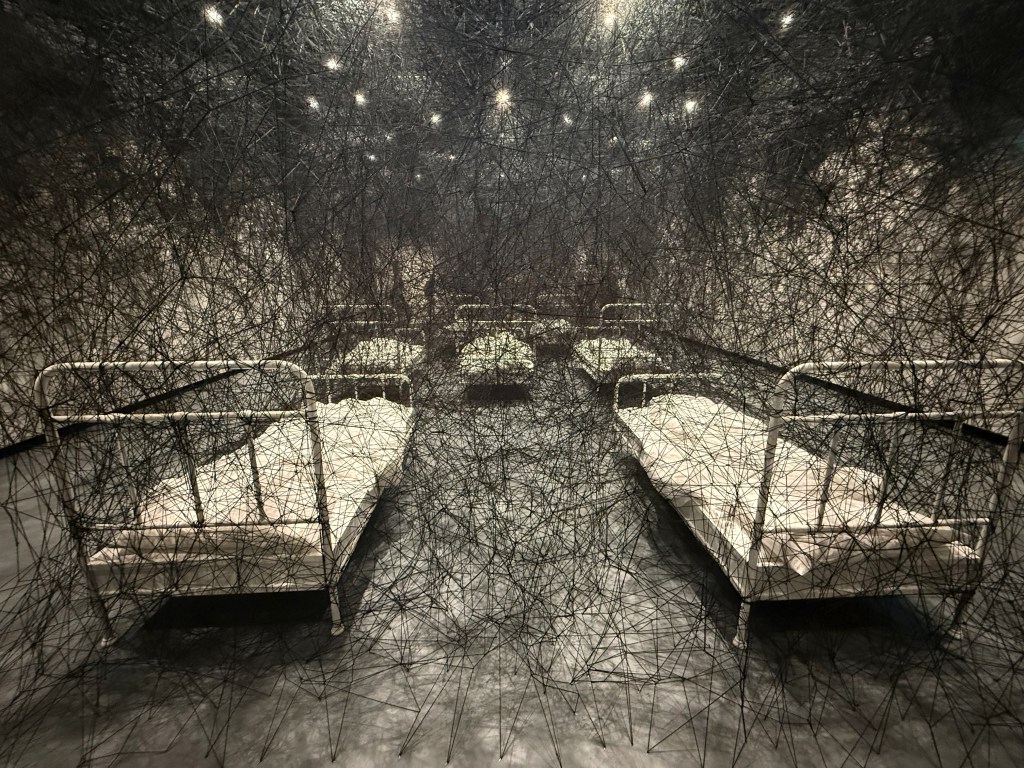
Whilst I was in London I went to the Hayward Gallery to see Chiharu Shiota’s Threads of Life.
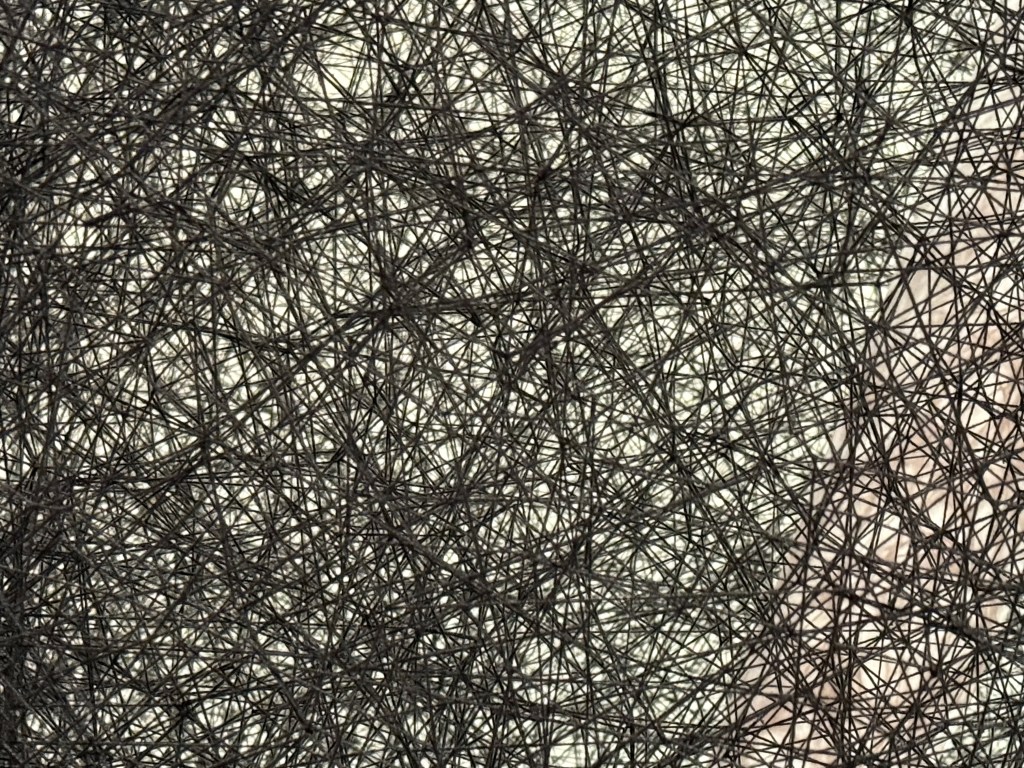
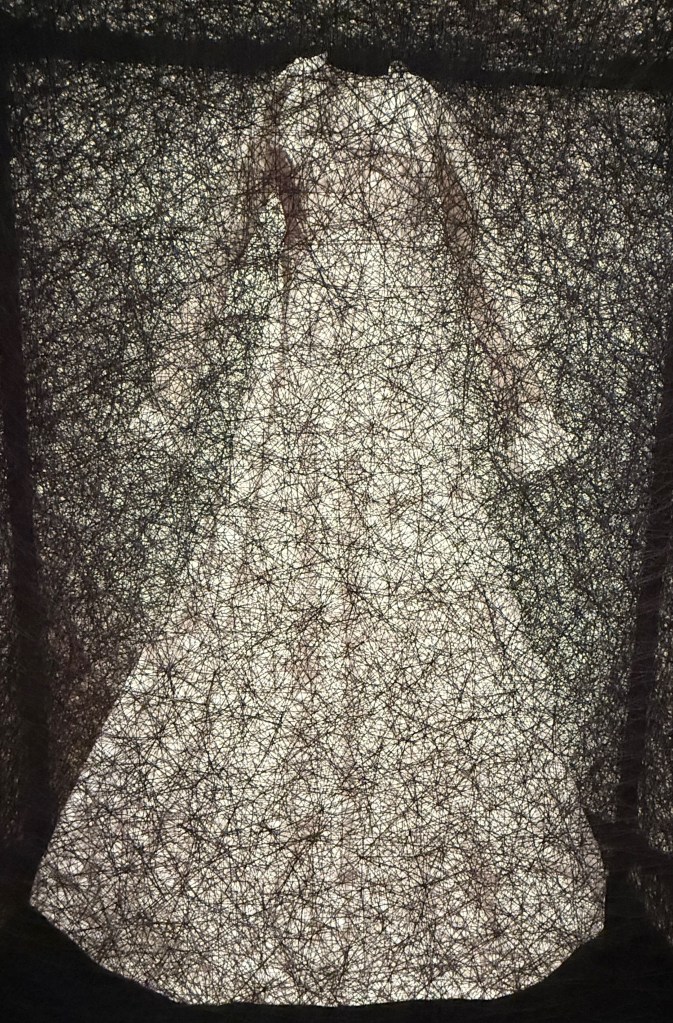
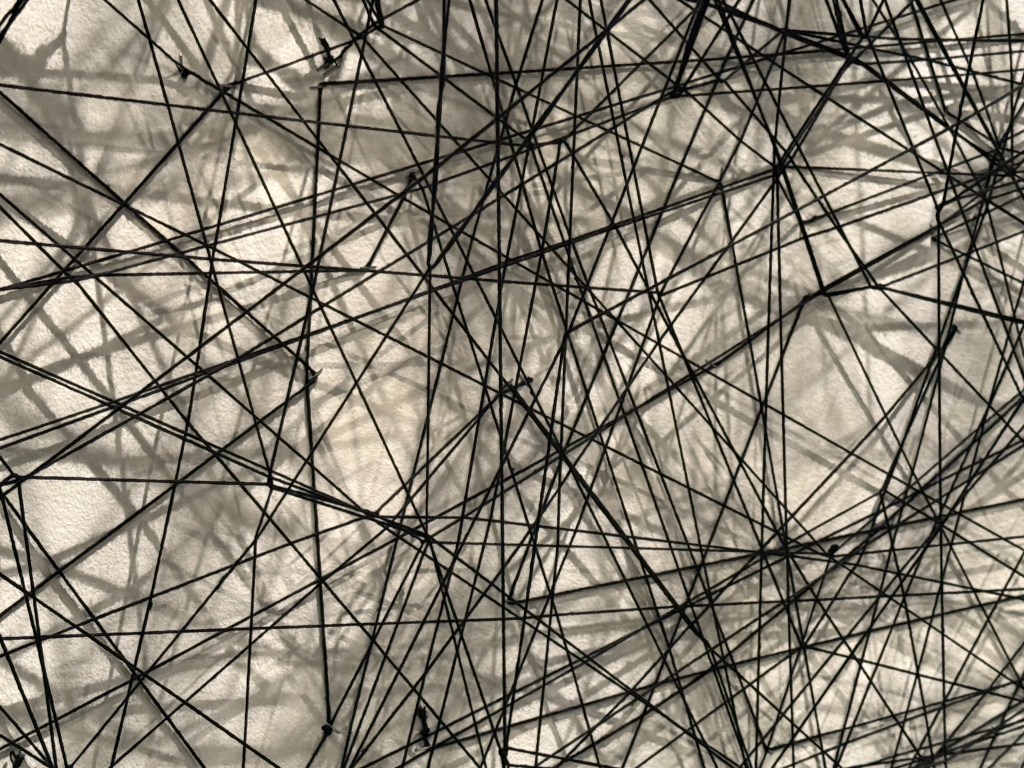
It was captivating. It wasn’t just the scale, the sheer amount and complexity of the thread, or its immersive effect, it was also the effect it had on what is viewed through it. I stood in front of the dress in the cabinet for ages. The fragmentation of the image of the dress through the threads gives it an almost spectral presence. I was also fascinated by how the threads were stapled to the wall, and woven in between each other, casting shadows which create further depth.
I watched some footage of her working when I got back, and looked at some of her drawings. They remind me of Do Ho Suh. Having used thread recently, I can see myself using it more in the future. I even like the effect of it in the photos, which are only 2D images.
This time last year I was feeling like I had an awful lot to process as a result of the Low Res, and that I couldn’t really get on with very much until I had done so. This year I don’t have the luxury of time. The ‘end’ of the course is nigh. I really need to make the most of what time is left.
Thoughts inevitably turn to the end of year show. I’m still thinking that I will take Jonathan’s advice and keep on as I am, seeing where I am at when the time comes. I’m no longer fixating on a large final piece. I will probably show a few smaller pieces of work, depending on what I have to hand. However, I keep returning to the idea that my blog is a piece in itself. Jonathan and I have previously discussed making it into a book. From what I can see, there are websites that will do this for me but there is little editorial control, and I’m not sure that farming it out to a third party would make it a developmental experience. I think that I would like to make an artefact of sorts out of the blog, and I am thinking about making a book myself. How difficult can it be? Probably, deceptively so, but I’m going to give it a go anyway.
As with last year, I received my annual rejection from the RA during the Low Res. I think that’s the seventh year in a row. My instagram feed is littered with posts by successful applicants, and more recently by unsuccessful ones. They all prove how subjective art is. One caught my attention: how the applicant is trying not to take it personally, but how it is so difficult when she is her art.
I think that I am resolved that I am not my art – it is something that I have made; it is not me, at least not the present me. Even if it is, I came to terms a long time ago with the idea that I can’t please all of the people all of the time, and so it follows that not everyone will like the art that I make.
I spoke with my daughter yesterday. After a short while it became apparent that something wasn’t quite right. She eventually told me that she felt really stressed. It’s difficult when all you want to do is give someone a hug but they’re miles away. It’s her final year: she has a dissertation due in a month and she starts her last set of exams shortly afterwards. She’s in a group of three and they are conducting an experiment, but circumstances have transpired that she has been the one who has had to spend day after day on campus conducting the testing of the participants, whilst one of her group has been abroad and the other has spent half of each week at home with his parents. She feels snowed under with work. She’s waking in the early hours, and not sleeping properly.
I asked her what is the worst that can happen? I don’t graduate, she replied. And what then? I have to redo the year. Is that such a bad thing? It upsets my plan. Well, that’s life, plans often have to change. So, if the very worst case scenario is not that bad, why make yourself ill worrying about it? We also discussed how she needs to be kinder to herself. I reminded her that it’s been non-stop since her car accident last May. She lost her summer holidays to pain relief, physiotherapy and trying to process the situation she found herself in, and no sooner was she emerging from it all than she was back at uni with the onslaught of the final year. I suggested that she discuss how she’s feeling with her supervisor – if you don’t tell people you’re struggling, they won’t know. I think she felt better – she said she did.
The conversation reminded me of the day in my early thirties when I walked out of the office to go to a meeting and realised that I just couldn’t do it and so I went home. I remember how I felt that day. I had an overwhelming feeling that I just had to get away – the best way to describe it would be as a survival instinct to run. There was absolutely no doubt in my mind that it was the right thing to do. I was signed off work for two weeks with ‘exhaustion’, the culmination of running an expedited trial which instead of taking a year to progress, was condensed into less than a couple of months; working incredibly long hours, every day. I coped because I was expected to cope, and like my daughter I just got on with it, reliably taking up the slack. The night before I ‘ran’, my mother had told me that she had been diagnosed with breast cancer – it was the nudge that had pushed me over the edge.
I learnt two important lessons from that experience: no-one is indispensable (they managed to get by without me) and how to say ‘no’. As a consequence work became more tolerable, but not enough for me to go back after maternity leave.
Whenever I hear that a friend’s child wants to be a lawyer, my heart sinks. I still feel uncomfortable when I go back into that environment. The visit to Clifford Chance’s offices during the Low Res to see Jo Boddy’s wonderful exhibition stirred up some old feelings. But worth it to see her amazing work. It was a privilege to hear her thinking behind her process, and how she went about its making.
I used to think that the key to getting away from product driven working practice would be to free myself up – be looser and more expressive, be out of control, go bigger.
But I’ve recently realised that this isn’t necessarily the case. Maybe I’m not looking for drama, physicality or excitement. Some of the most satisfying moments have been making with repetitive mark-making and slow movements. I don’t need to be writhing around on the floor in a puddle of paint or covering huge pieces of paper with big swooping marks to free myself up; I just need to keep my brain distracted with the process.
I found myself back in Vienna in December – my husband had a conference and I tagged along as there were quite a few galleries we hadn’t made it to on our visit last year.
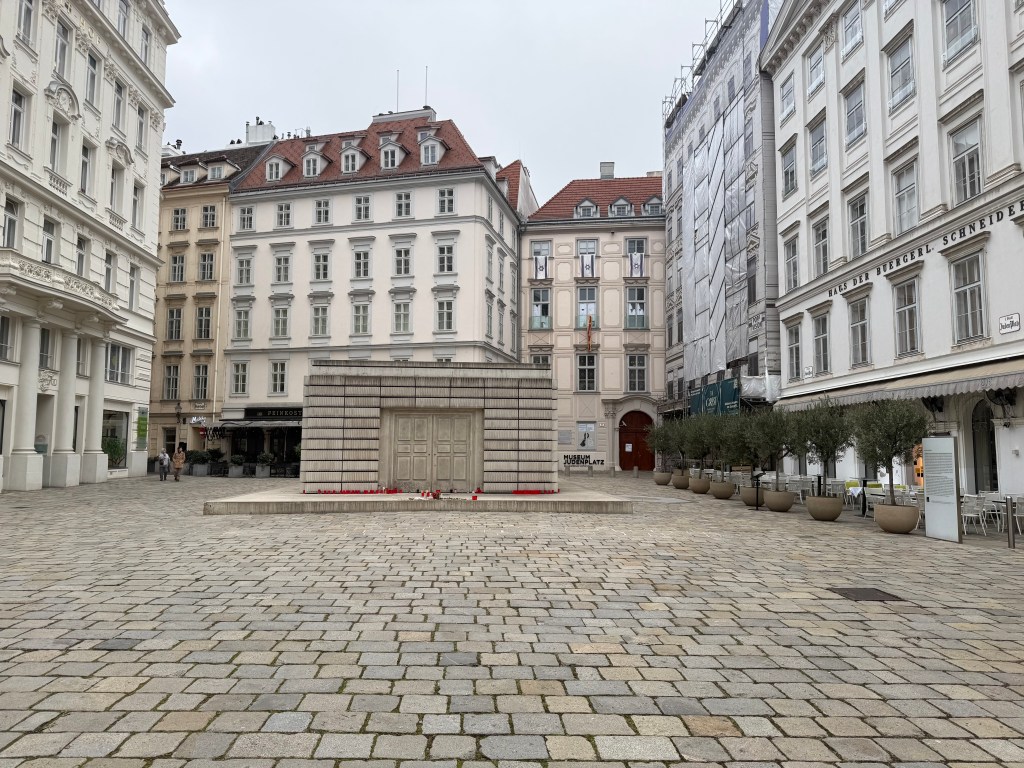
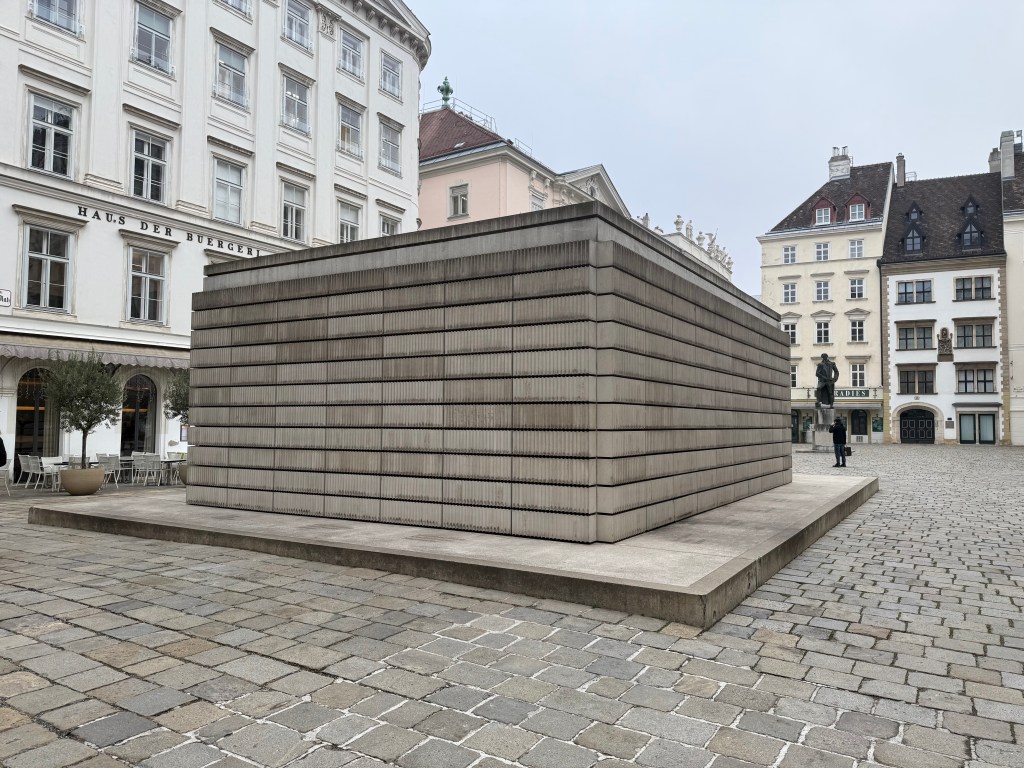
Also, I specifically wanted to go and see the Judenplatz Holocaust Memorial by Rachel Whiteread. There is an interesting history behind it and in many ways it echoes the city’s past. Walking around you get the sense that a lot of the city’s architecture remained intact after the Second World War. The city was annexed by Nazi Germany in early 1938 but didn’t suffer prolonged bombardment during the war, being targeted mainly towards the latter stages, and even then it was primarily strategic targets such as the industrial areas, until the city eventually surrendered to Soviet forces. Any buildings which were affected were rebuilt in line with their historical appearance.
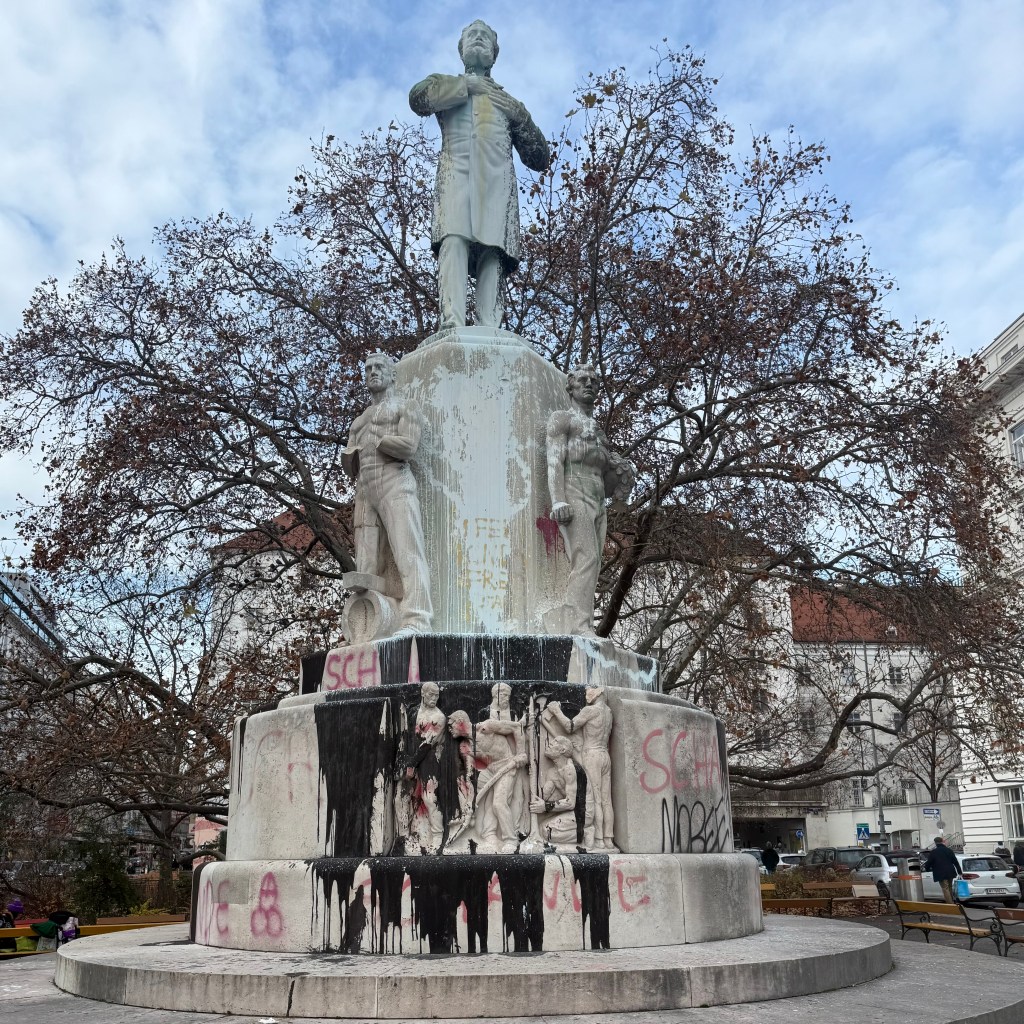
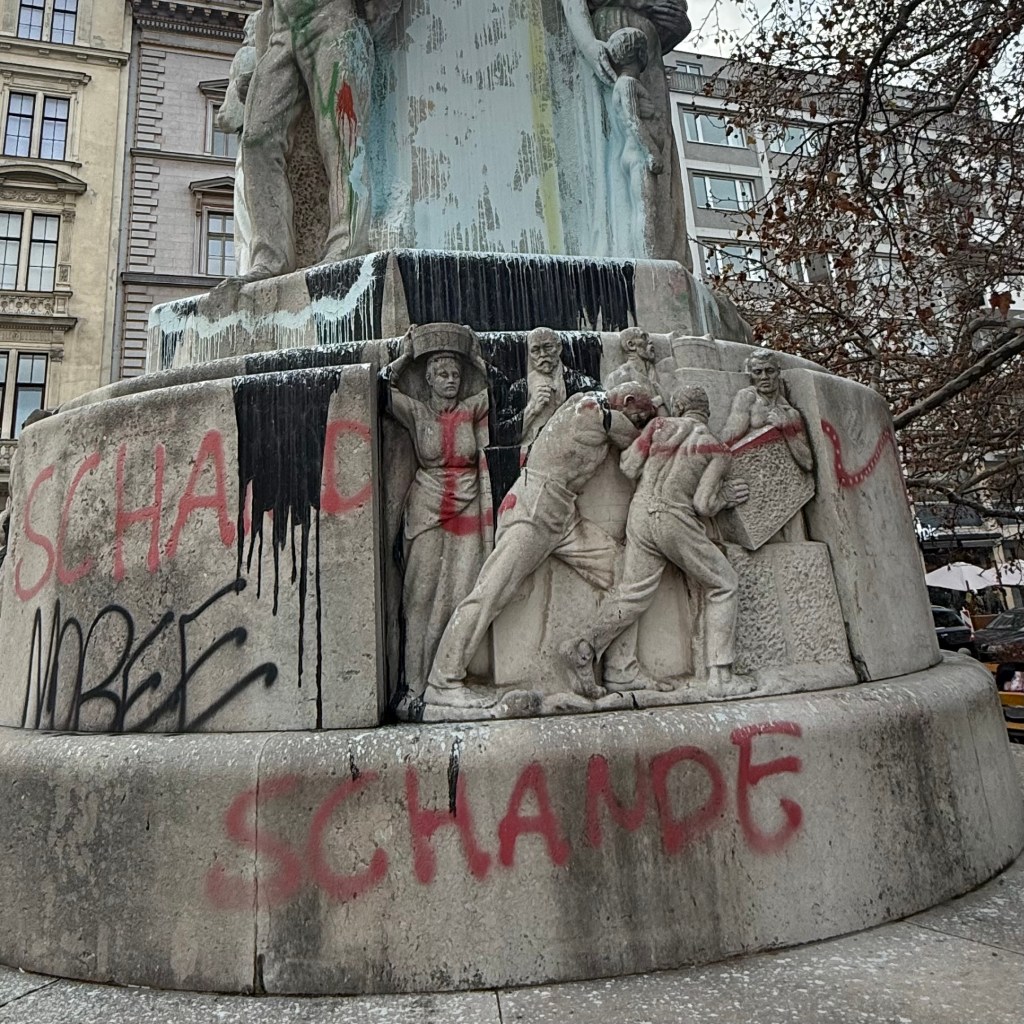
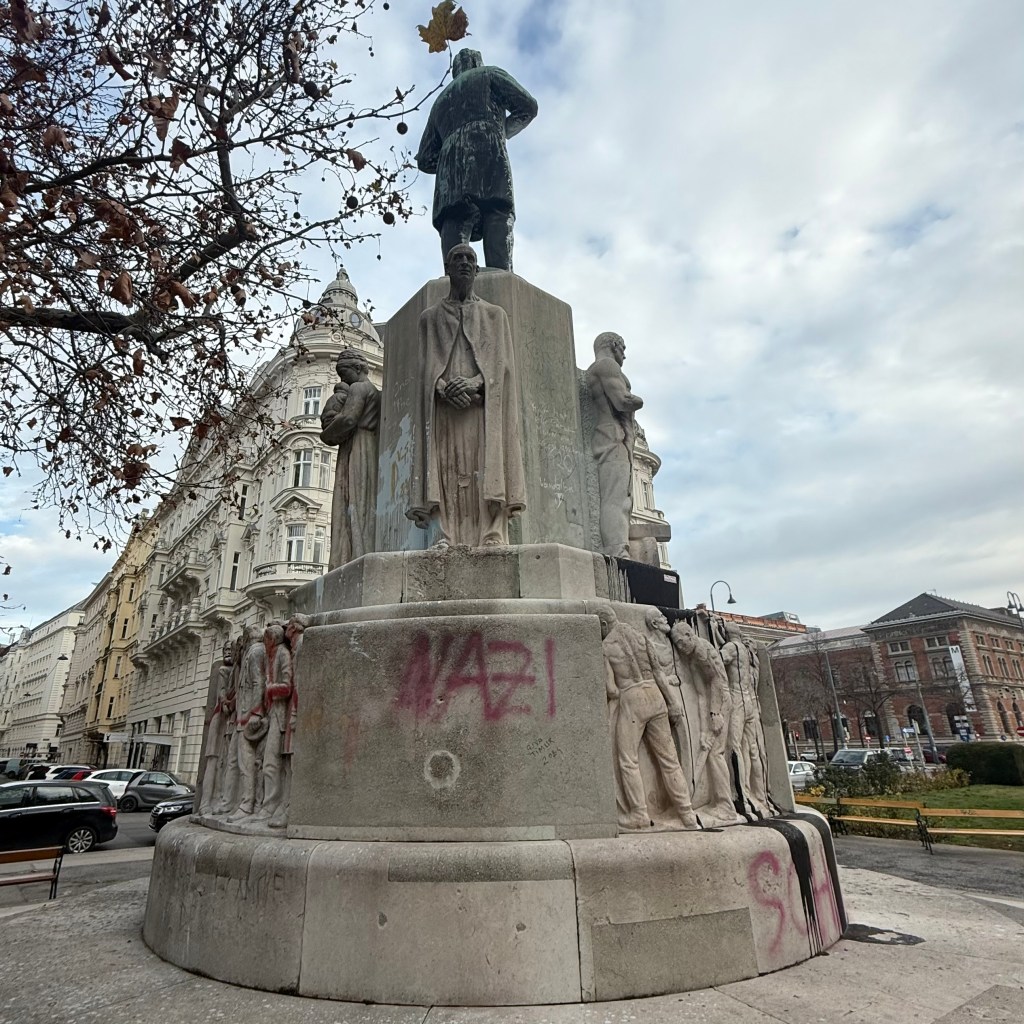
As I left the hotel each morning I passed a statue which had been graffitied.
It’s a statue of Karl Lueger who was mayor of Vienna from 1897 to1910. He is a divisive figure. On the one hand he turned Vienna into a modern city by implenting major infrastructure projects including extending the water supply, introducing the tram transport system, building schools and hospitals and improving welfare. On the other, he was antisemitic and founded the populist Austrian Christian Social Party. He is believed to have influenced Hitler who was living in the city at the time, and who credits him in ‘Mein Kampf’ as being the greatest ‘German’ city mayor ever. Some believe that Lueger adopted antisemitic views in order to gain office and that they did not really represent his private beliefs. Whatever the truth, he is at the centre of an ongoing and controversial debate.
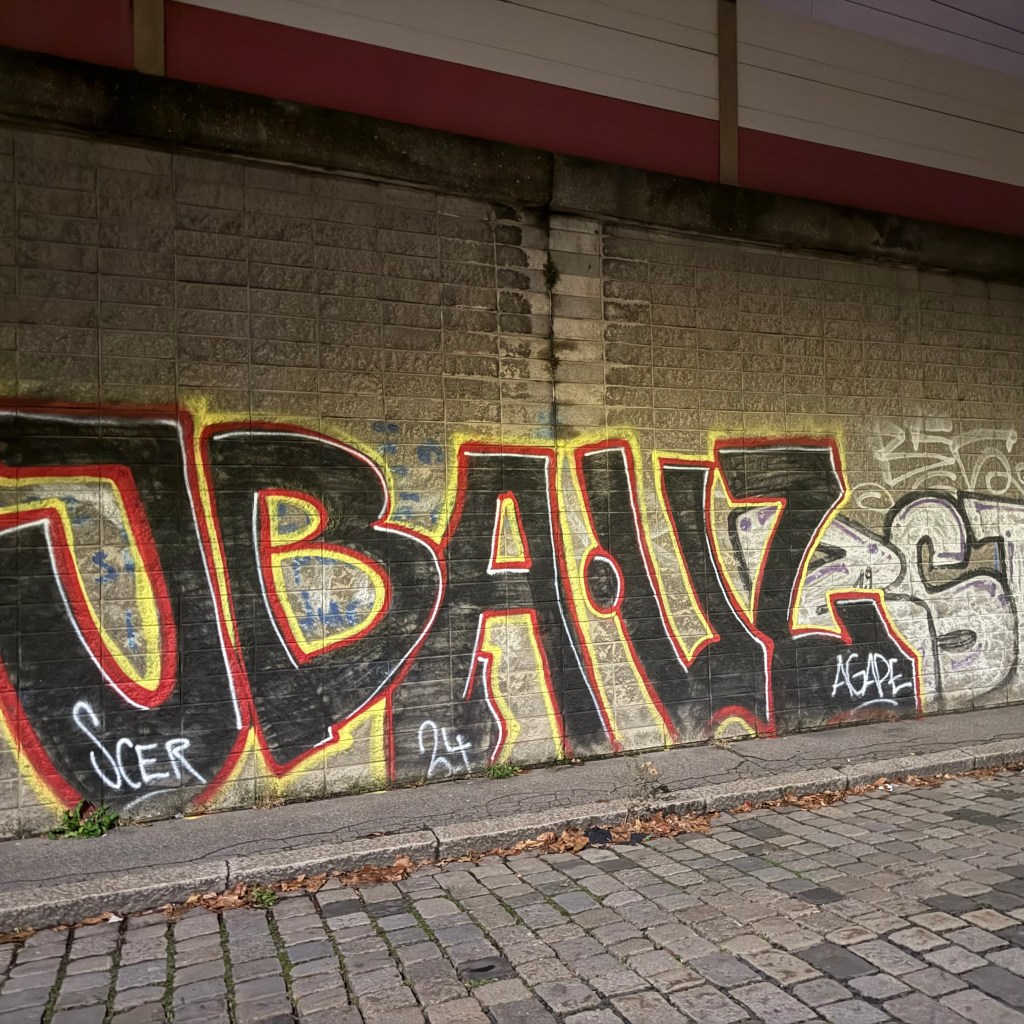
In an effort to come to terms with its troubled history, just over a decade ago the city renamed its main ring road which had originally been named after Lueger, and on which sit many prominent institutions including the University of Vienna, which had campaigned for change. The move has been divisive with accusations of whitewashing the city’s difficult history. The fate of the statue appears to be uncertain. There is a plaque next to it explaining Lueger’s legacy and his antisemitic beliefs and the graffiti which expresses how people feel has been left. There were plans to tilt it by 3.5 degrees to the right to give it an air of impermanence, but according to a friend who lives in Vienna, the cost of doing so would run into millions of euros and so it has been shelved for the time being. All I can say is that if I hadn’t seen it, wondered why it was covered in graffiti and read the plaque, then I would never have known, and I would have just walked on past. Incidentally, there areas of Vienna where graffiti, or more particularly, street art, is legal and encouraged.
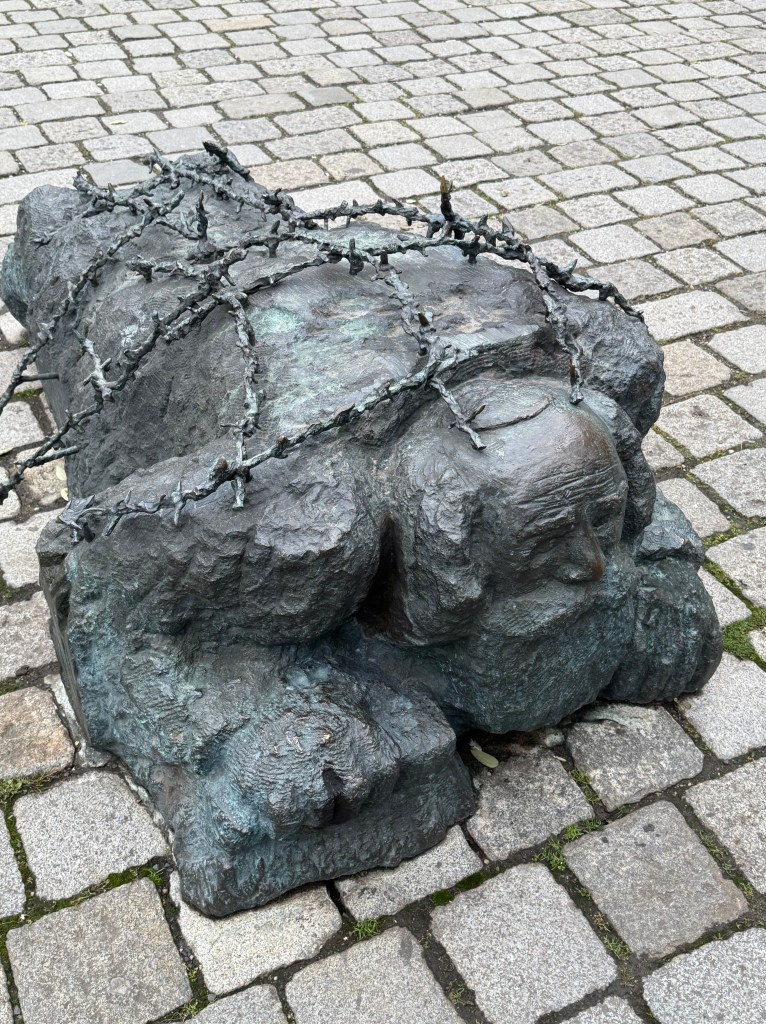
But going back to Rachel Whiteread. There is a war memorial outside the Albertina Musem – the memorial against war and fascism. It was heavily criticised in particular because of the bronze figure of a kneeling Jew washing the street.
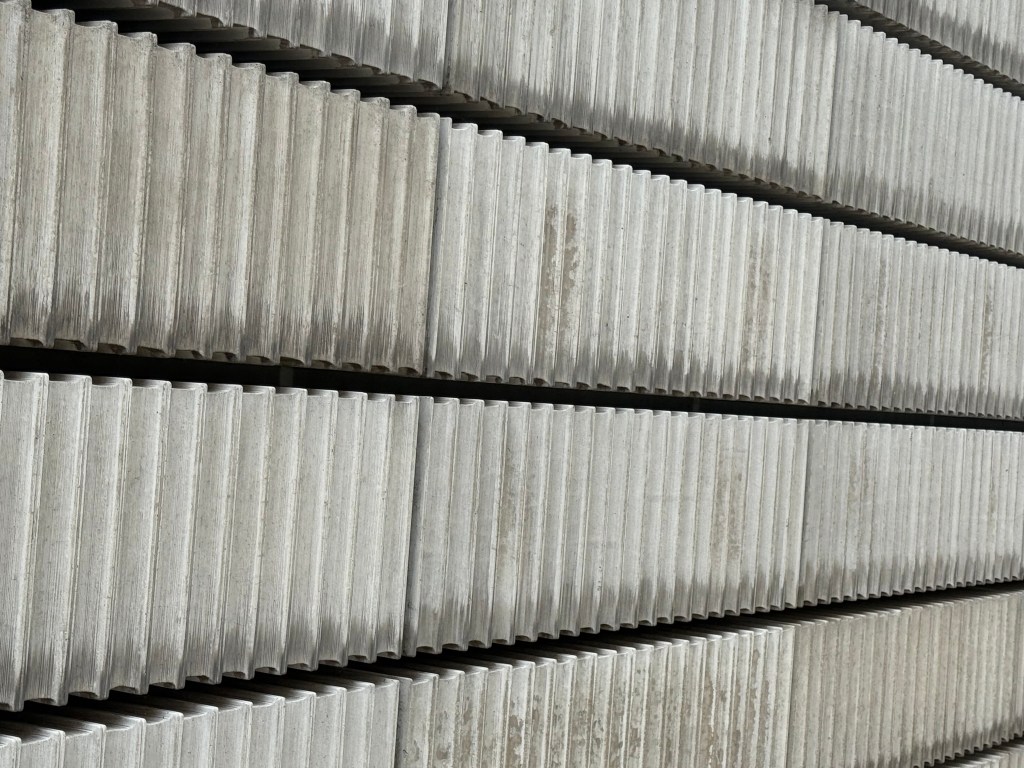
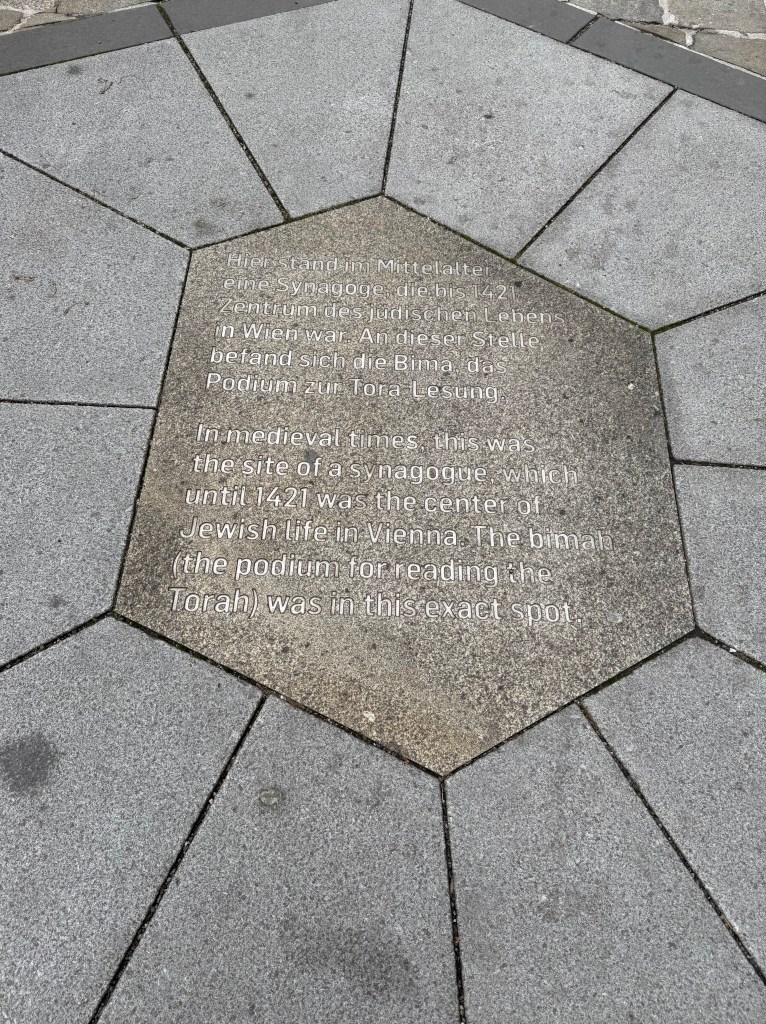
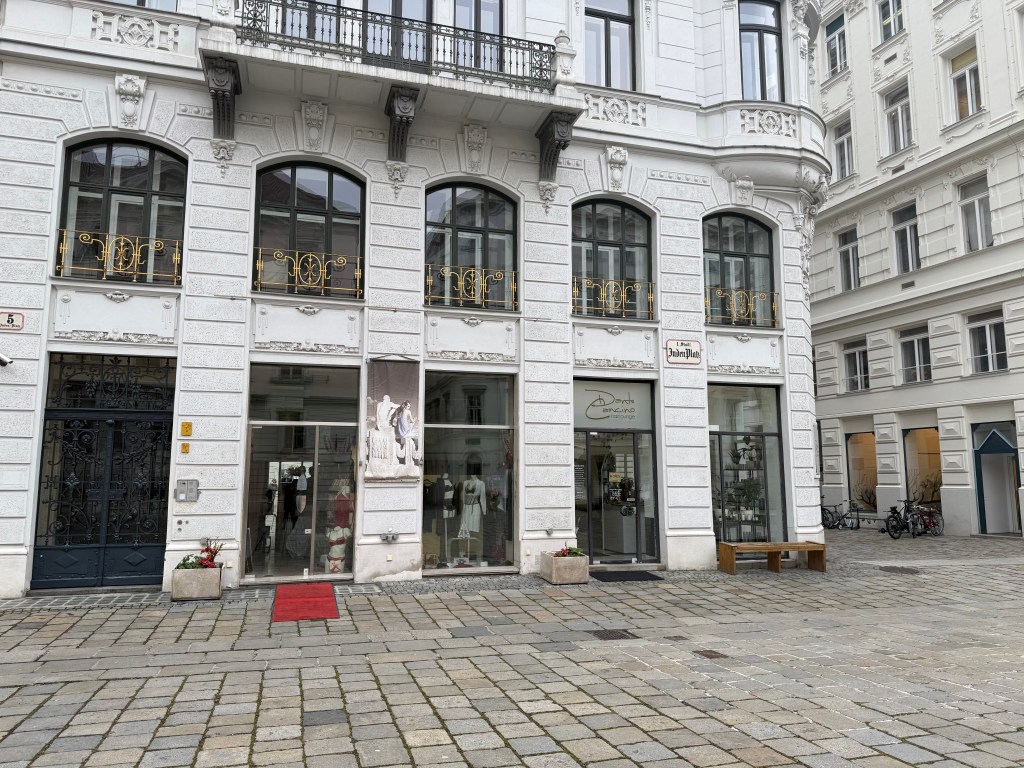
The Jewish community campaigned for a separate Holocaust memorial. Rachel Whiteread was chosen and her memorial is sited in Judenplatz above the excavations of a medieval synagogue which was uncovered during its construction. It resembles a bunker. The outside is lined with library shelves turned inside out so the spines and contents of the books are hidden – the nameless library. Apparently, Whiteread specifically requested that it should not have an anti-graffiti coating applied. Just opposite is a shop selling lingerie, and, when I was there, a couple were busy taking photos of themselves eating food. All very odd and out of keeping with the sense of solemnity created by the memorial. I spent quite a long time there – it demanded it. I also tried counting the number of books – by my reckoning there are 7,682. As a cast of empty space, it’s been suggested that it is almost a counter monument.
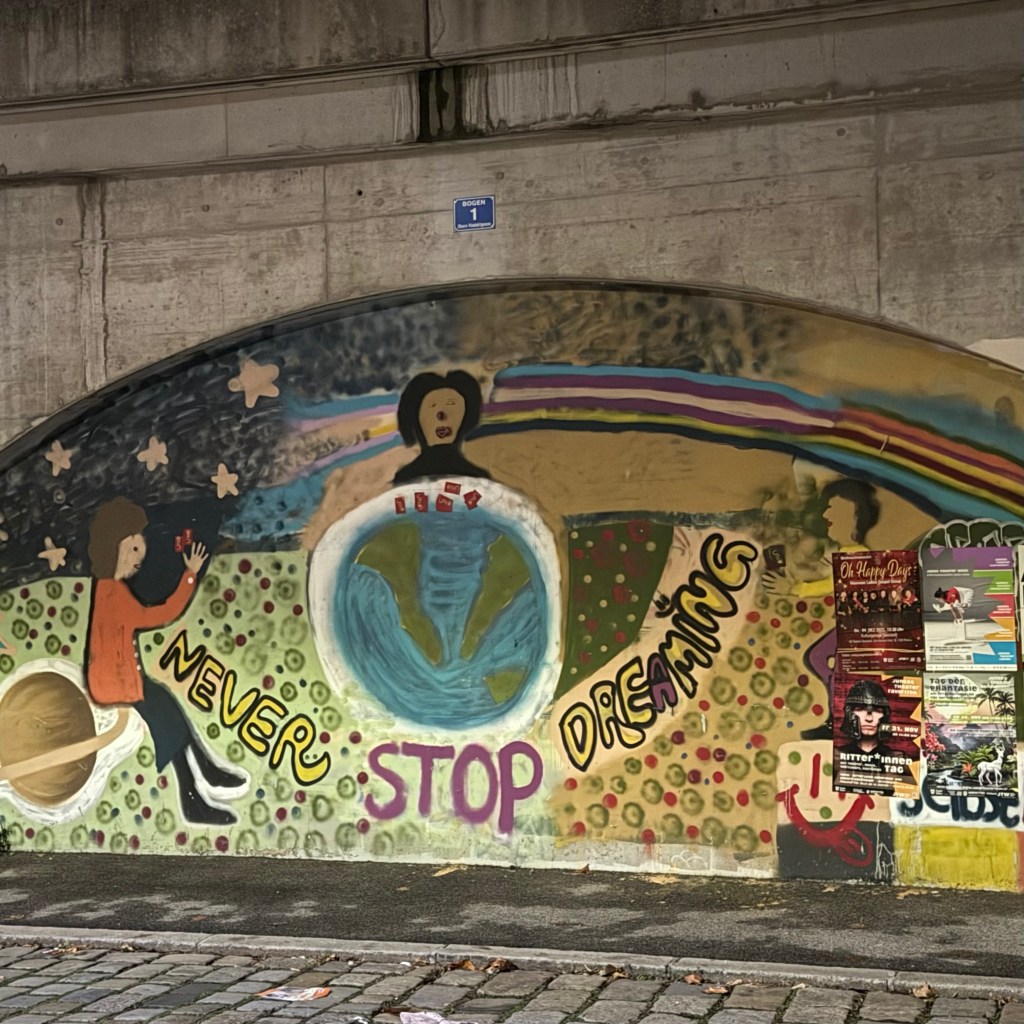
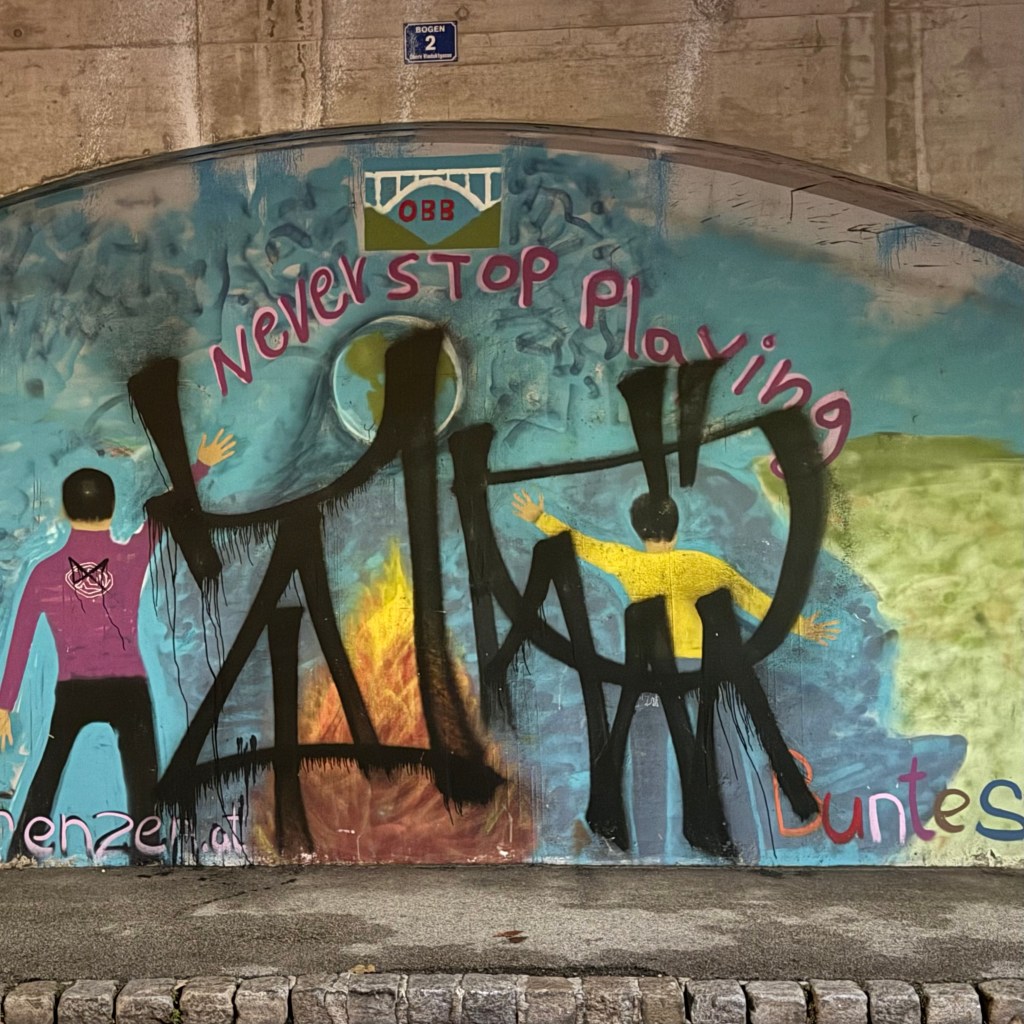
I walked around Vienna by myself, looking and experiencing. I took some photos and videos which I’m in the process of making into a video.
 Kate McCalmont-Woods