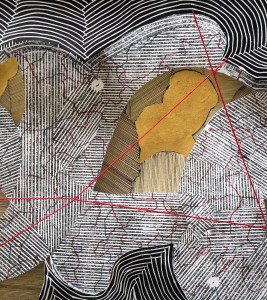
Enough said.
Category Thoughts
A Line Made by Threading
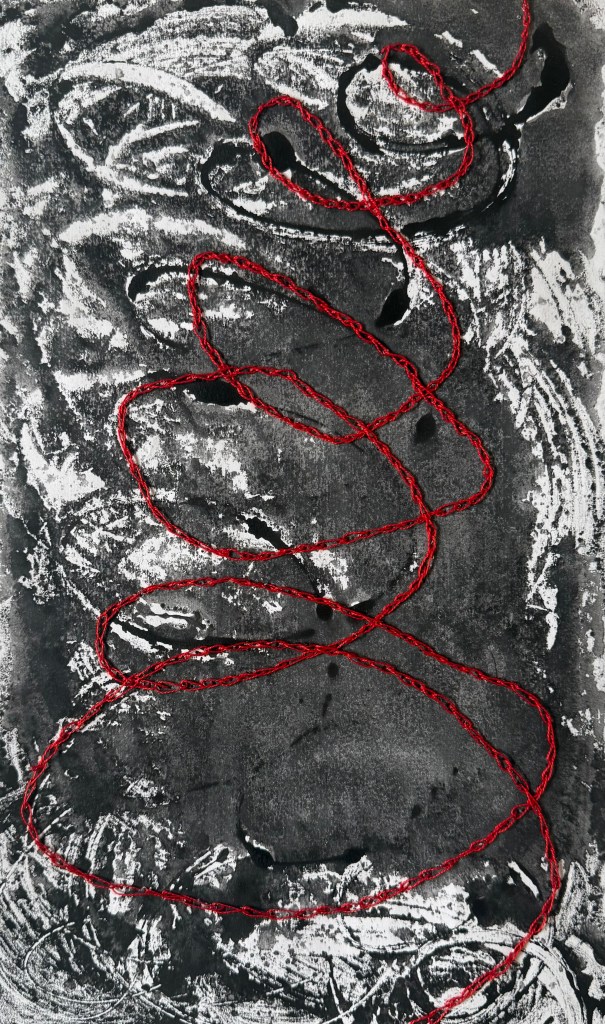
I had some leftover ink and made some monotypes with it – just swirls and wipes. The ink is oil based Cranfield Safe Wash and so I also employed a spray bottle of water.
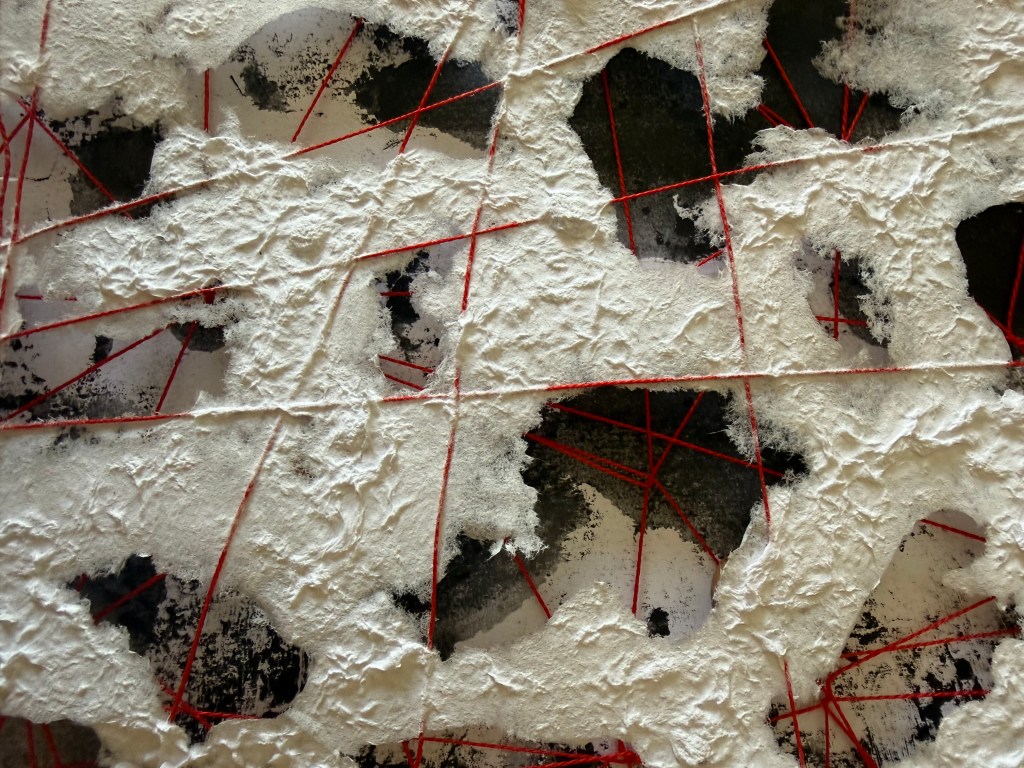
After they had dried, I decided to add another layer, another process – I used thread. I played around with the burnt paper and threaded paper I made the other day.
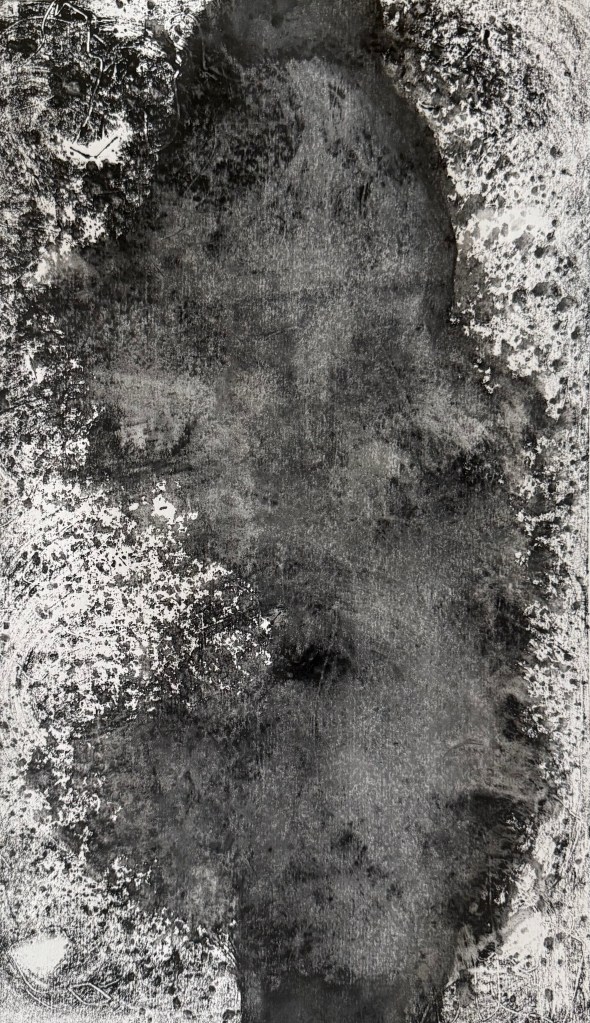
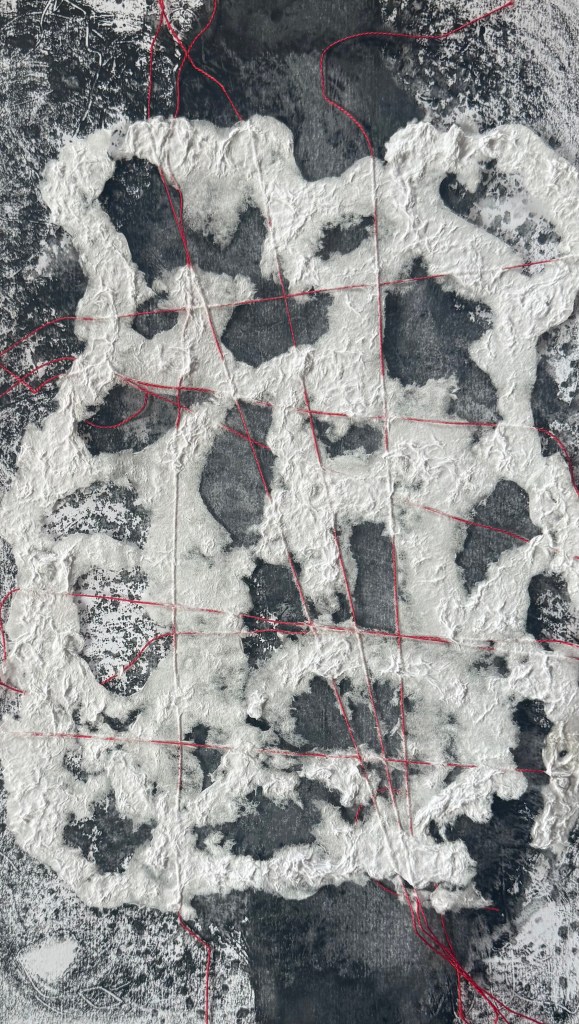
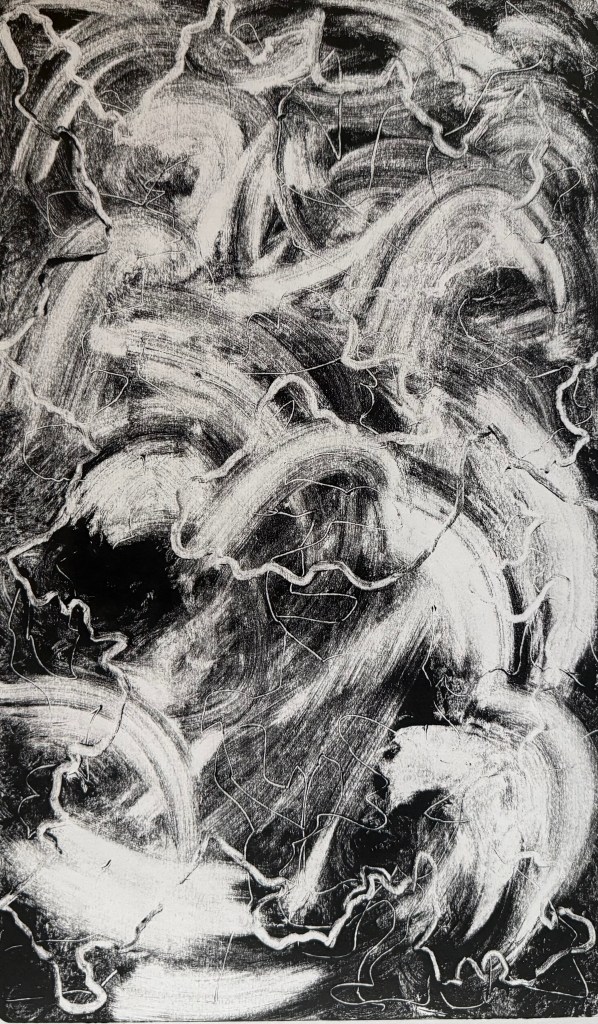
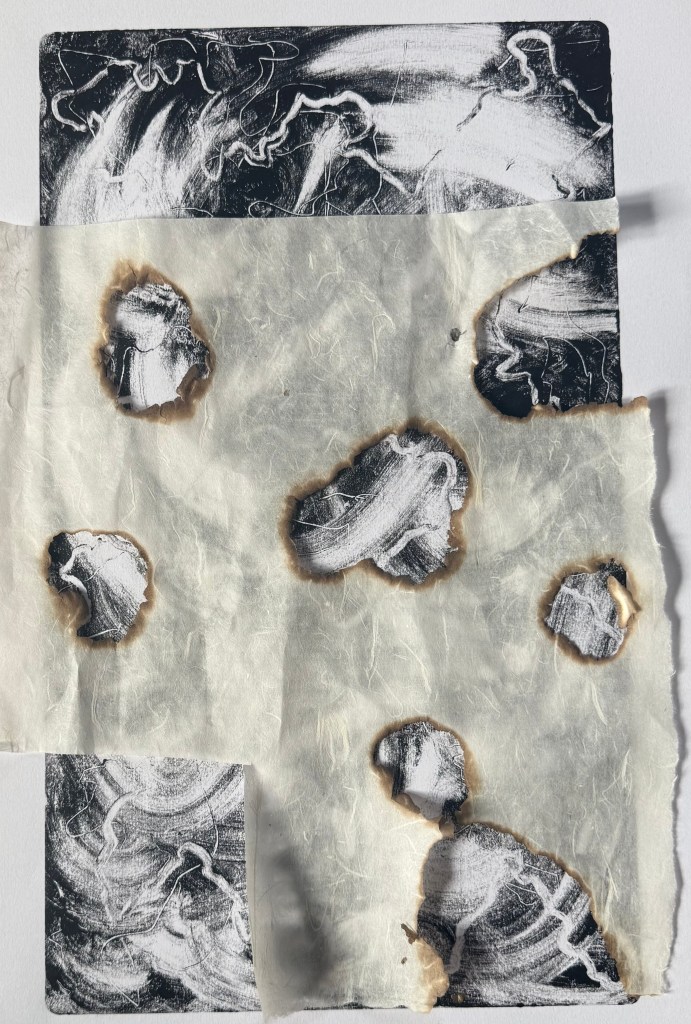
My daughter walked in while I was doing the next one – oh, do different stitches she said. I’m not making an embroidery sampler I replied, but then I did end up experimenting with different stitches and combinations of colour. I much prefer the lines in which the stitches aren’t apparent – where it looks like a line made by thread.
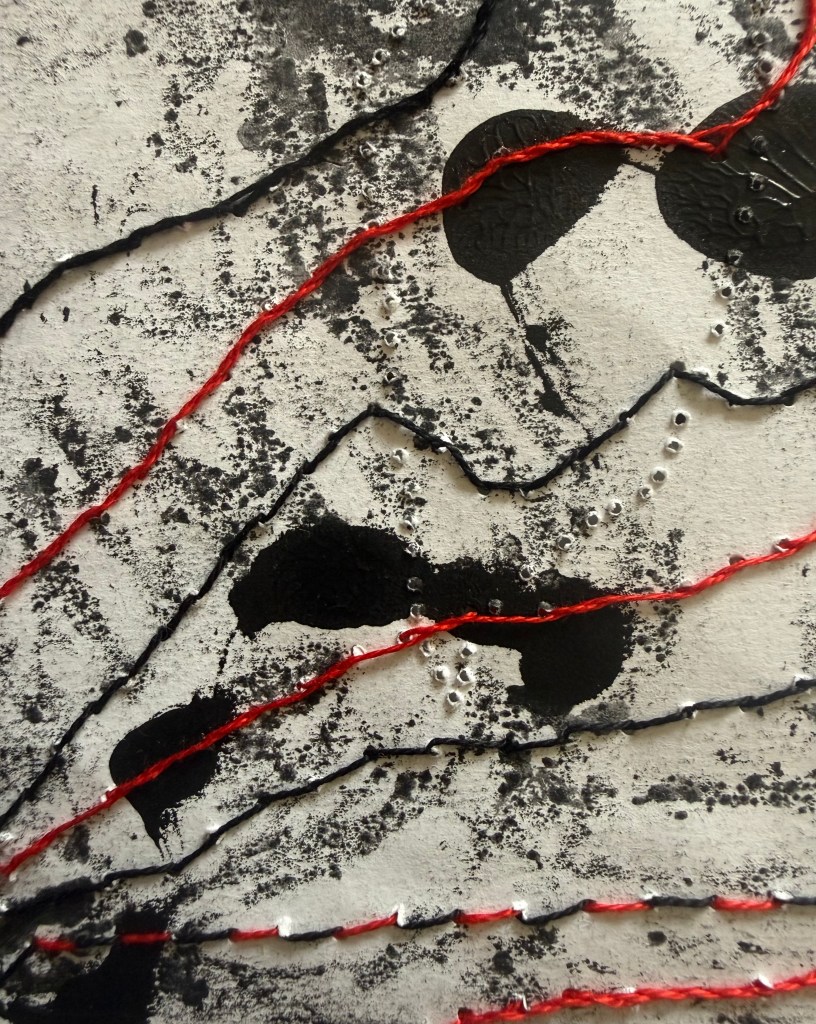
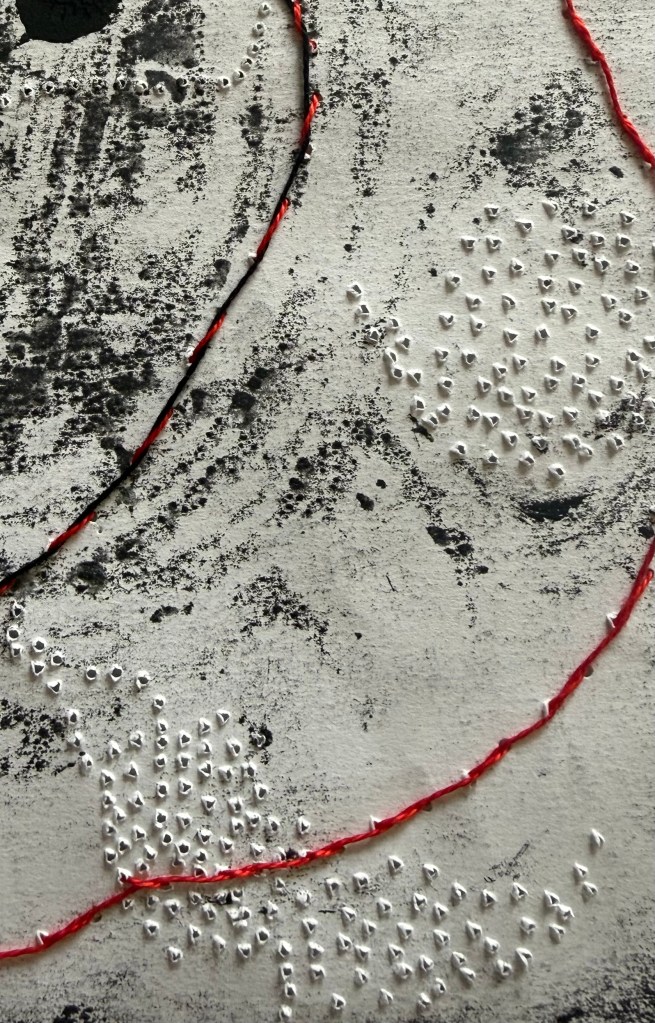
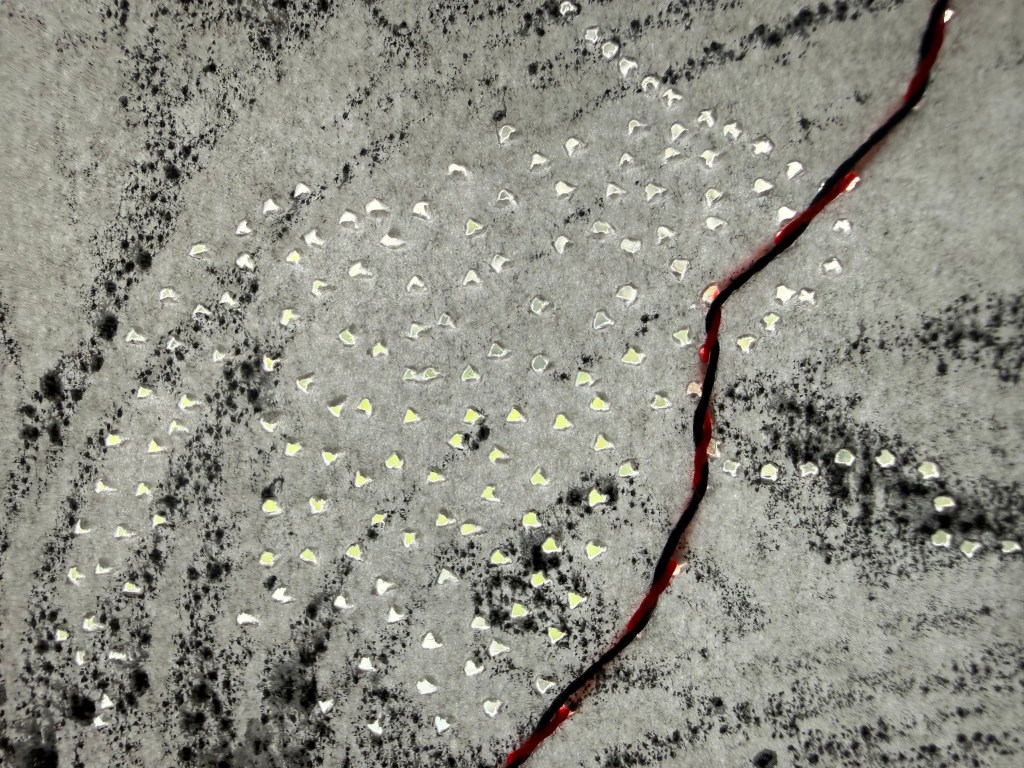
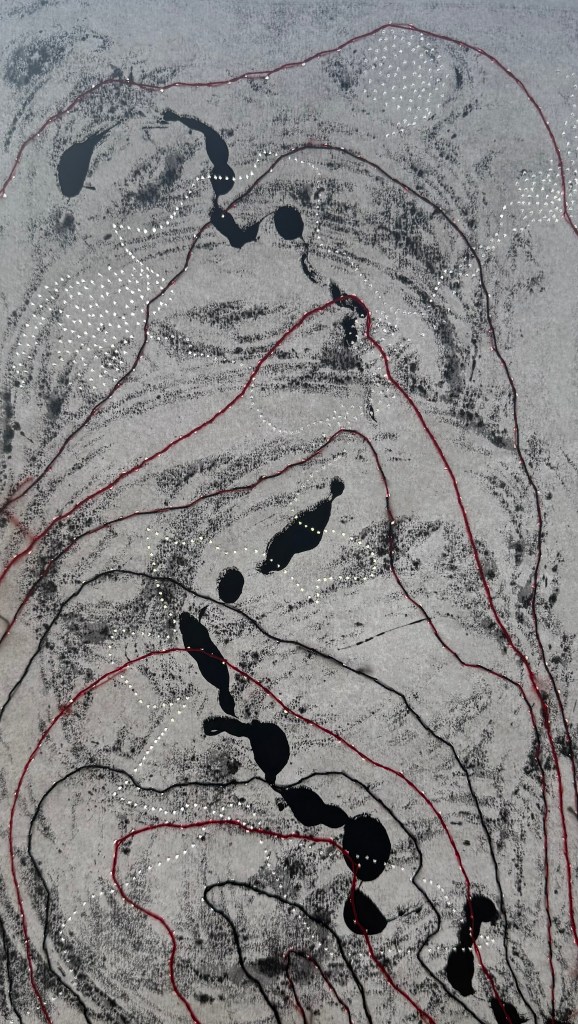
I punctured the paper from the reverse to make raised bits to add texture – nothing new, I’ve seen a lot of it on Instagram.
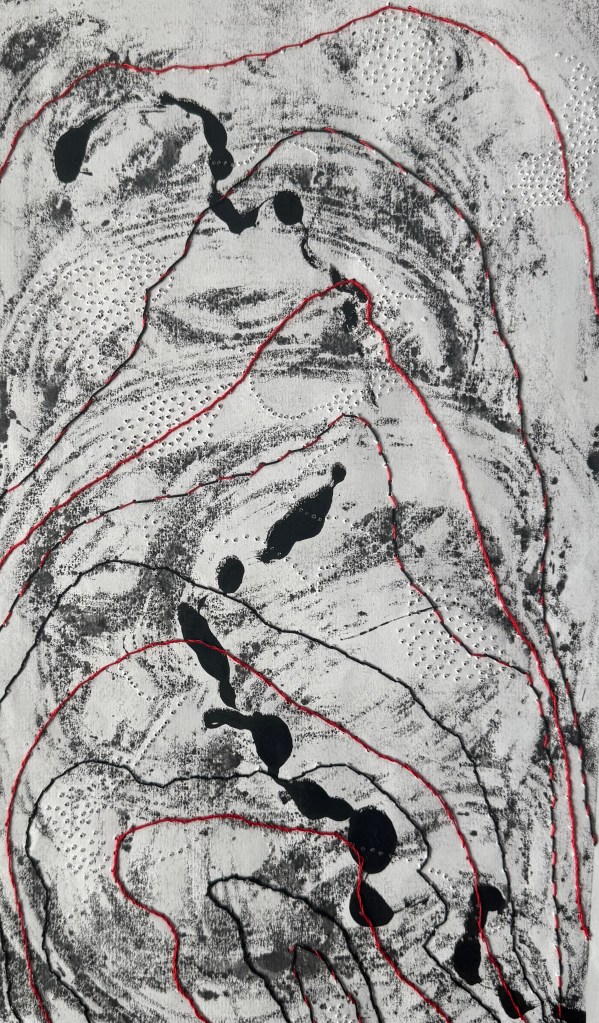
And held up against the window:
I’m still thinking about Shiota’s threads.
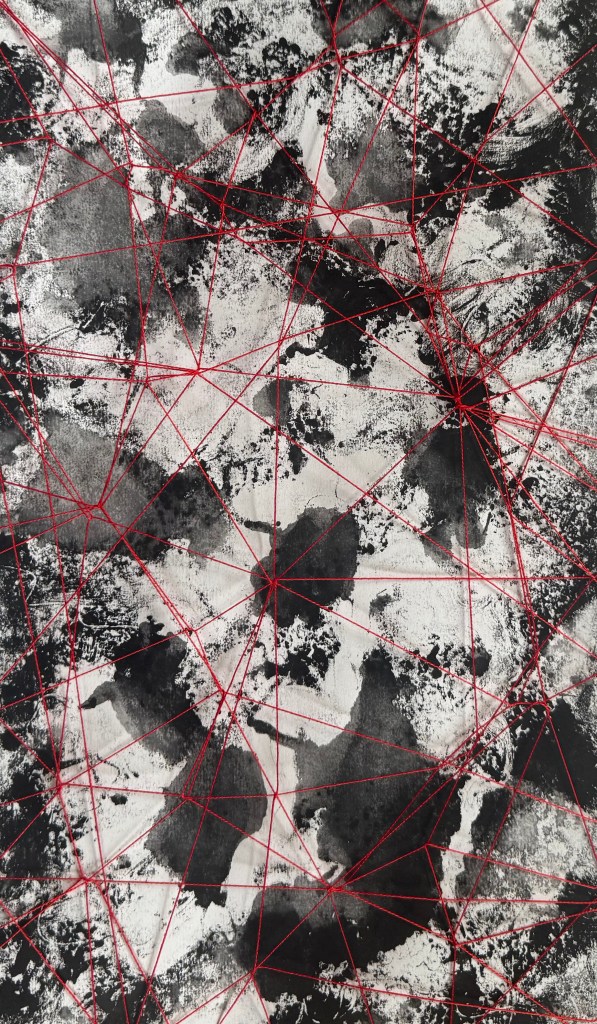
And threads on top of threads.
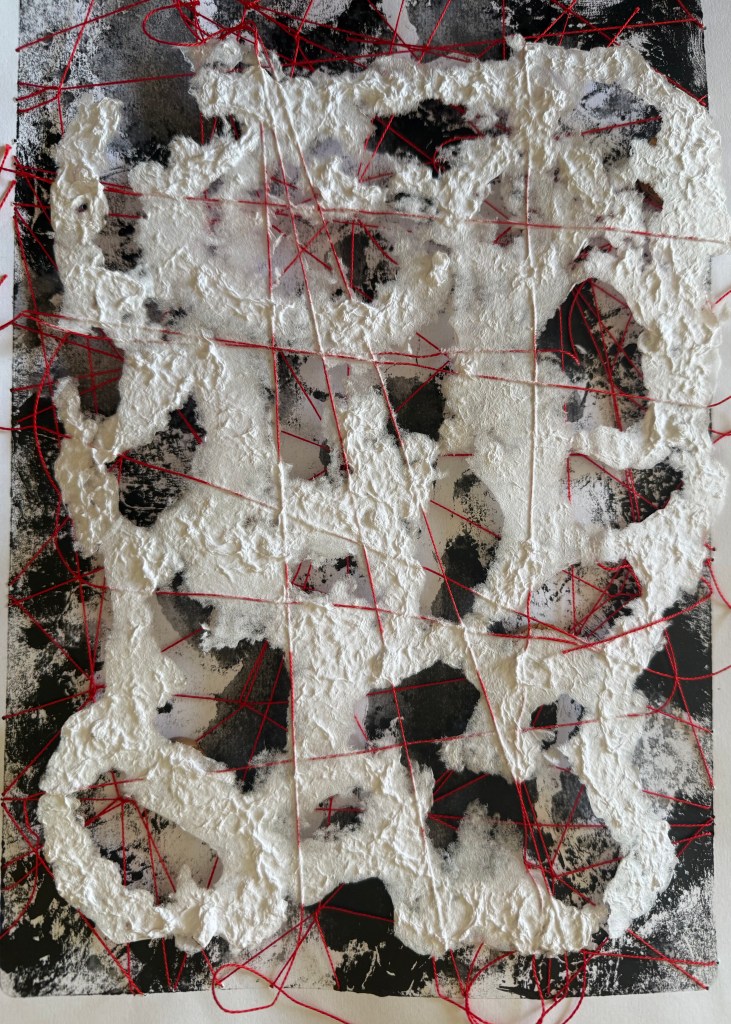
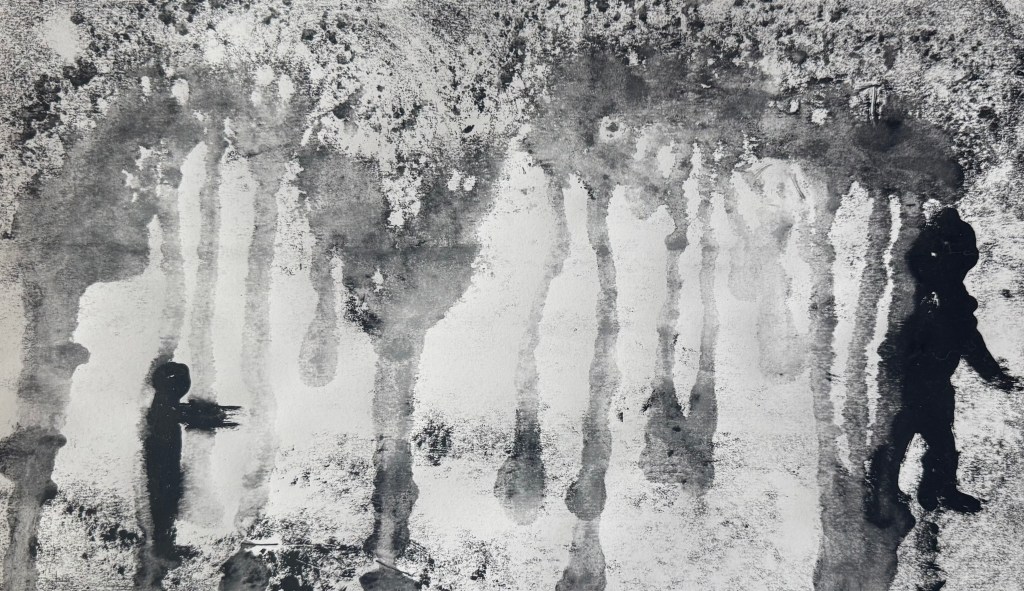
Originally in this post, I wrote about an incident in my childhood in which my mother intentionally tried to disassociate herself from me by walking away when I was not feeling very well. I published the post but then deleted the passage. It felt unnecessary because this image is enough.
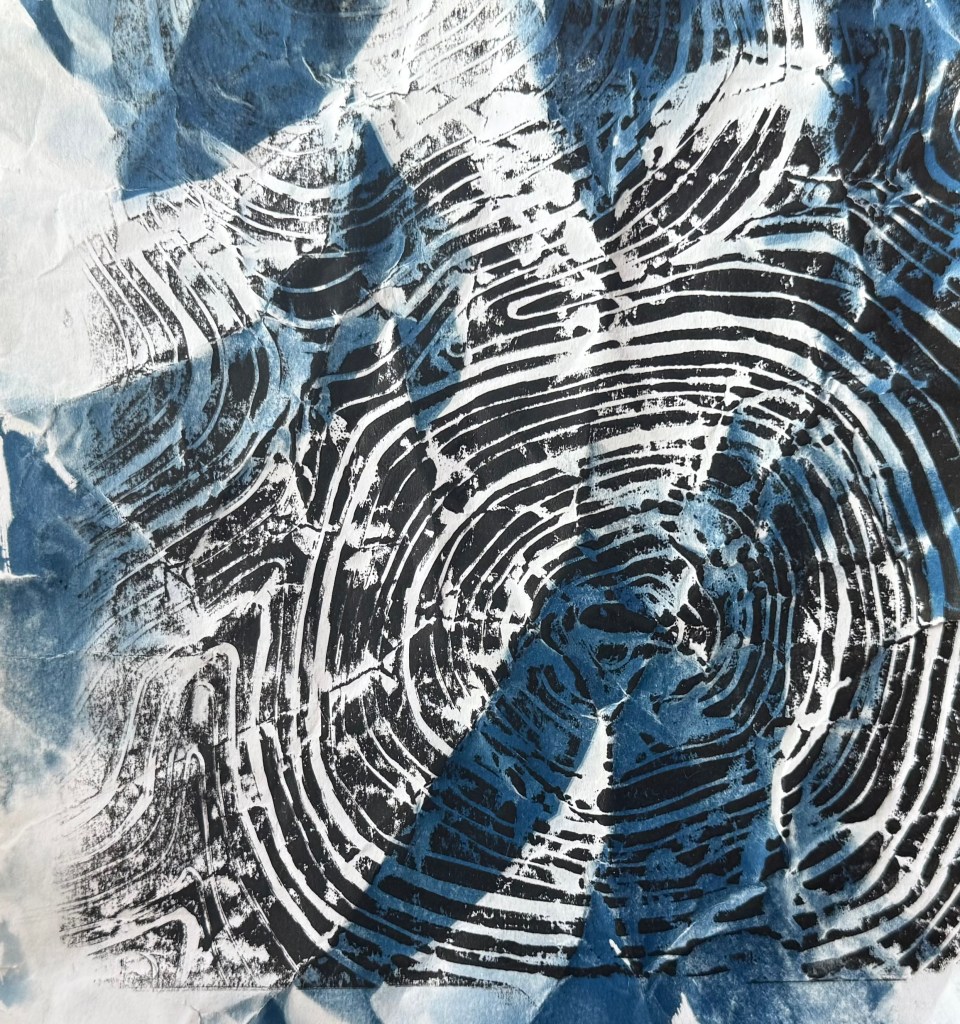
I’m interested in trying combinations of processes, like print over cyanotype. I used a piece of scrap cyanotype for this one and I like the effect – I’ll experiment some more.
Chasing My Tail
I’m conscious that each time I post I’m creating more work for myself in terms of making my book. But there’s so much to think about, to process and to make at the moment.
We started this week’s session by reflecting on the response we had to the prompts last week. It’s quite interesting in that I didn’t, and still don’t, feel concerned about my identity. Maybe it’s because it can’t be defined, because it exists in and is created by my work. It doesn’t seem important to me – I live, I make.
We then looked at adjusting or disrupting our practice, considering whether there is anything we can do which might create new possibilities. We looked at placing ourselves on a line between two points and considering what would happen if we shifted our position between those points.
Material______________________________ Conceptual
Iterative Making ______________________________ Research-based
Intuitive ______________________________ Structured
Continual ______________________________ Periodic
Process ______________________________ Outcome
At first glance I placed myself clearly to either end: material, iterative making, intuitive, periodic and process. But thinking about it more carefully, and discussing the concepts with other members of my group, I began to see that it is not as simple as that.
- I’m very much about materials, but then again I often have a concept in mind eg experimenting with combining specific processes
- I make iteratively, but often there is a period of time in which I consider the work, research how other artists have approached it etc
- I would say that I work intuitively but often that intuition is grounded in the structure of previous experience and knowledge
- I have periods of activity in physical making, but then I’m thinking about things all the time
- I think process v outcome is the only one in which I can say that I am possibly on the side of process although it could be said that outcomes are important in the sense that they feed back into the process of iterative making, and that outcome does not necessarily carry a sense of finality, in the same way as product does.
In a way, for me, they are more like recursive loops than linear continuums (or continua?). It was a helpful exercise as it highlighted to me that I’m neither one nor the other.
We then considered, what are the most important things to do that are not directly making art. In addition, to continuing to be part of a creative community, making space and time is important to me. In The End I talk about my concern that my time will be sucked up by everyday life. This last week has been busy and I’ve been making every day. The consequence is that tasks in everyday life have not been done and are now mounting up, and quite a few meals have been eaten separately. My art making has had a direct impact on home life and it’s not sustainable long term.
Having developed a way of working, I now need to put in place a time and place for working. By having a dedicated work space away from the house, I can try to develop a regular routine of making, physical or otherwise, in which the boundaries are clear and which minimises disruption to everyday life.
What immediately comes to mind is the Ad Reinhardt quote in After Everything Else:
‘one paints when there is nothing else to do. After everything is done, has been taken care of, one can take up the brush. After all the human social needs, pressures are accounted for. Only then can we be free to work.’
A Line Made By Running
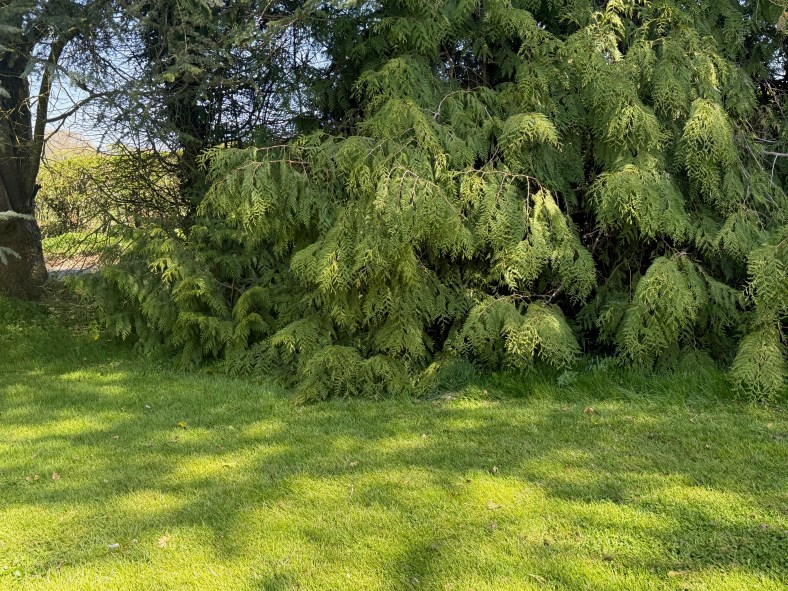
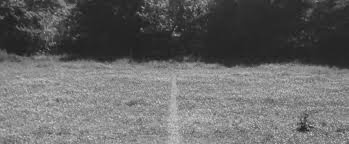
I went out into the garden this morning. Of course I had noticed it before now, but I hadn’t acknowledged it. The path has gone, the grass has regrown and the trace of his physical existence is no longer there. It left me feeling sad. He would run from one end of the trees to the other barking at the cyclists who would greet him as they passed. The path embodied his physical presence.
Video – A Line Made By Running
The line in Richard Long’s A Line Made By Walking (1967), embodied his physical presence in the act of walking and questioned which part is the art, the walking, the line, or the photograph documenting it?
I then started thinking about how dogs see the world and about colour, about whether colour only exists because we perceive it and what the world would ‘look’ like if we didn’t. It took me to the classic question of whether a falling tree makes a sound if no-one is there to hear it. From a scientific perspective it does, because it still creates the sound waves. But what about a banana in a dark room? It still exists even though we can’t perceive it, but is it still yellow? My initial thought was no, because there are no light waves to be reflected or absorbed.
I think that I prefer the scientific view to Berkeley’s idea that ‘to exist is to be perceived‘ in which neither the tree nor the banana exist until we perceive them. But that led me to thinking about whether my work is art when only I perceive it or whether it needs to be perceived by others as being art. I think Merleau-Ponty would say that it is enough that I experience it as art because our perception is embodied in our experience of being in the world. It is art because I declare it to be, the perception of others enhances it and adds to its meaning.
Rightly or wrongly, some rambling thoughts when I’m supposed to be getting on with something else.
What Is My Work About?
Our first two sessions since we’ve been back have made me think – a lot.
This week’s session was about our artistic identity and how to answer the question – what is your work about?
It’s a difficult question to answer. I don’t want to be pigeonholed and I don’t want to be pinned down, which is why I deleted the contents of the ‘About’ page on this blog because it didn’t relate to me anymore, and I’ve been struggling since to think of what to say. I couldn’t think of a way to encapsulate how I see my practice and my work.
But this session has helped me in finding a way forward.
Jonathan showed us a quote by Robert Henri:
‘The object isn’t to make art, it’s to be in that wonderful state which makes art inevitable.’
It resonates with me as I interpret it as meaning that art comes out of a way of being, and that artists should focus on the process rather than the making of a product.
We considered the 6 prompts: idea, material, process, context, identity, and mood.
My responses:
Identity:
A woman who feels like she’s on the back nine of life who has been trying to find herself by reflecting on all that has been, is and will be. After Fatemeh mentioned the Iranian philosopher who said that his identity was a lover and his job was to love, I think I’ll change mine to a living maker who lives and makes.
Context:
My lived experience
Process:
Drawing, painting, photography, video, printing, sewing, paper-making, mark-making, playing, whatever feels right in the moment.
Material:
ink, pencil, paint, fabric, paper, canvas, paper, thread, charcoal, pastel, whatever feels right in the moment
Mood:
Exploratory, experimental, fluid, reflective
Idea:
The reiteration of shaping what I make and in turn being shaped by what I make.
A possible short answer: My work is an exploration of becoming; how I shape what I make and how it shapes me in return. I work fluidly across a range of materials and processes from print and drawing to video and photography allowing each piece of work to evolve naturally through experimentation. My work is rooted in my lived experience both past and present, reflecting on an ongoing shifting sense of self.
I like the reference to fluidity, it reminds me of my earlier thoughts and videos about flow and flux. It needs further work, but will do for the time being.
Space
I’ve been thinking about life afterwards.
I need a space of my own, a place where it takes positive effort to find me. I have such a space and at the beginning of the course I said that I would sort it out, in the third post on this blog, embarrassing, but not surprising – That Sunday Feeling…
That is what I will do. In fact, I have recently started trying to sort out the stuff which currently inhabits the space – a collection of this and that from our past and our parents’ past. I came across some of my old exercise books from school, covered in pages from Smash Hits magazine, which my mother would buy me on Fridays, which was shopping day, together with a yoghurt and a chocolate bar. I also had several pieces of fruit that were to last me the week, and which sat in the fruit bowl on the dining table, slowly decomposing.
My daughter couldn’t get over how neat my handwriting was. My handwriting is a standing joke in our family – I should have been a doctor, apparently. What I noticed was the frequency with which it changed – experiments in mark-making.
Neatness was something which was commented on and leaving space for your work to breathe wasn’t encouraged.
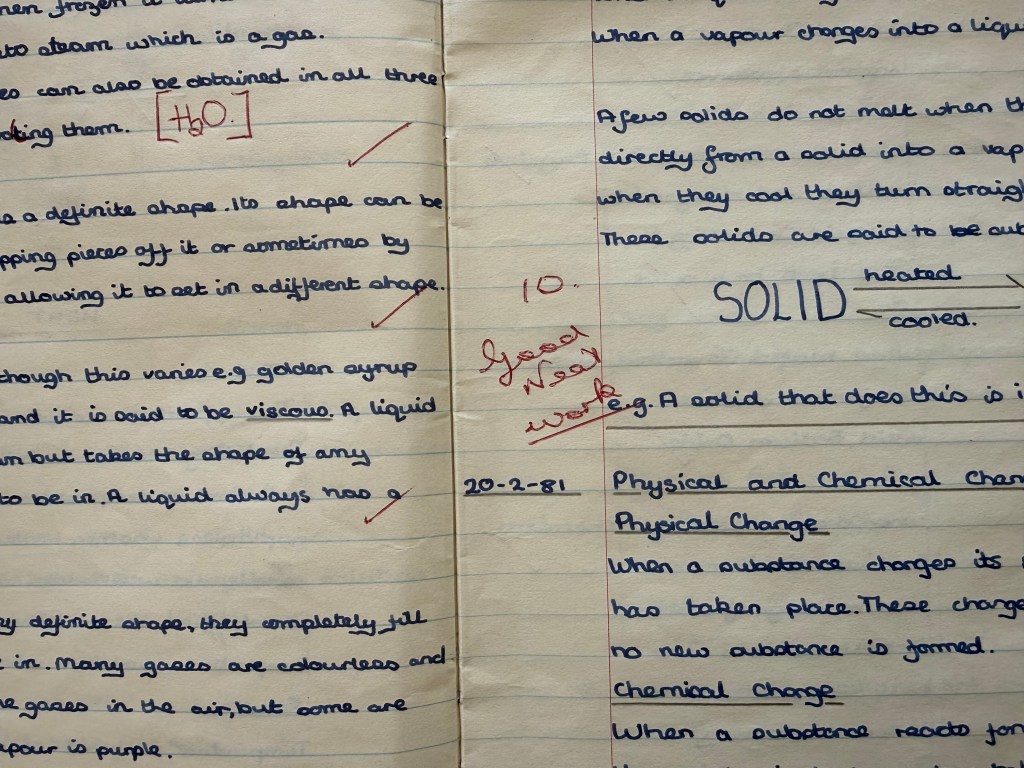
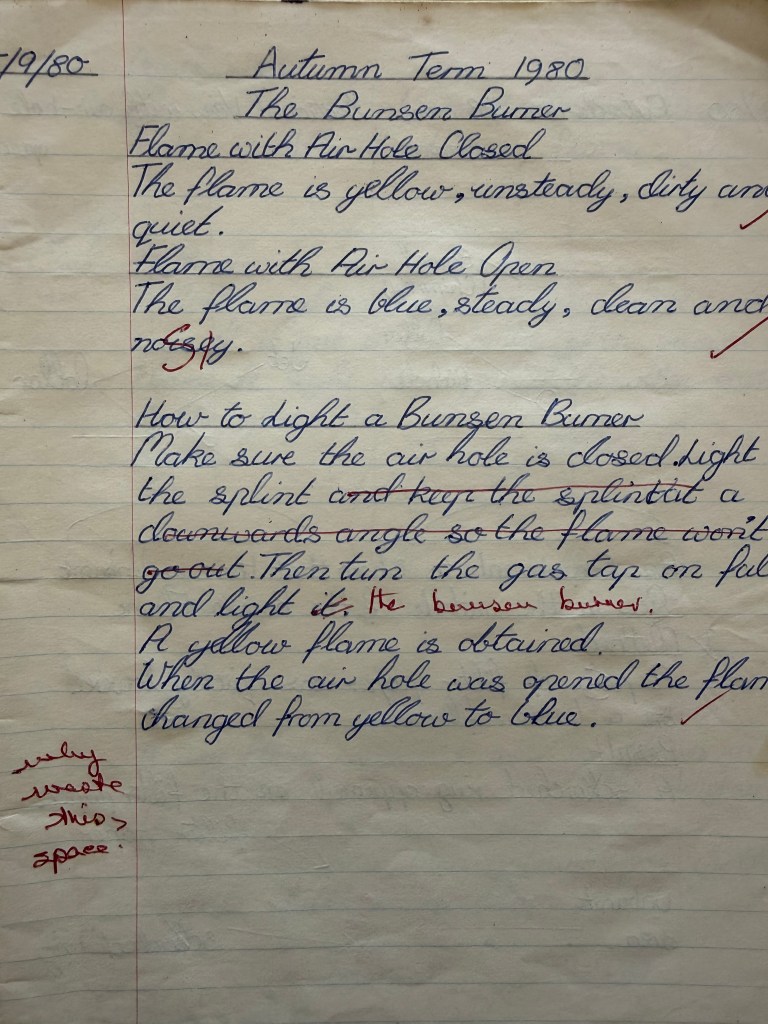
My sister had obviously got her hands on them when she was a child living out her dreams of becoming a teacher. She even gave me a lower mark than the teacher. But I’m glad to see that I had my priorities right at that age: I liked drawing, pop music, going to parties and discos, and also boys.
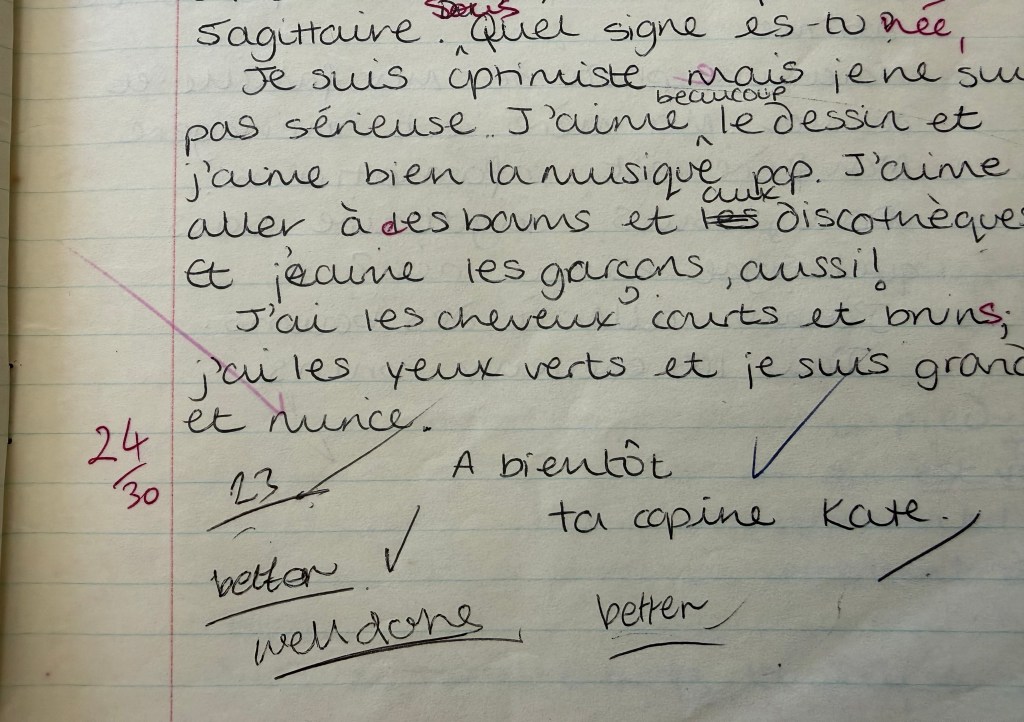
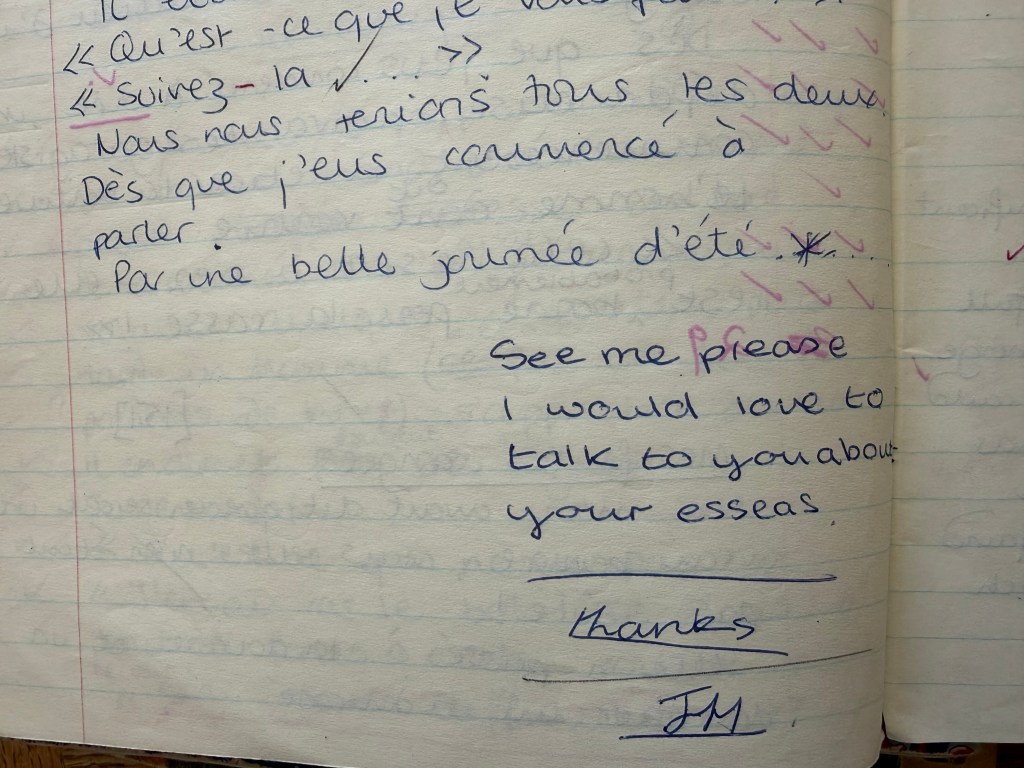
I suspect that I will discover a wealth of material to prompt further work.
My Best
‘…the sane human being is satisfied that the best he/she can do at any given moment is the best he/she can do at any given moment…’ Art & Fear.
A question I’ve been asking myself recently is whether I have done my best over the last two years. Yes, I think I have. Yes, I could have spent more time making, but even if I had, I don’t think that I would be in any different position than I am now. What I have done has been enough to enable me to see that I have discovered my way of thinking, seeing and making. There are things that I had hoped to explore within the structure of the course, such as my childhood in my grandmother’s village, but circumstances have not allowed me the time to do so. No matter – it is a project for the future, something to look forward to.
I never used to have this attitude. I always had to do my absolute best, I had to fix everything and in my head I was the only person who could do it. I decided to become a parent and so I would be the best mother that I could be. Fortunately, (or maybe not), I was able to give up work and stay at home, devote all my time and energy to my new job. I tried all sorts of things from puréeing superfoods to baby Beethoven dvds and playing educationally stimulating cds in the car which used to drive me round the bend. I kept up to date with all the new advice being dished out by ‘professionals’ as to how to be a good parent.
I wish that I’d seen this:
You’re Not the Architect of your Children
And I put my hands up to having been a helicoptering mother who carried out her own 360 appraisals as to how well she was doing as a mother by looking at the success of her daughter – how well is she doing at school, how many friends does she have etc.? I’m not entirely sure how it all came about – maybe because I was brought up with the belief that if a job’s worth doing, it’s worth doing well. I stopped being that parent years ago, but I wish that I’d done it sooner.
Some might say that having given up work, I was somehow validating myself through my daughter and there might be a small element of truth in that but, with hindsight, I can now see it for what it really was – a coping mechanism – a practical way to try and deal with a situation which was emotionally overwhelming. And that’s what I do when I feel that way – I try to exert some control. If you were to ask me what the most momentous events in my life have been, my answer would probably be having a child and experiencing the possibility of losing her, and the death of my parents. In both instances I felt overwhelmed, by responsibility, fear, vulnerability and grief. Not having fully processed those feelings of overwhelm has affected how I have related and responded to circumstances since.
This course has given me the time and space to come to that realisation and to begin to process. One might argue that all I needed was a break from everyday life or therapy, but there is something intrinsic within this course and the making process that has brought me the clarity I needed – the process within which I felt able to relinquish control; to experiment and to accept where the process led me, to lean into the uncertainty and not to resist it.
Ideas
Often as I’m scrolling through Instagram I’ll save posts which interest me, that create effects or demonstrate processes which I want to try out. I get inspiration from a whole range of sources and often this includes other people’s thoughts, writings or art work. I suppose this goes back to Will Gompertz’s view that there is no such thing as an original idea (Part One: Think Like An Artist), but even so where I know that I have been directly influenced by someone I do acknowledge it – Do Ho Suh, Shiota, Rebecca…
But then what about situations where the influence is subconscious? I was listening to the radio on the way home the other day and an author was being interviewed about one of his novels. The interviewer asked whether it had been written as an homage to a film made by one of his favourite directors and which shared a very similar plot line. The author’s response was awkward. He acknowledged that he knew of the film and thought highly of it, but that he hadn’t written the novel as a direct homage, although he had possibly been indirectly influenced by it. I wondered afterwards why the exchange had seemed, to me at least, a tad uncomfortable.
When considering an issue it is often helpful to turn the tables, so, what would I do if someone took an idea of mine and made it their own? I suppose that I should feel flattered but I’d probably feel irritated. Would I feel any better if my influence was acknowledged? Most definitely. But why is this? Shouldn’t I just accept that once it is out there it is anyone’s, part of Brian Eno’s scenius? After all, there is no property in an idea as an abstract form.
Something to ponder.
The End
This week’s session centred on the Unit 3 assessment and the end of year show.
It was interesting listening to others talking about their planned pieces and how they could be displayed within the space. I can’t deny that I had a small flicker of panic that I don’t have a singular large finale piece in mind. But on the whole I felt quite calm and relaxed about it. Fingers crossed, I will hopefully have my book which is A5 in size. I would also like to show a larger piece but I think that is yet to come. For the time being, I’m feeling confident that something will emerge from my ongoing experimentation over the coming weeks. I just need to be mindful of elements that might be time dependent such as drying etc.
Josh then said it out loud. He acknowledged the end of the course. We then had a moment reflecting on how we feel about it. Eleana commented that she had asked herself whether she would want to repeat the experience (yes) and Rebecca mentioned that she is dealing with it by having plans and making work which go beyond its end date. Personally, I wouldn’t want to repeat it. There was a time when I wondered whether I could apply again, but on reflection I wouldn’t want to go back to the beginning – I have made so much progress. What I would like is for it to continue because I like the structure and I like the people, but that’s not possible, although we can always stay in touch with each other and use the structure and the way of working which we have developed within the course to carry us forward.
I feel that I now have the tools to continue to develop as an artist beyond the end of the course. The problem is time. My fear is that once the structure has gone I will slip into old ways, of allowing the everyday things and the needs of others to suck up my time. At the moment, others accept that I spend periods of time making because there is a reason – the course. But when it is gone I need to find a way to ensure that I keep that time for myself and that others respect it. I think carrying on the blog will be fundamental to this. One can’t really post about the making of work without making it. I also need to think about my future goals and how I might achieve them.
The Accidental and the Incidental
I wanted to make some marks – layers of marks – and so I took some A2 paper and used charcoal, pastel, an eraser and a pen.
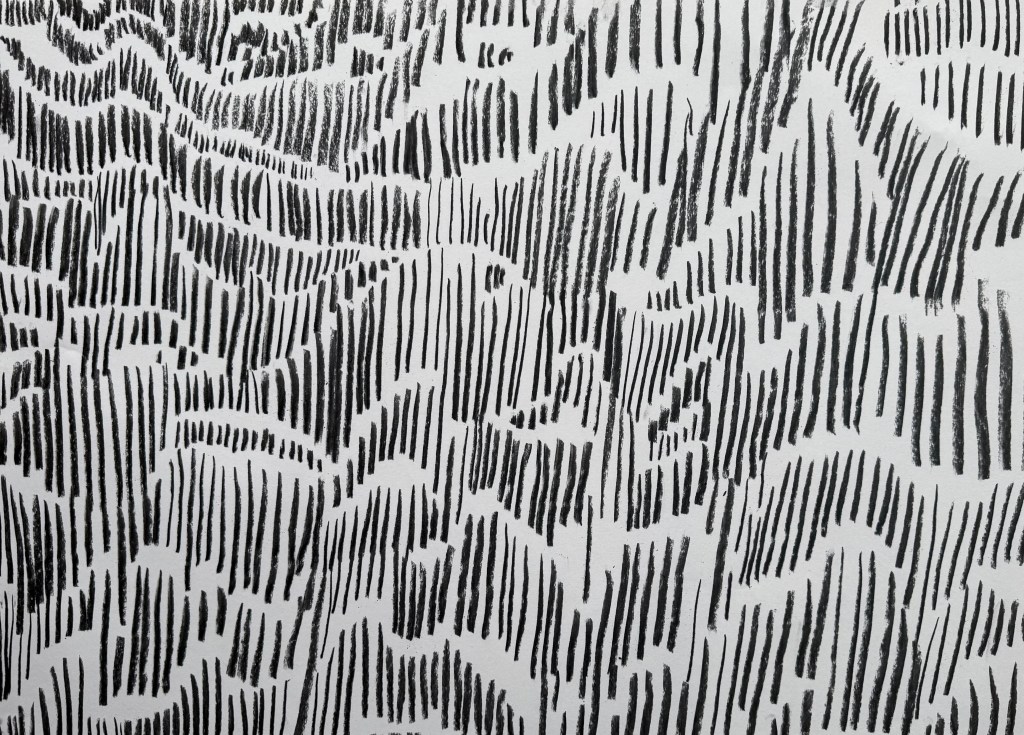
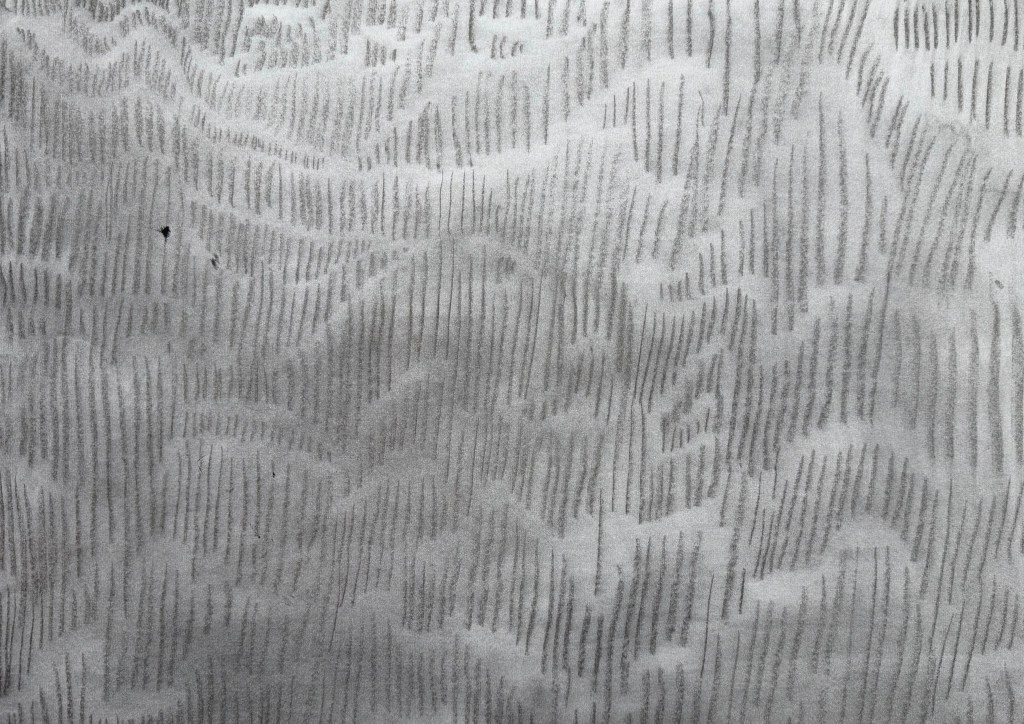
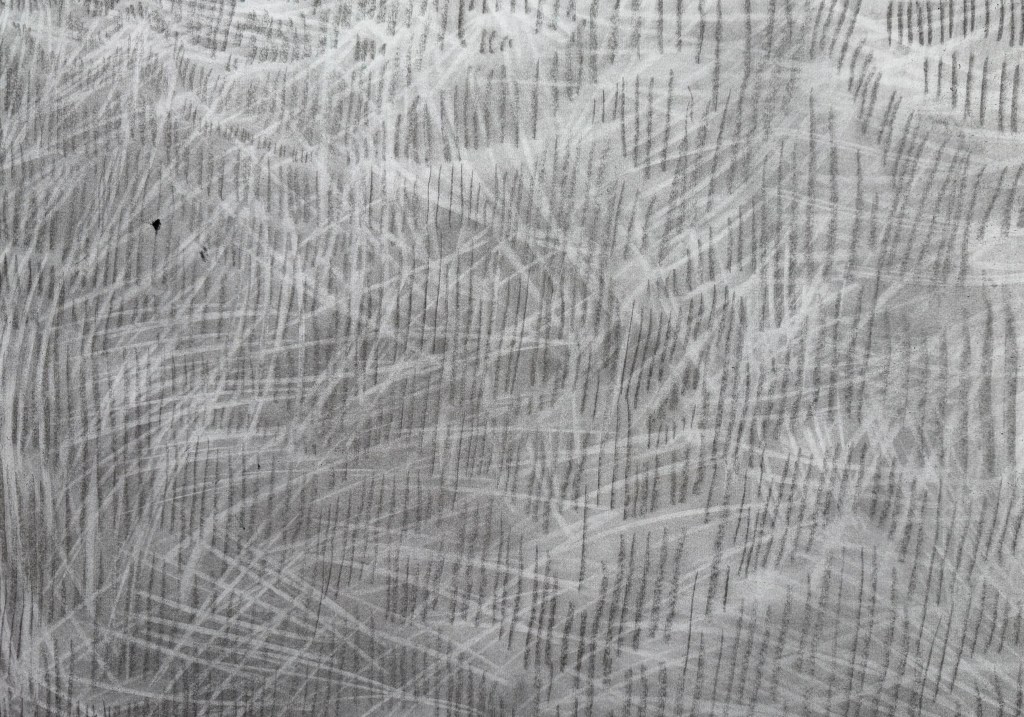
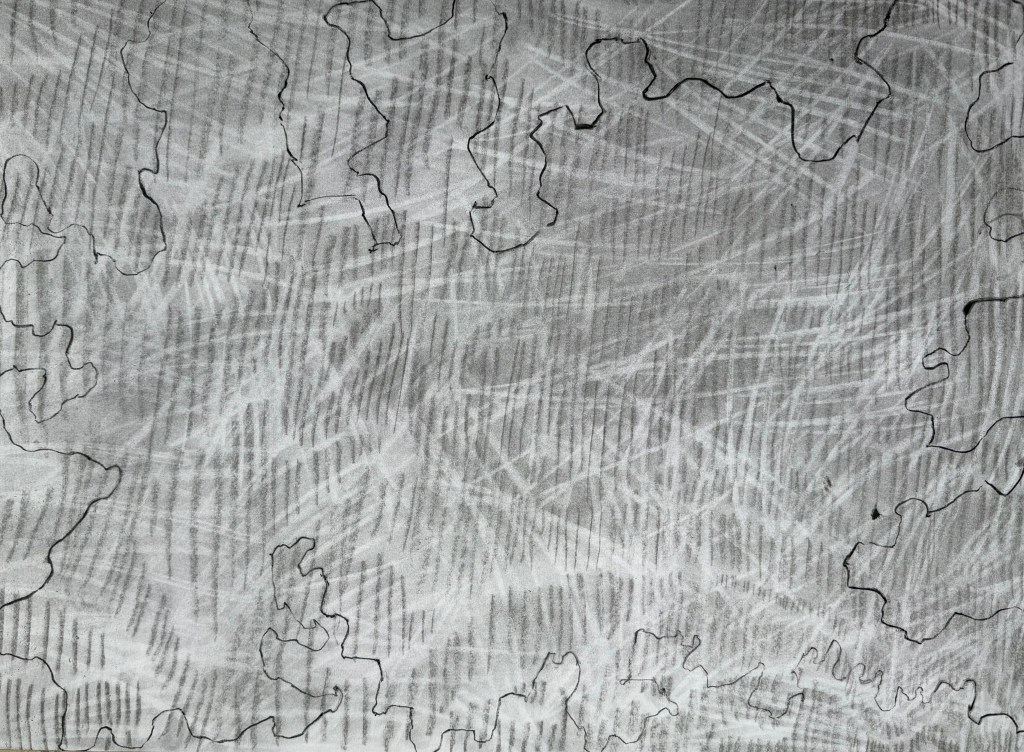
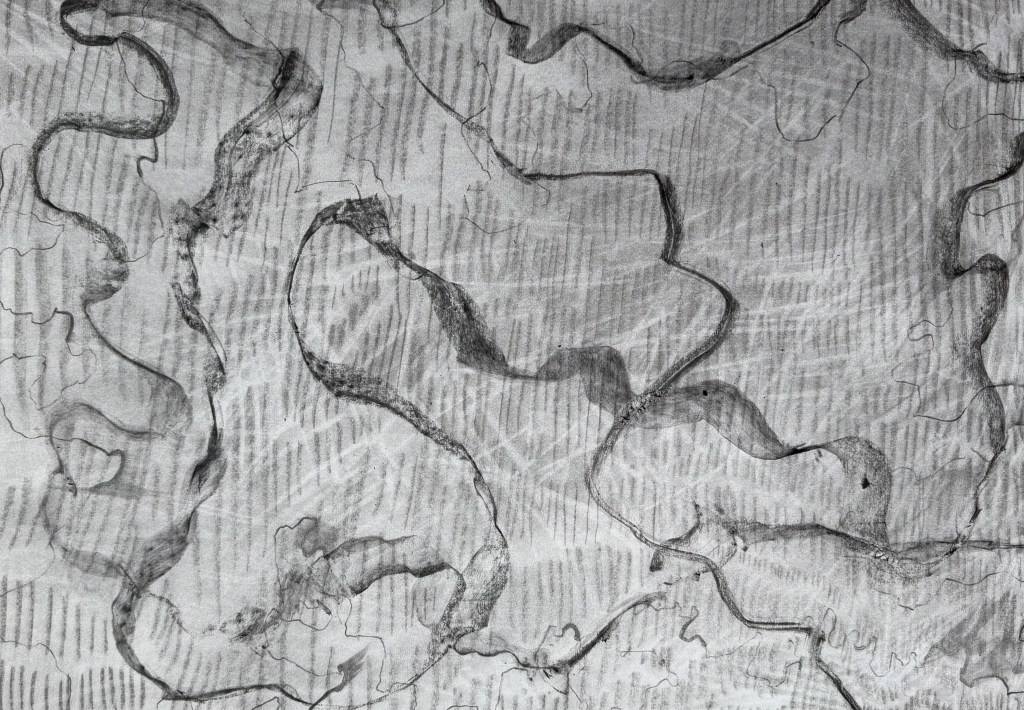
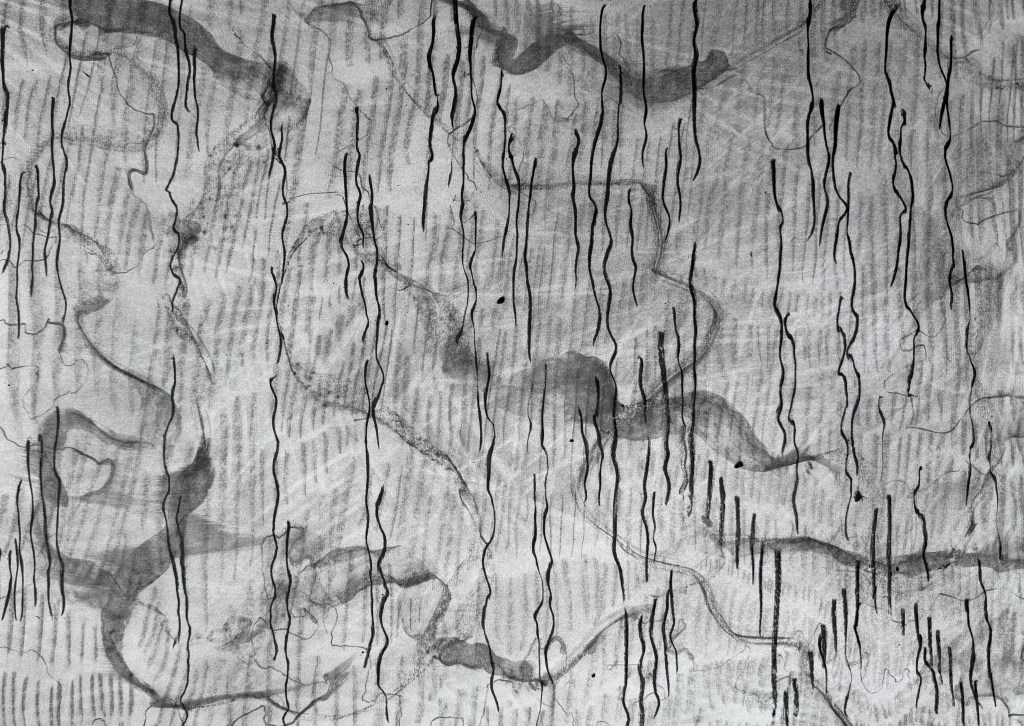
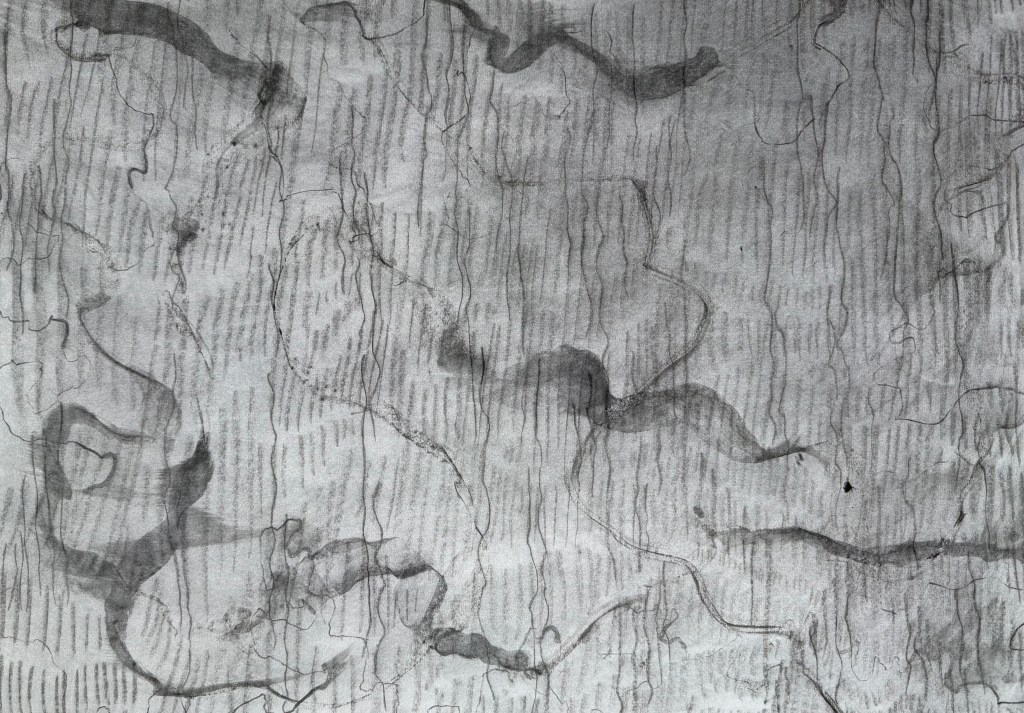
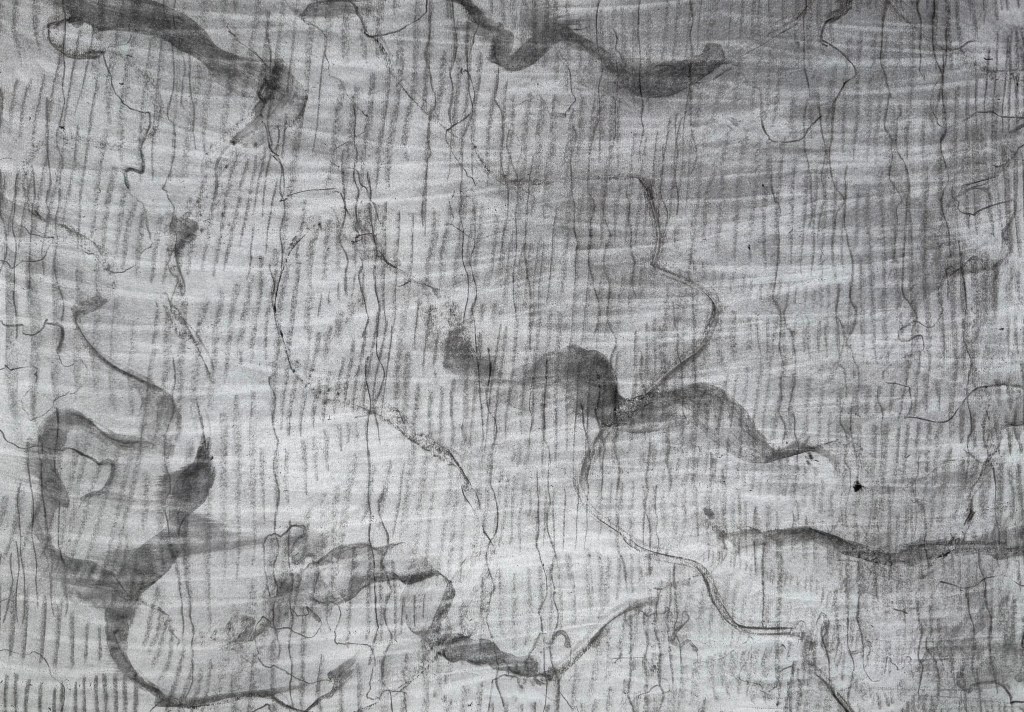
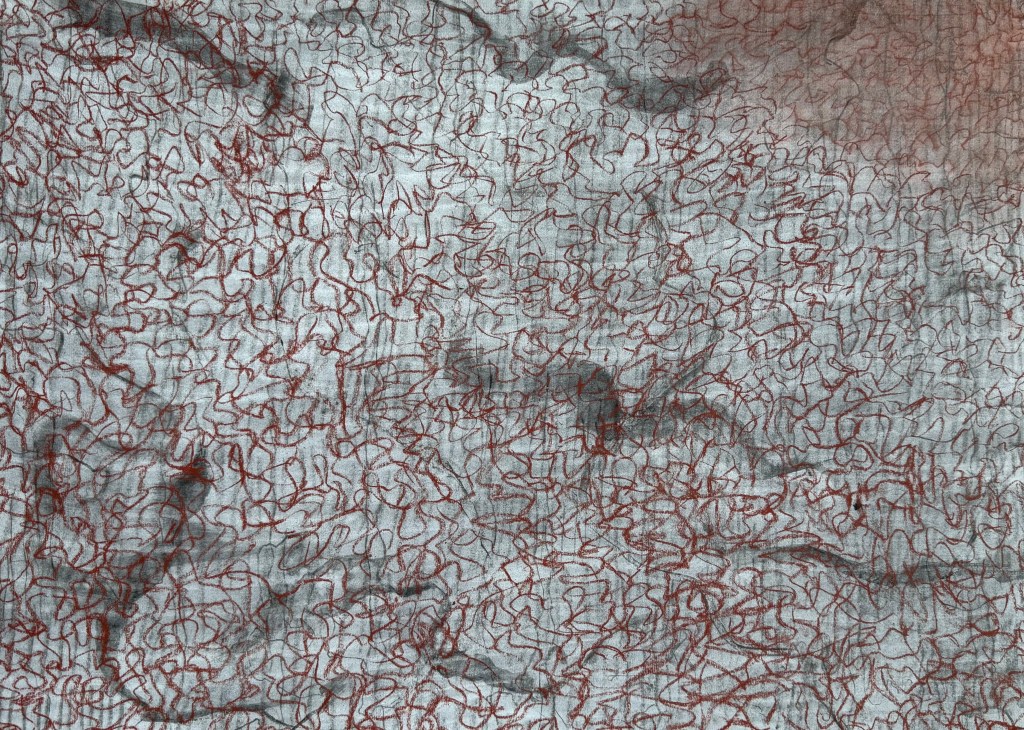
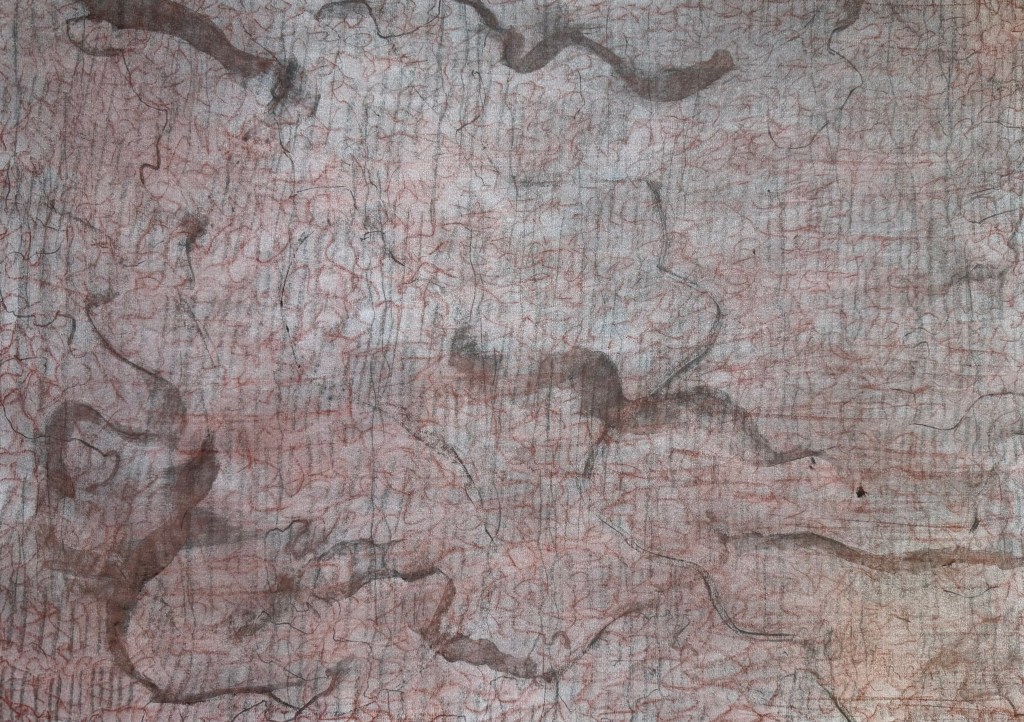
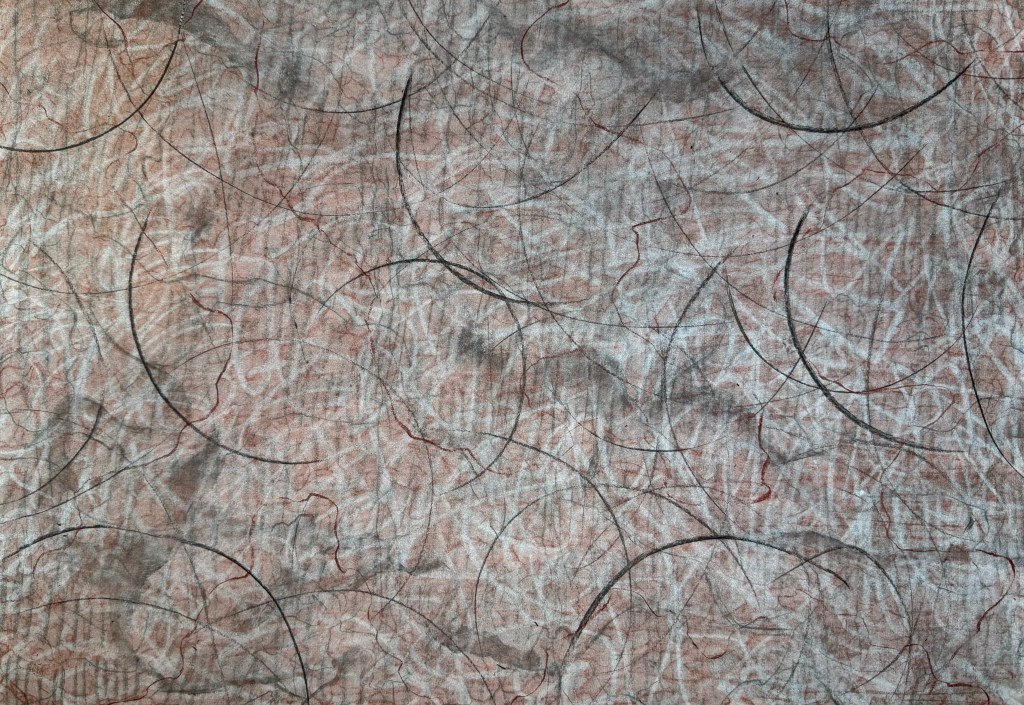
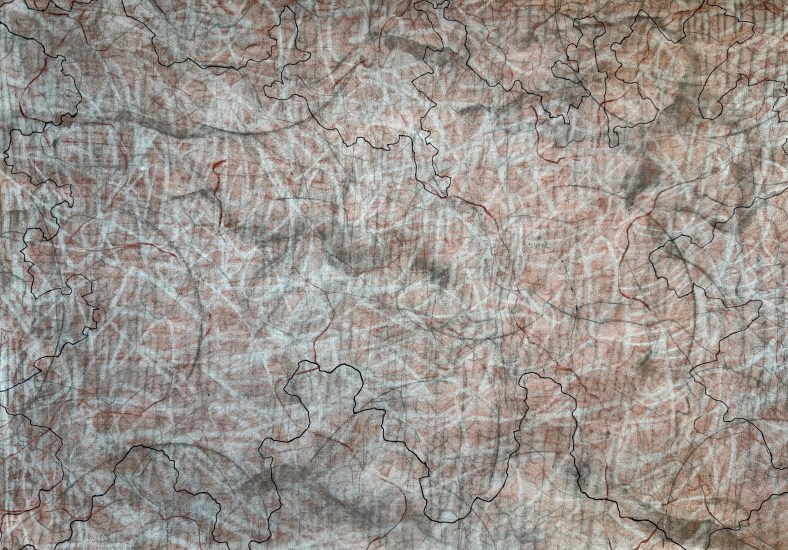
It wasn’t meant to be anything. I thought that I might use it as a base for something else. I had been wanting to have another go at overprinting the linocut image from Never Say Never. In that post I comment that the shapes look like crouching figures – in retrospect they are foetal-like. The subject of microchimerism has come back to my mind recently and I thought that the idea of making the ink more transparent with each print could touch on that. Also, the marks underneath would also become increasingly visible. I gave it a go but I made a hash of the ratio of ink to extender, and I couldn’t find the new tube of extender so I just added some white which, of course, made the print totally opaque, which wasn’t the original intention.
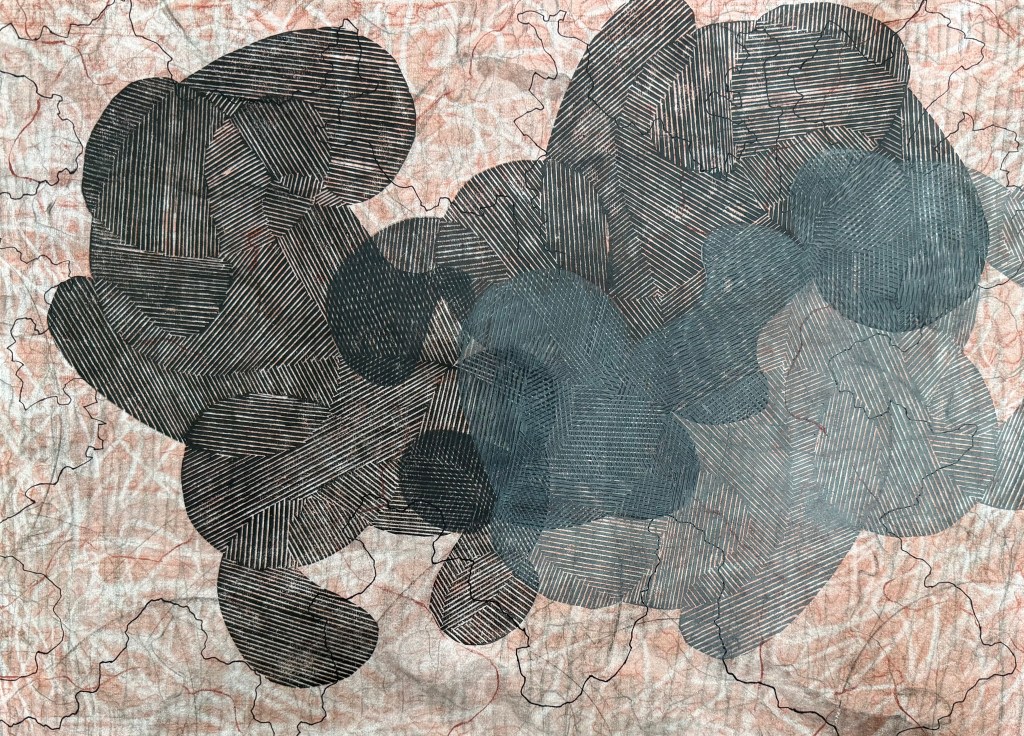
I left it for a while and got on with other tasks relating to the book and when I revisited it I thought about umbilical cords (something I have referenced previously in Sisters). I thought I might use some of the red thread that I had for my paper experiments to sew some kind of twisting cords which then made me think of using black stitching to delineate between the three shapes. I used a blanket stitch on the second shape as I’d seen at her Tate Modern exhibition that Tracey Emin had used it on her blankets to give a less defined line.
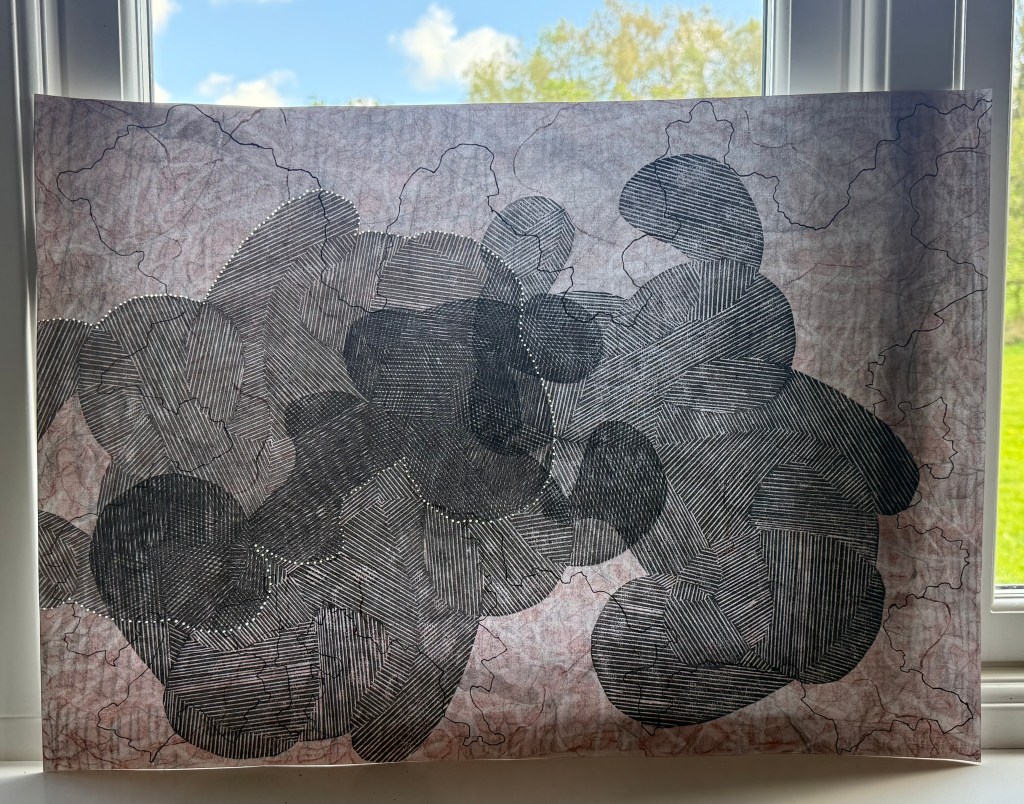
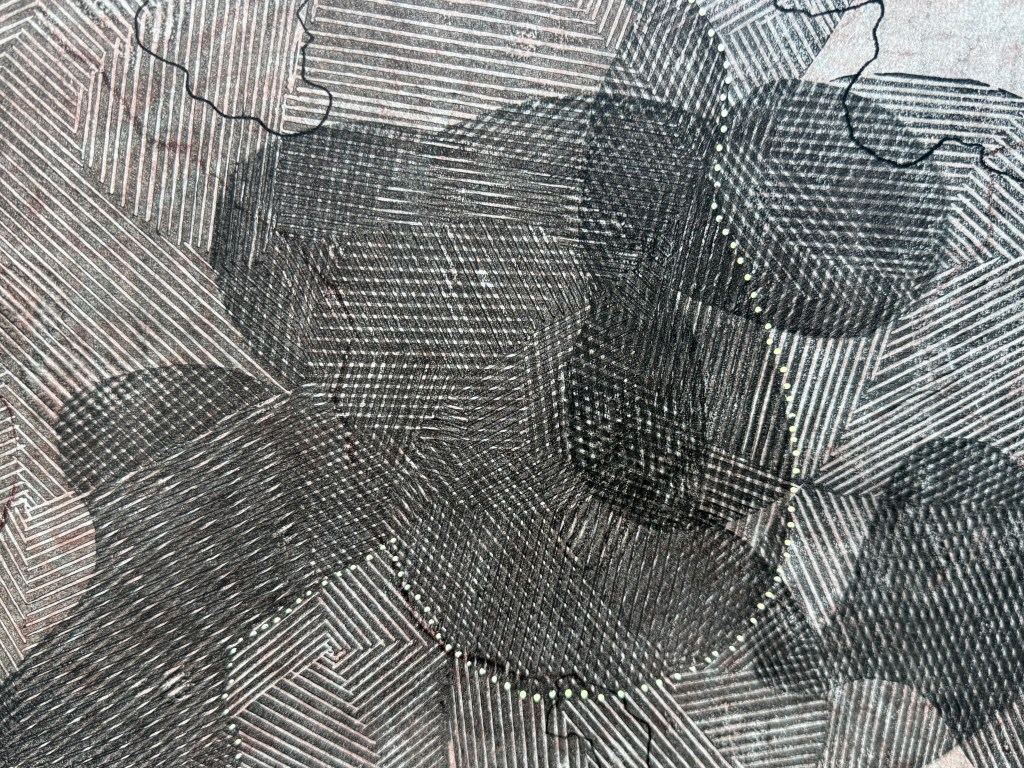
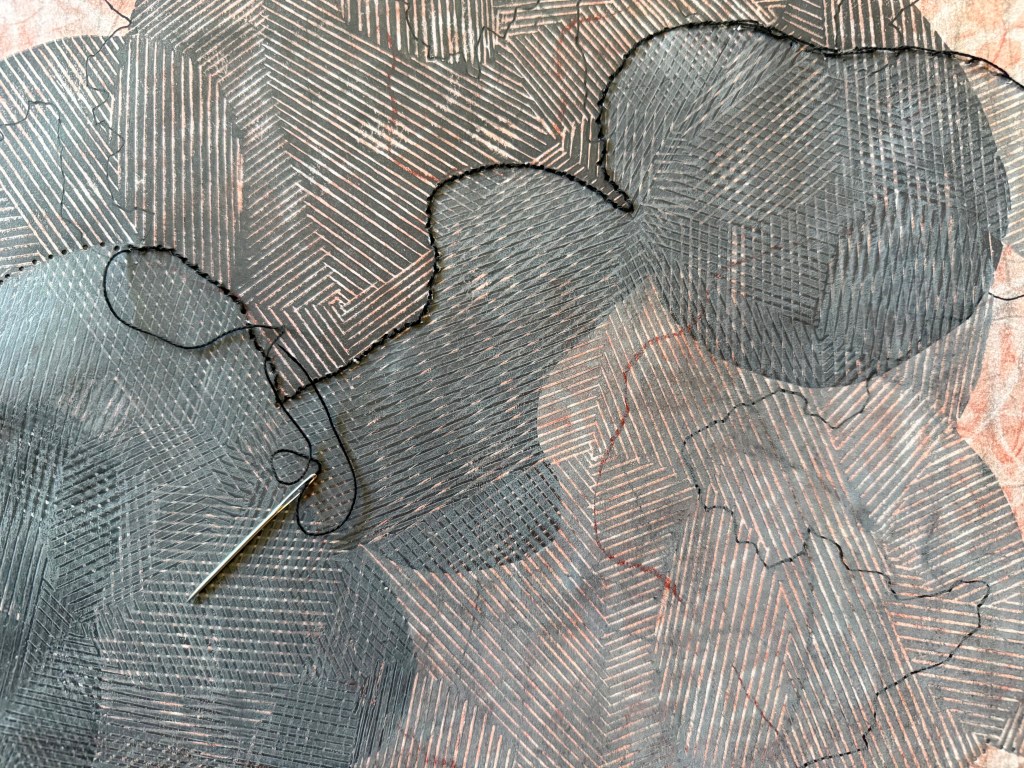
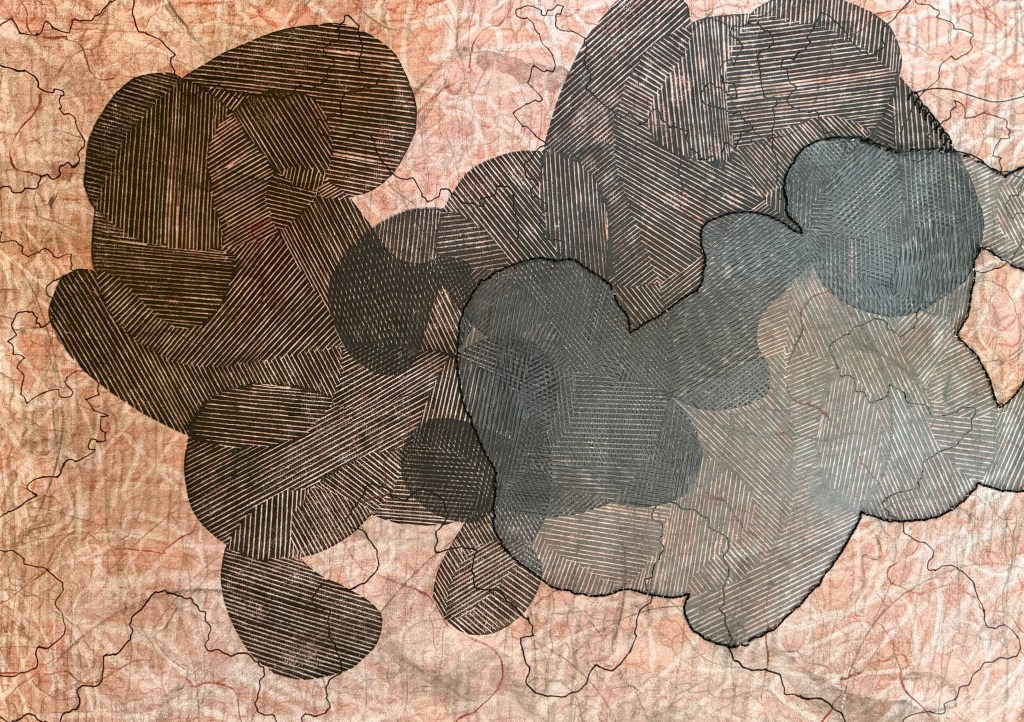
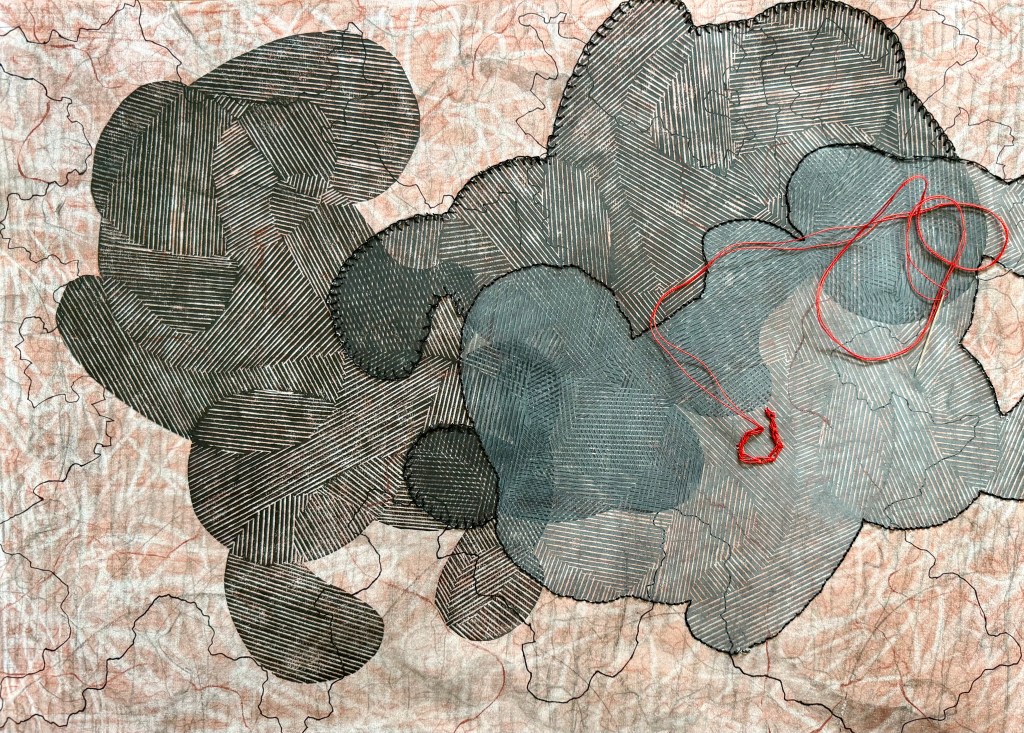
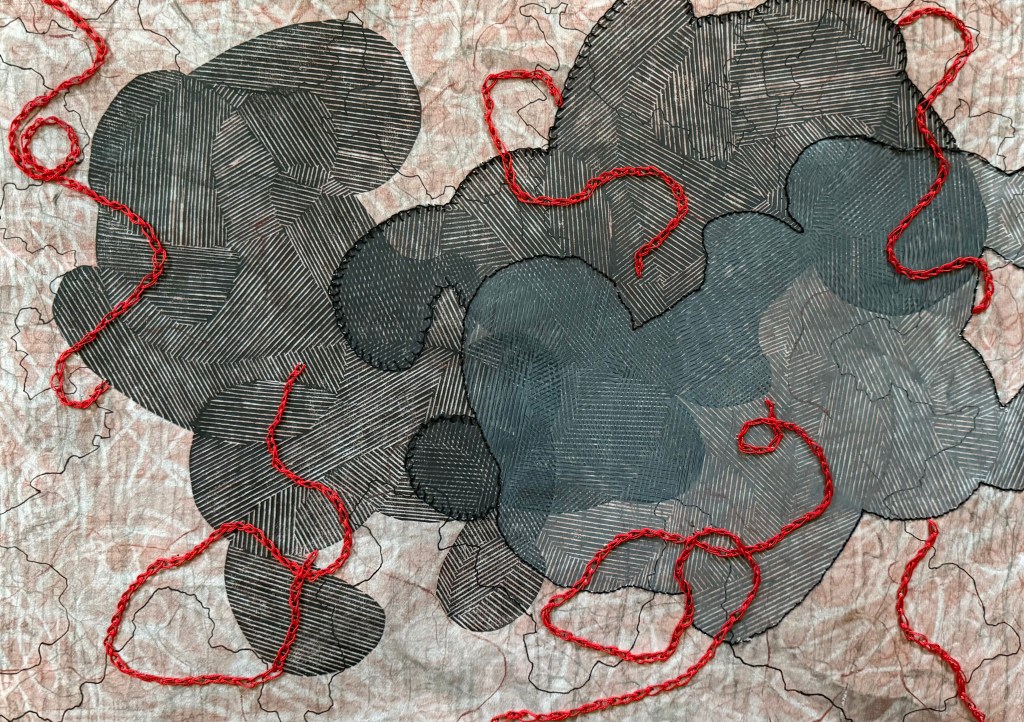
I’m really chuffed. I was thinking as I was sewing that maybe I should have planned where I was going to go, but then decided that, no, I liked the spontaneity of it all. Would I have done anything differently? No. How did I feel as I was making it? I felt pleasure, at all stages. I enjoyed the making of it and I like how it turned out. In fact, over the last few months (Summer Exhibition aside) I have really enjoyed making. That’s not to say that I haven’t enjoyed the process of making before then – I have, particularly the experimenting and and the wandering, it’s just that recently I have felt contented, as if some things have fallen into place. I particularly enjoyed the experiments with lino cuttings and packaging, and I’m really happy with the video that I made.
I think that it comes down to the accidental and the incidental; the unexpected that happens in the process and the small things I notice within the process which then lead to something else.

