Chasing My Tail

I’m conscious that each time I post I’m creating more work for myself in terms of making my book. But there’s so much to think about, to process and to make at the moment.

We started this week’s session by reflecting on the response we had to the prompts last week. It’s quite interesting in that I didn’t, and still don’t, feel concerned about my identity. Maybe it’s because it can’t be defined, because it exists in and is created by my work. It doesn’t seem important to me – I live, I make.

We then looked at adjusting or disrupting our practice, considering whether there is anything we can do which might create new possibilities. We looked at placing ourselves on a line between two points and considering what would happen if we shifted those points.

Material______________________________ Conceptual

Iterative Making ______________________________ Research-based

Intuitive ______________________________ Structured

Continual ______________________________ Periodic

Process ______________________________ Outcome

At first glance I placed myself clearly to either end: material, iterative making, intuitive, periodic and process. But thinking about it more carefully, and discussing the concepts with other members of my group, I began to see that it is not as simple as that.

  • I’m very much about materials, but then again I often have a concept in mind eg experimenting with combining specific processes
  • I make iteratively, but often there is a period of time in which I consider the work, research how other artists have approached it etc
  • I would say that I work intuitively but often that intuition is grounded in the structure of previous experience and knowledge
  • I have periods of activity in physical making, but then I’m thinking about things all the time
  • I think process v outcome is the only one in which I can say that I am possibly on the side of process although it could be said that outcomes are important in the sense that they feed back into the process of iterative making, and that outcome does not necessarily carry a sense of finality, in the same way as product does.

In a way, for me, they are more like recursive loops than linear continuums (or continua?). It was a helpful exercise as it highlighted to me that on the whole, I am not necessarily one thing or another.

We then considered, what are the most important things to do that are not directly making art. In addition, to continuing to be part of a creative community, making space and time is important to me. In The End I talk about my concern that my time will be sucked up by everyday life. This last week has been busy and I’ve been making every day. The consequence is that tasks in everyday life have not been done and are now mounting up. Others have been wandering around rather aimlessly at times, and quite a few meals have been eaten separately – my art making has a direct impact on home life and to a certain extent that validates questions about time spent by me making art. In an ideal world, I could say that it’s time for everyone else to step up, and they do from time to time, but in the real world it’s not sustainable long term.

Having developed a way of working, I now need to put in place a time and place for working. By having a dedicated work space away from the house, I can try to develop a regular routine of making, physical or otherwise, in which the boundaries are clear and which minimises disruption to everyday life.

It’s funny, because what immediately comes to mind is the Ad Reinhardt quote in After Everything Else:

one paints when there is nothing else to do. After everything is done, has been taken care of, one can take up the brush. After all the human social needs, pressures are accounted for. Only then can we be free to work.’
Space

I’ve been thinking about life afterwards.

I need a space of my own, a place where it takes positive effort to find me. I have such a space and at the beginning of the course I said that I would sort it out, in the third post on this blog, embarrassing, but not surprising – That Sunday Feeling…

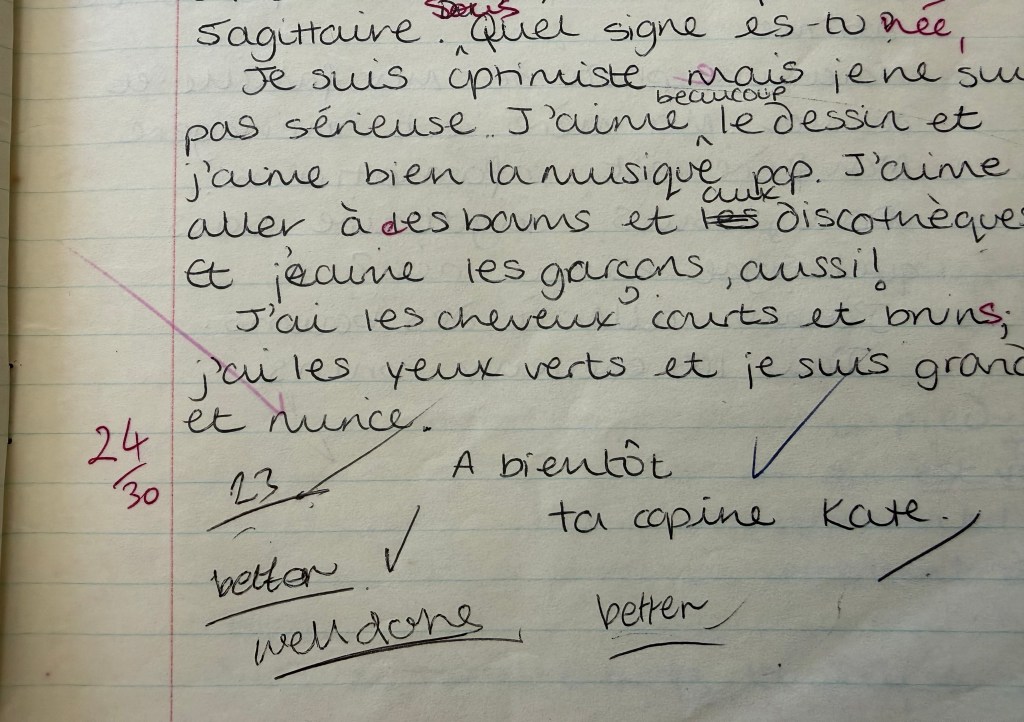
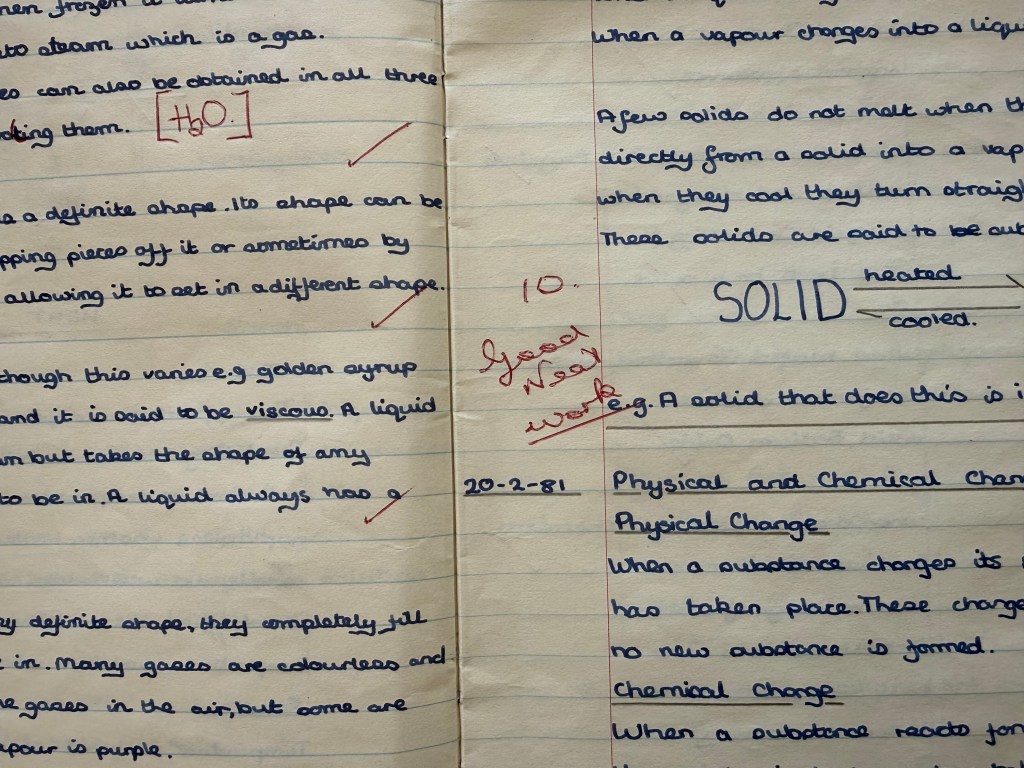
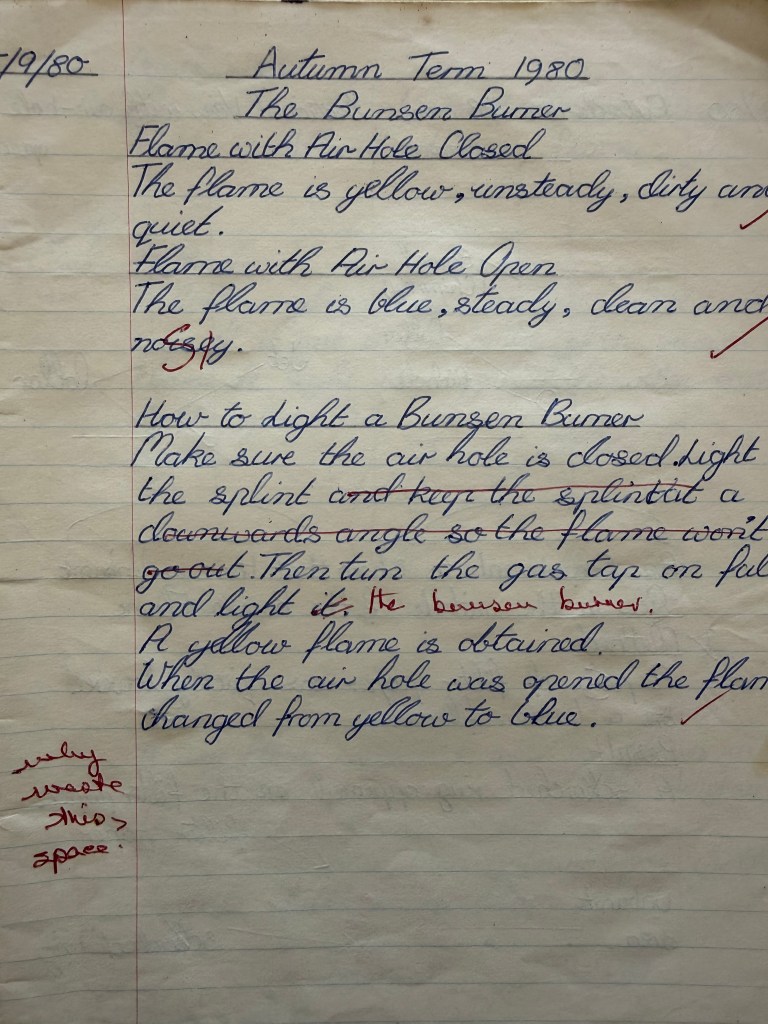
That is what I will do. In fact, I have recently started trying to sort out the stuff which currently inhabits the space – a collection of this and that from our past and our parents’ past. I came across some of my old exercise books from school, covered in pages from Smash Hits magazine, which my mother would buy me on Fridays, which was shopping day, together with a yoghurt and a chocolate bar. I also had several pieces of fruit that were to last me the week, and which sat in the fruit bowl on the dining table, slowly decomposing.

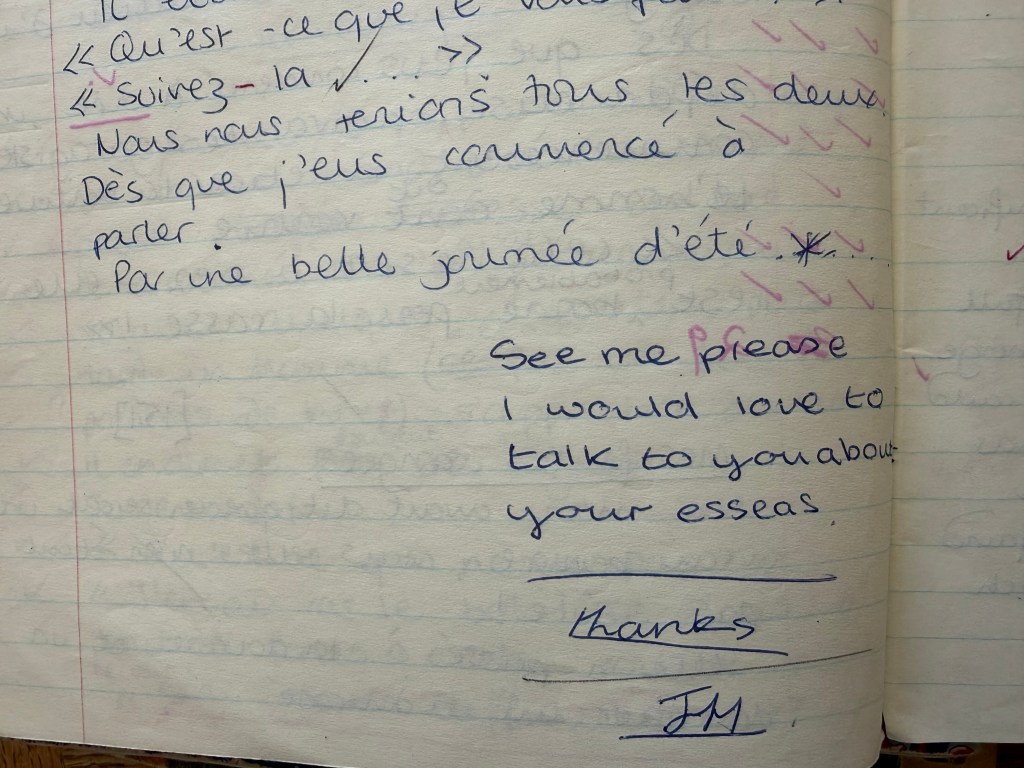
My daughter couldn’t get over how neat my handwriting was. My handwriting is a standing joke in our family – I should have been a doctor, apparently. What I noticed was the frequency with which it changed – experiments in mark-making.

Neatness was something which was commented on and leaving space for your work to breathe wasn’t encouraged.

My sister had obviously got her hands on them when she was a child living out her dreams of becoming a teacher. She even gave me a lower mark than the teacher. But I’m glad to see that I had my priorities right at that age: I liked drawing, pop music, going to parties and discos, and also boys.

I suspect that I will discover a wealth of material to prompt further work. This is the right time.

Figuring It Out

I’ve started back at my weekly art class after the Christmas break, and over the last two sessions we have been looking at figures, in particular, figures in an environment. I’m not very good at depicting humans (or any animate subject for that matter), so this was a bit of a challenge.

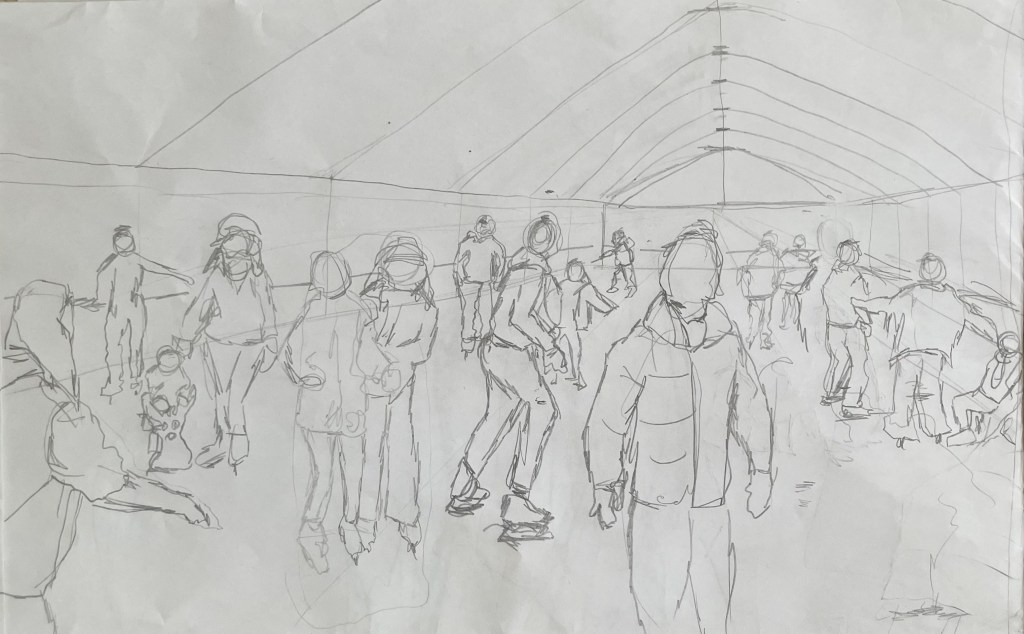
We had to work from images which we had sourced: I took my nieces ice-skating at Christmas, which was really entertaining to watch. There were the confident, well-practised skaters who came equipped with their own boots; the ‘I’m-competent-but every-now-and-then-lose-my-balance-and-windmill-my-arms-brigade; and then the rest – hopelessly clutching the side, or each other, for dear life, inching their way round. There was a whole range of shapes, gestures and weights, in the sense of where in the body the weight is being distributed, and there was a lot of tension.

We started by sketching out the composition.

I used a combination of photos and video stills from my phone – I could have been more organised because I lost track of which figure was on which photo, which wasted quite a bit of time. Next time I work from numerous image sources I will organise them so that they are more accessible and easier to switch between.

I then applied a ground to the support (I used oil paper as opposed to a canvas, as I wasn’t sure how it was going to go). As it was a painting of ice-skaters, I chose burnt umber thinned down with Sansador as my ground, as it’s the blue equivalent of the earth colours. I then drew in the figures using a rigger brush and thinned paint – I found the techniques covered by Chris Koning’s workshop of gestural drawing (‘Perception of the Whole’) to be really helpful in trying to get some dynamism in the portrayal of the figures. I also changed the composition from the pencil sketch to bring forward the pair of skaters on the left and to give the skater next to the pair some extra space into which he could move. I also packed some more figures in, including my favourites, the couple in the centre – the man skating alongside and watching his partner who is leaning forward – and the girl behind them.

The next step was to block in the background. I decided that I didn’t want to put the figures in the specific setting of an ice rink, so I left out the details of the roof and sides which were included in the original sketch. This gives a feeling of more space.

I used a thinned down mixture of titanium white, ultramarine blue and burnt umber to create a grey/blue and then scratched into it with the end of the paintbrush to create skate marks.

I then started blocking in some colour using thinned paint. I liked the fact that the burnt umber drawing was still visible and decided to try and retain as much of it as possible. This meant that I would not be able to use much thick paint in subsequent layers, and so the painting will retain a sketch-like quality. The purpose of the exercise was to capture the essence of the figures, so there will be very little detail in the figures and their faces, other than those in the foreground, and even then I will keep these limited.

I regretted having the large figure in the foreground, but he felt necessary to add variation to the height of the figures, and his static quality should hopefully contrast with the sense of movement in some of the other figures.

I carried on adding some more colour and changed the colour of the skater’s hoodie to differentiate him from the figure in the foreground.

I really enjoyed the process of being looser: the multiple visible alterations and the pared back application of paint. I’m not sure that I like the finished piece, probably because of its subject matter – it’s all a bit twee. But that’s my own fault – I hadn’t adequately prepared for the class and so made a rushed decision. Next time we have to work from a preselected source, I will make sure that I prepare properly, so that the subject matter appeals to me as much as possible.

There are areas which really appeal to me; I like the way I have treated the ice and I think that I have managed to capture the sense of movement, the hesitancy and tension in the figures, and the atmosphere. I don’t like the way I’ve painted the faces in the foreground. Whilst the exercise was all about the figures, I don’t think I’ve managed to find a method to render faces in a non-detailed way which does not look childish. I need to work on this.

I was thinking about this painting whilst I was out on a dog walk yesterday. I enjoyed making it, but I’m not that enamoured with the overall result, which made me ask myself whether I need to like the work I make or whether enjoying the process is enough. Also, I like and am attracted to a wide variety of artists working in very different ways. I suspect that I have previously thought that I need to make myself like them and make the sort of work they make because it is something that I like and am drawn to. I’m starting to realise that this isn’t necessarily the case – I just need to be ‘me’.

Generally, the work which I produce at my art class is not something that I would ordinarily choose to do, (which is a good thing) and won’t necessarily be relevant to my field of study in terms of subject matter, but it will provide a useful source of exploration in terms of technique and approach in my art practice. As such it is a valuable resource and a good use of time as well as a commitment which ensures that I create work on a regular basis.