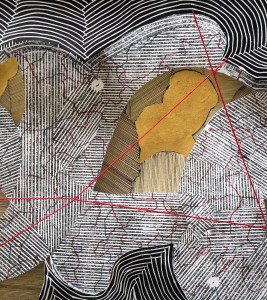
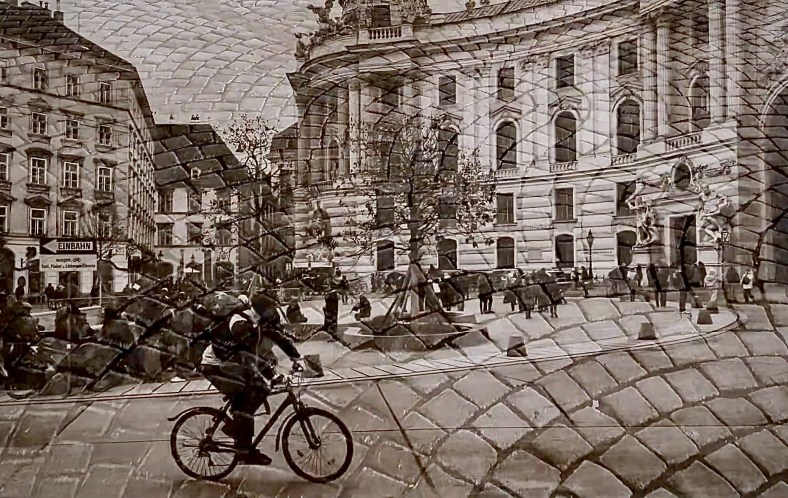
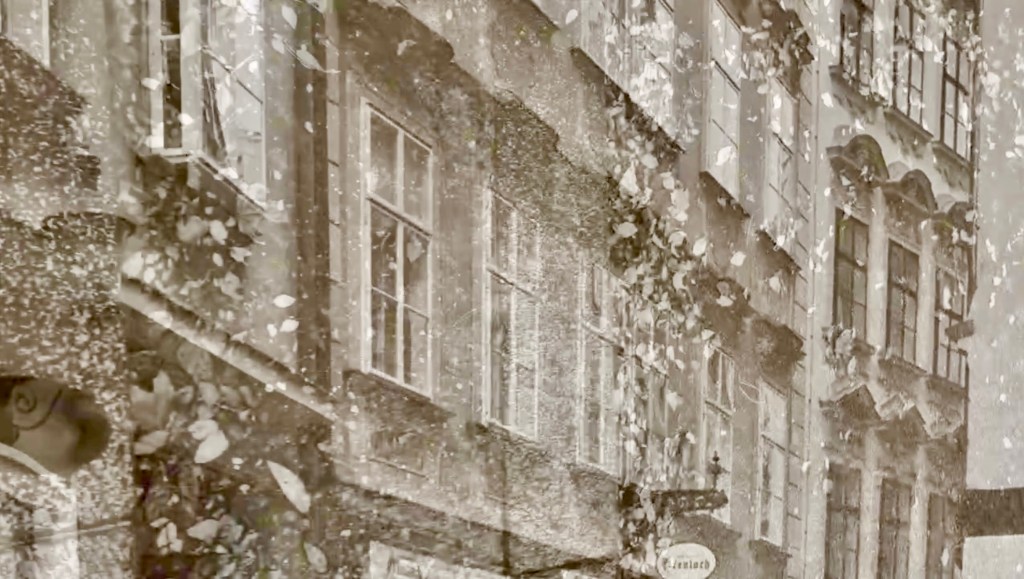
I’ve made a short video using clips I took in Vienna last December. I thought I had recorded a lot more, but no. The audio is me playing the Blue Danube on a piano with one finger. I played around with a lot of the effects on Capcut. My favourite at the moment seems to be ‘archaic lens’ although I find the dirty lens bit irritating but I do like the colour and the texture. I’ll have to experiment some more and see if I can achieve anything similar. Some of the transitions need a bit of work but, as a first iteration, I’m particularly pleased with it.
My next video project is to film the ink and water in my fish tank.
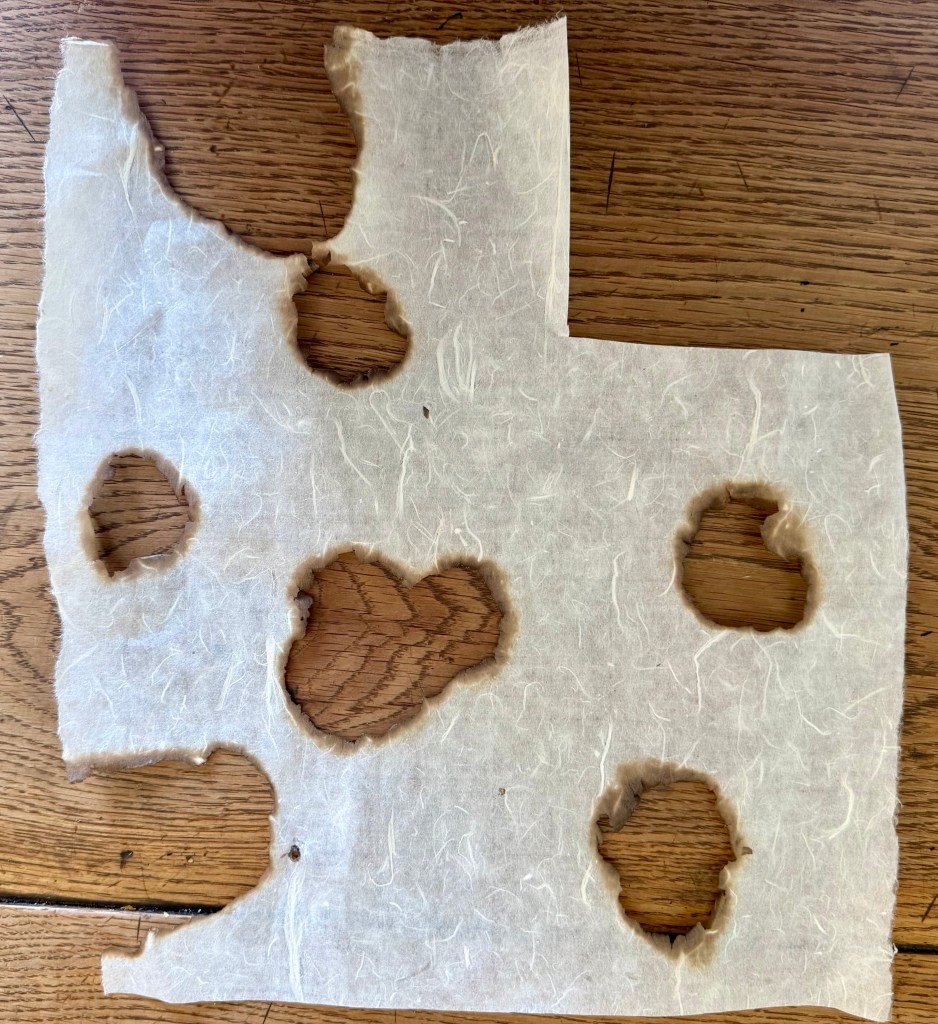
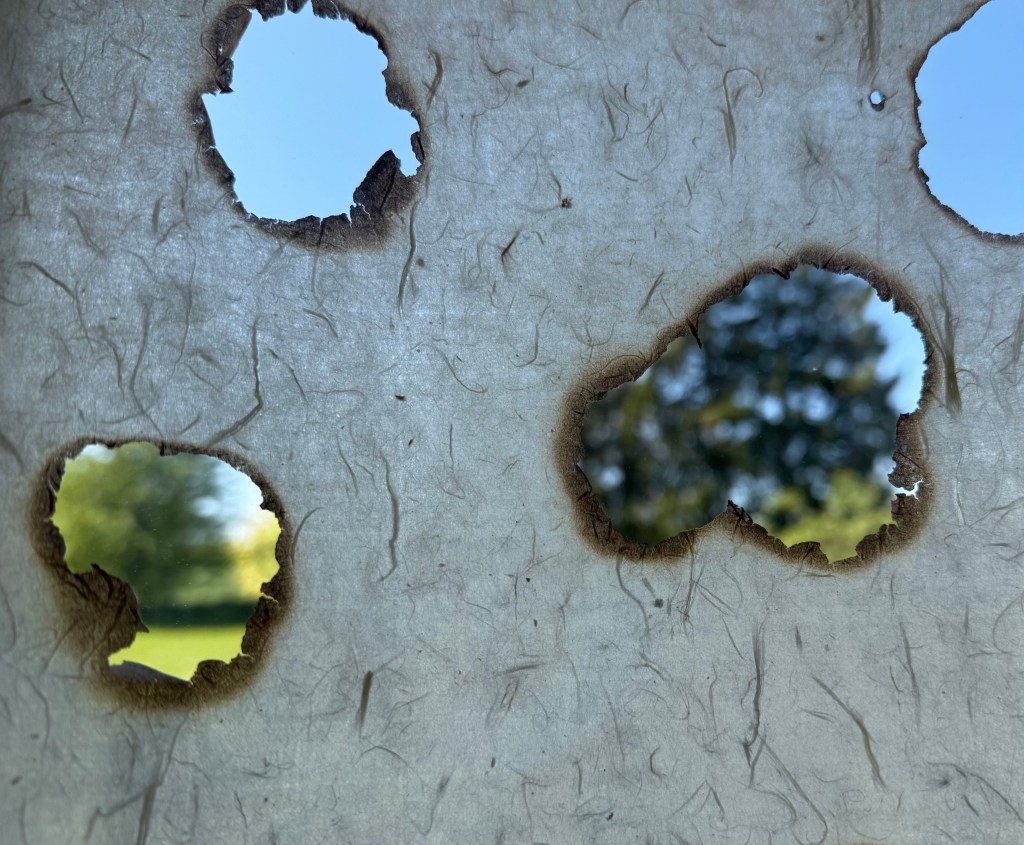
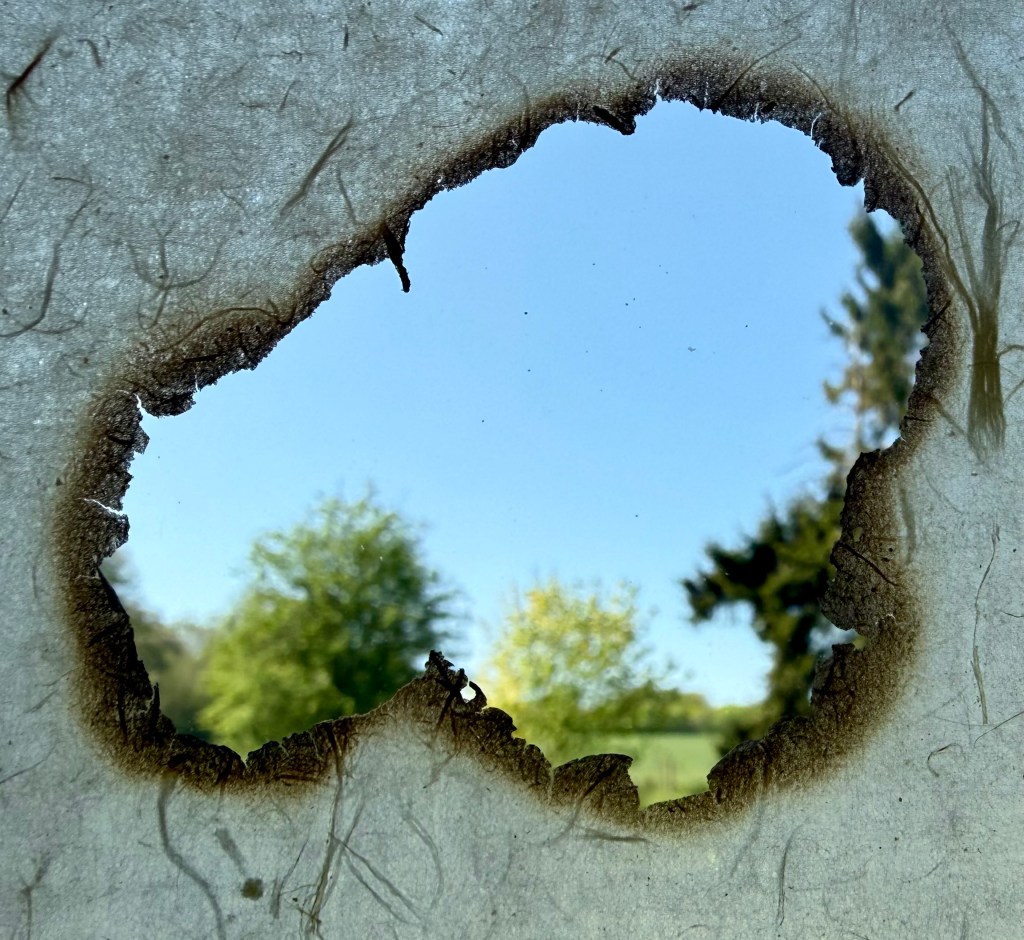
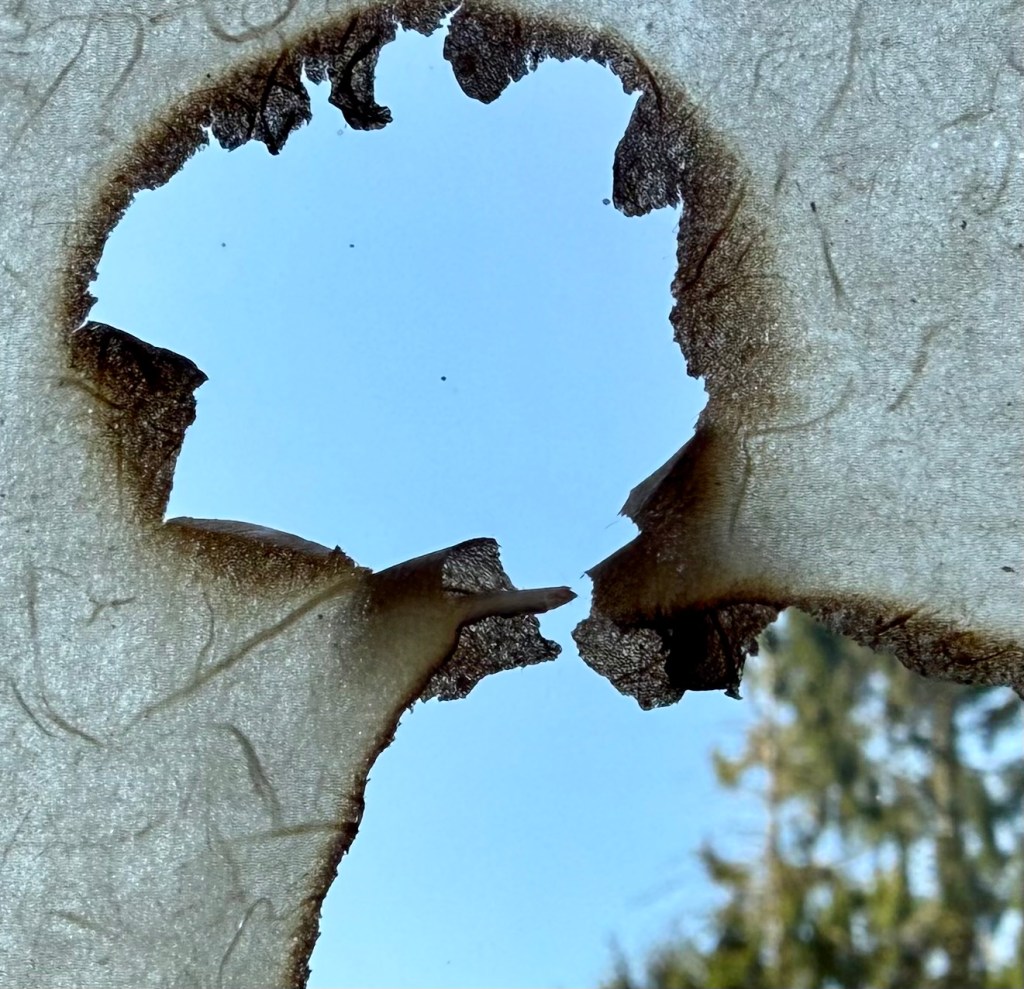
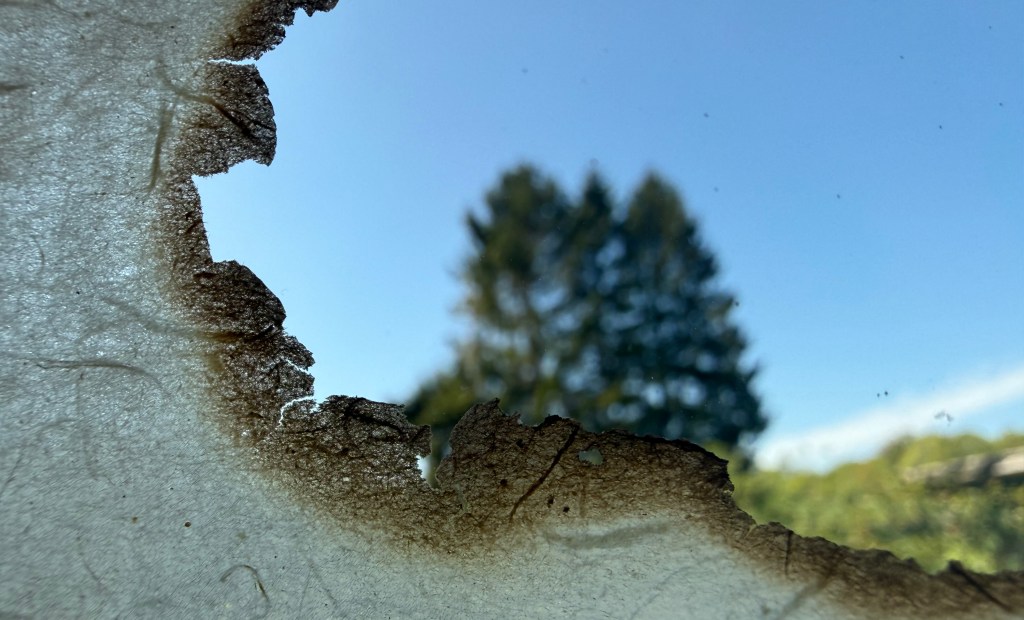
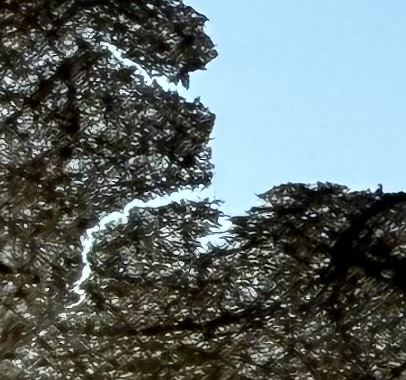
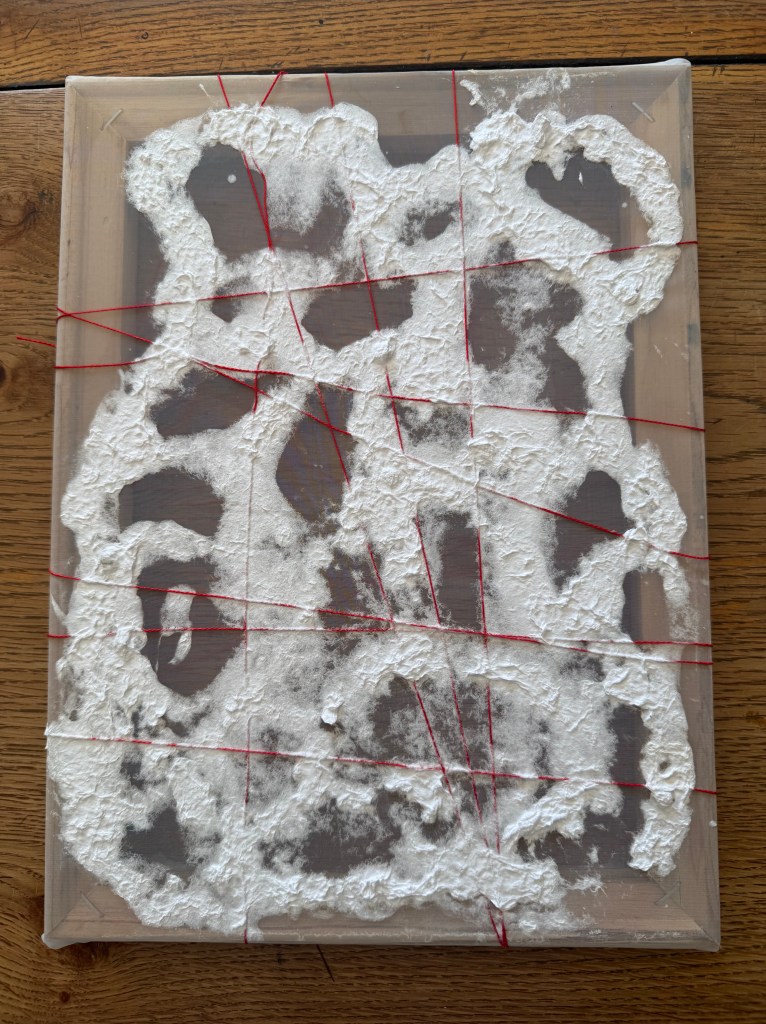
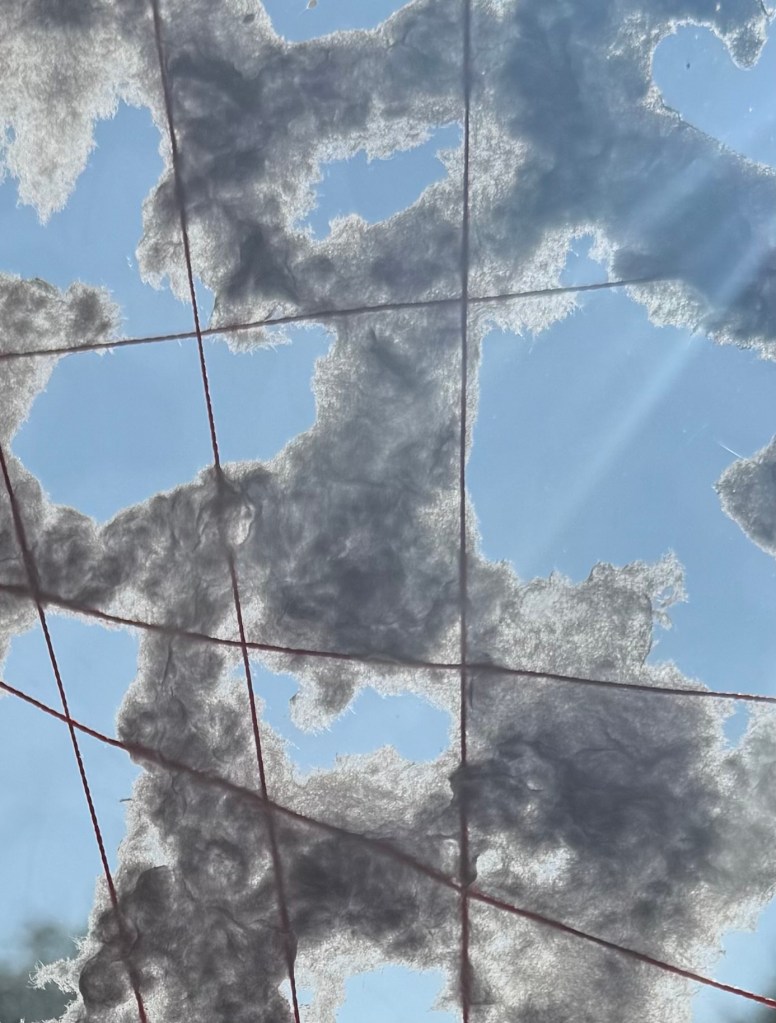
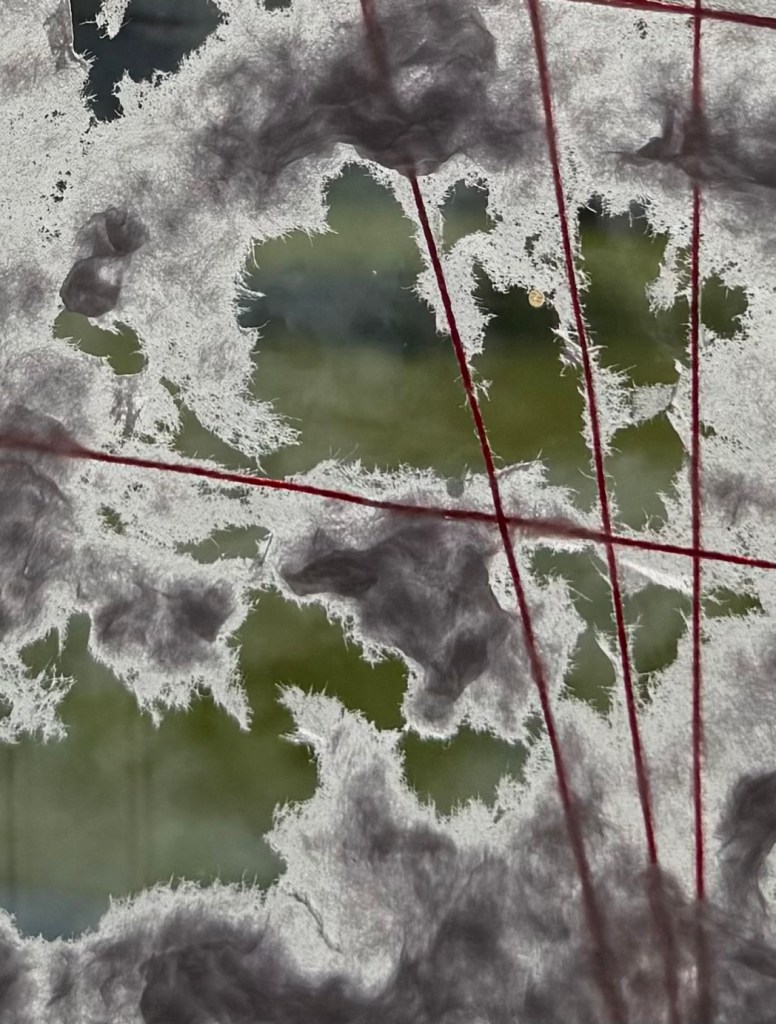
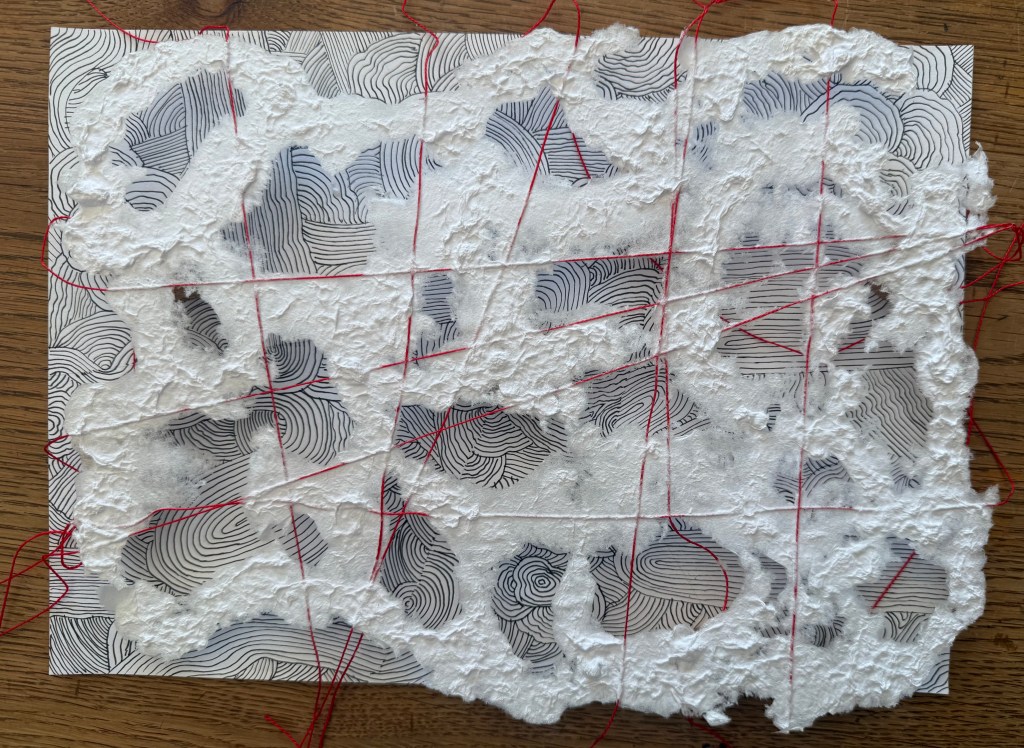
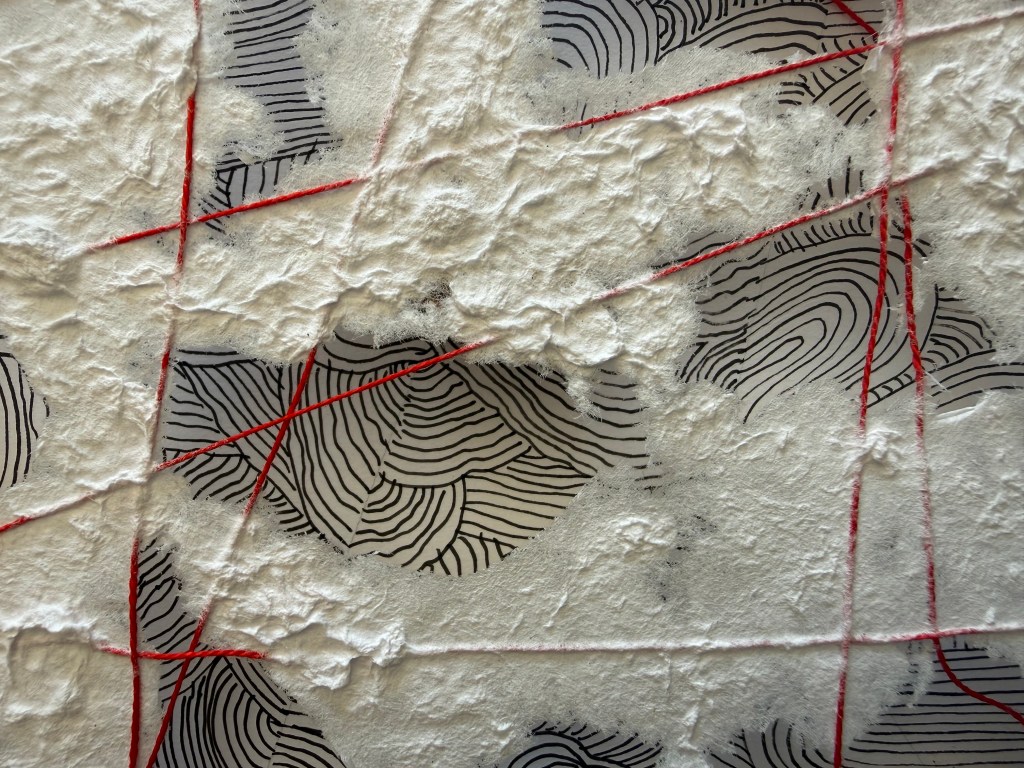
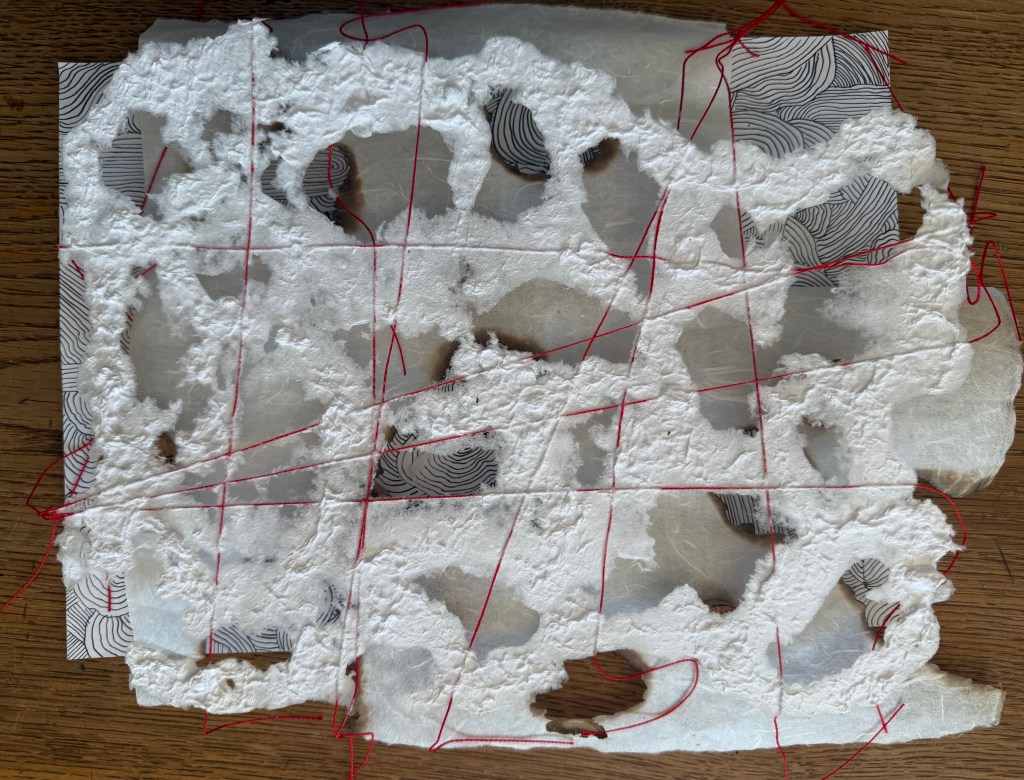
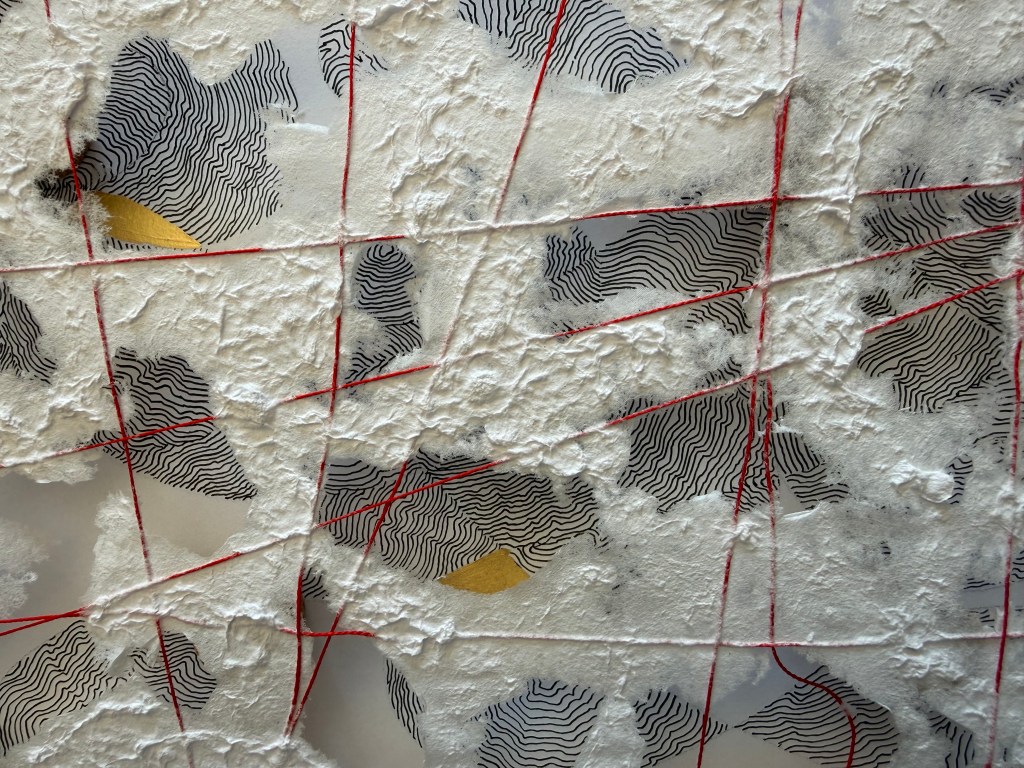
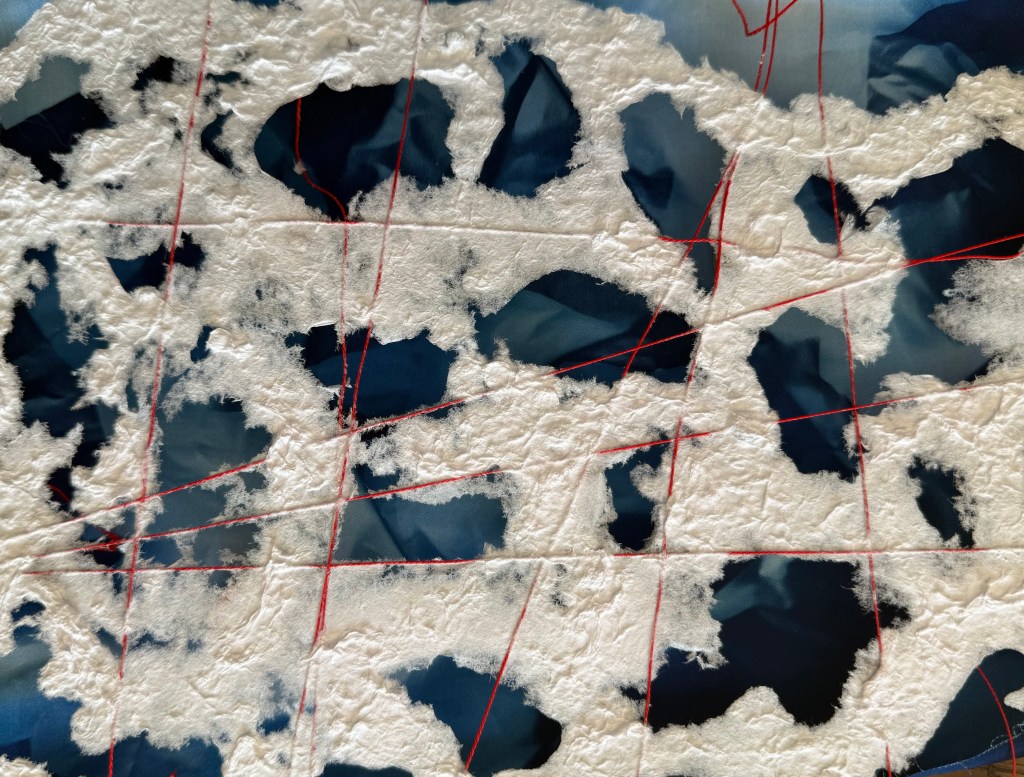
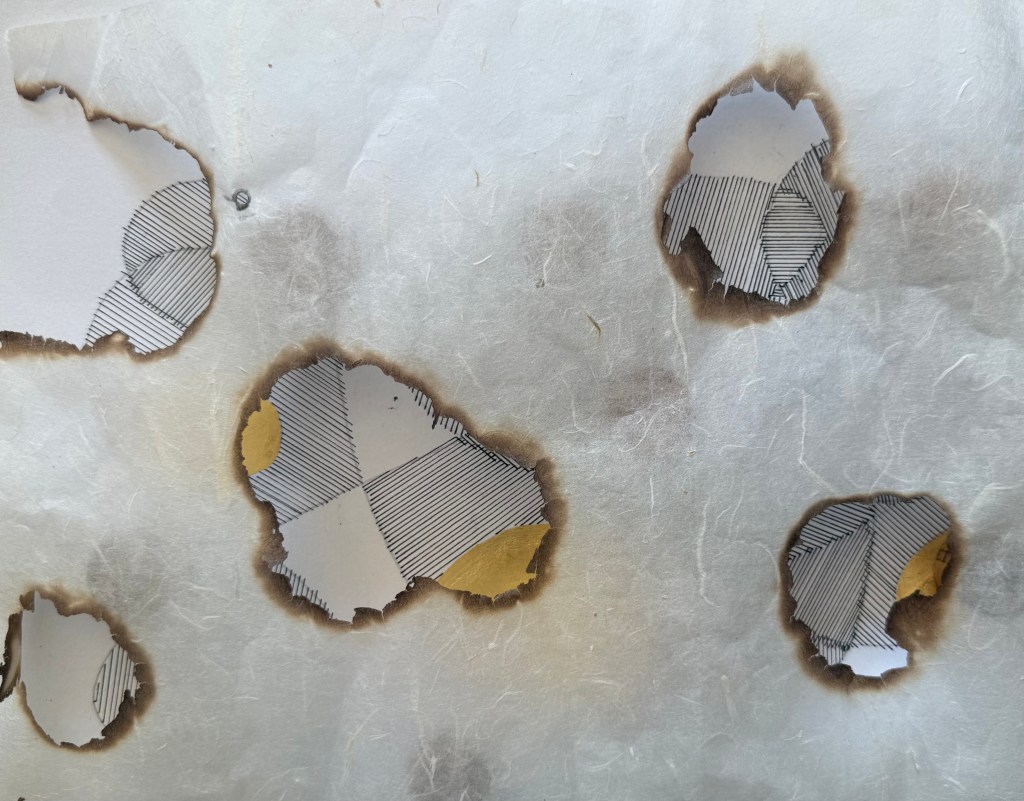
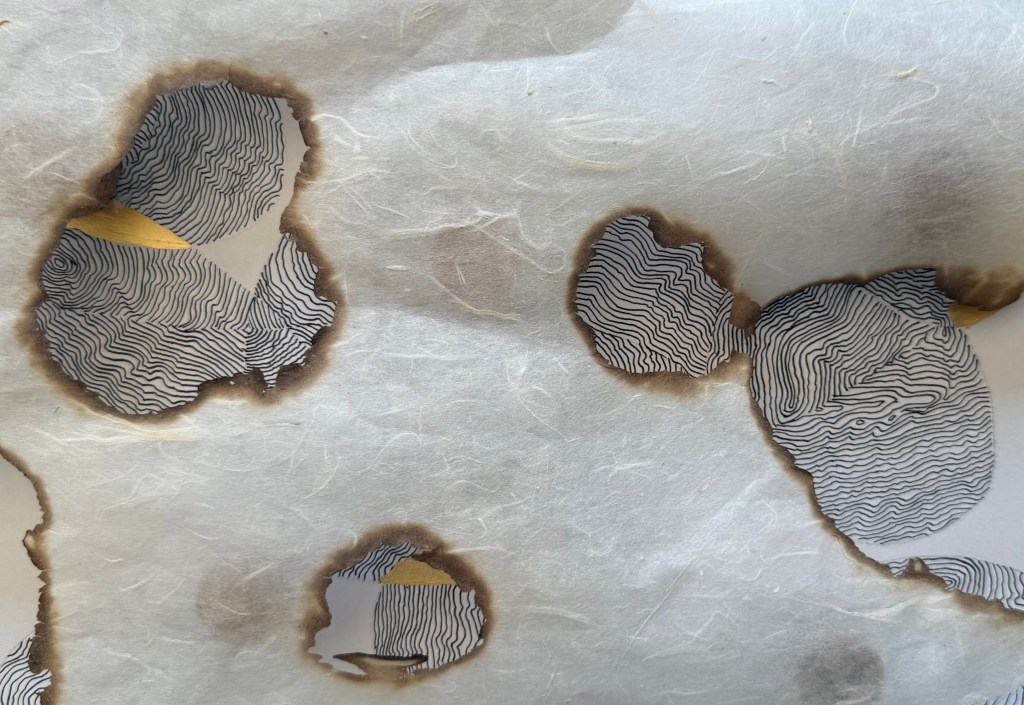
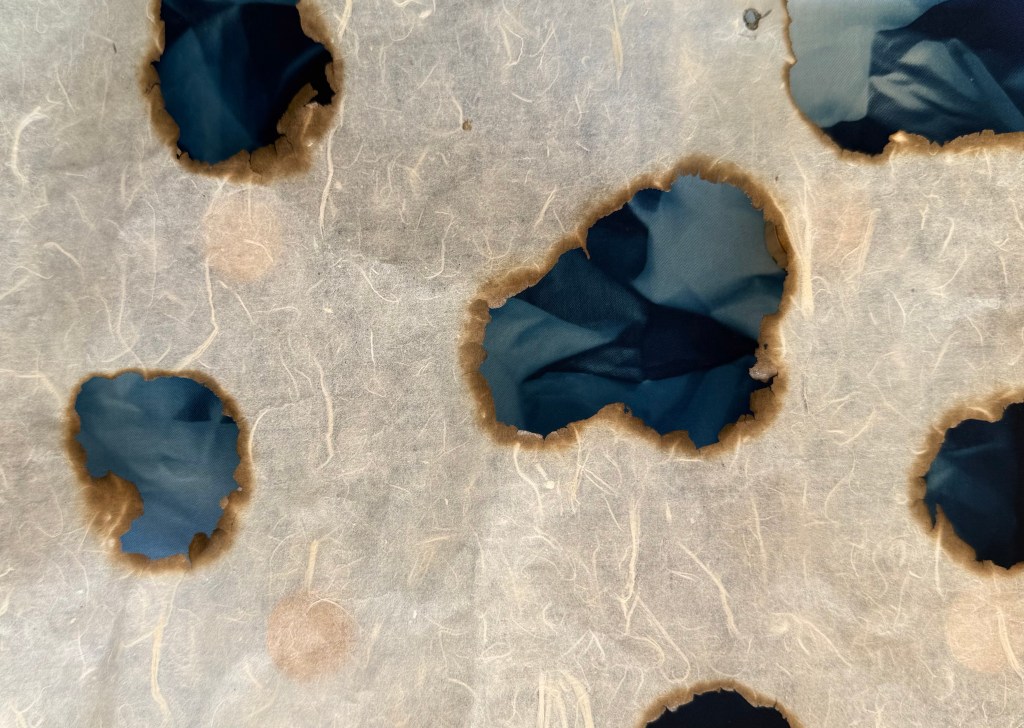
I’ve been thinking about layers again. I want to make a layered piece but I need to experiment with combinations. I’ve been meaning to have a go at making paper by squirting paper pulp. I used an old Nurofen syringe, but had to make the hole a bit bigger because the pulp kept on clogging it. I used a hot skewer to make it bigger, but while I had the lighter I decided to burn some holes in some of the mulberry paper I’ve been using to make book cloth.
I like the effect of the burnt edges. In the last two images they resemble coastlines, the last one similar to the Thames Estuary.
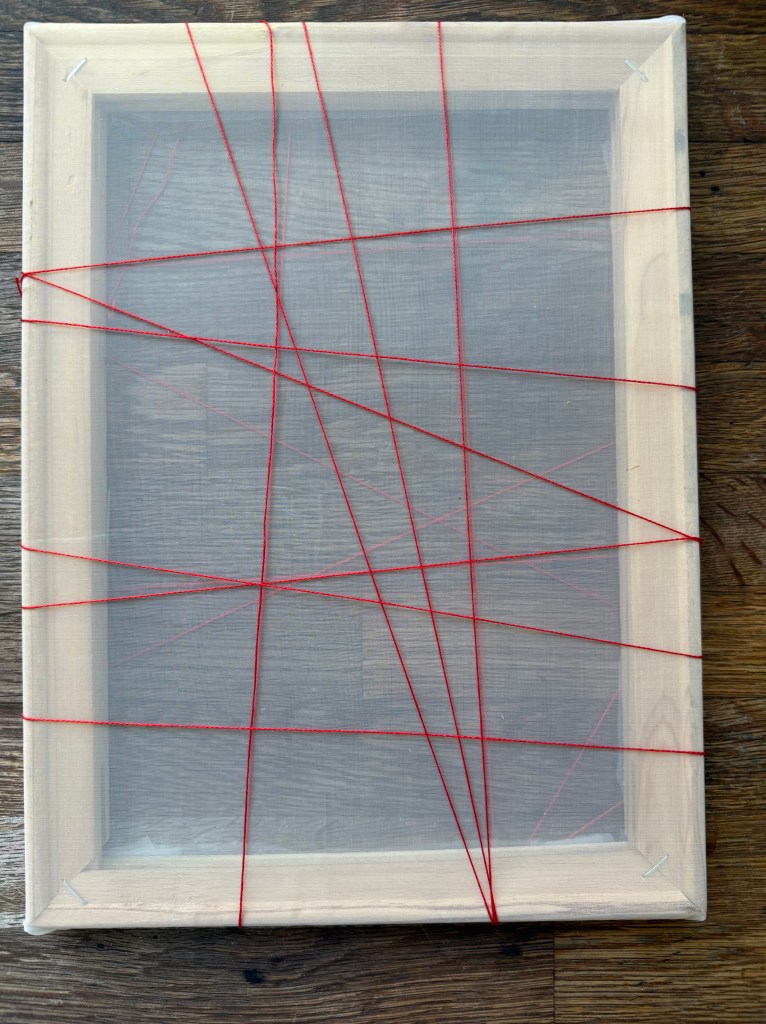
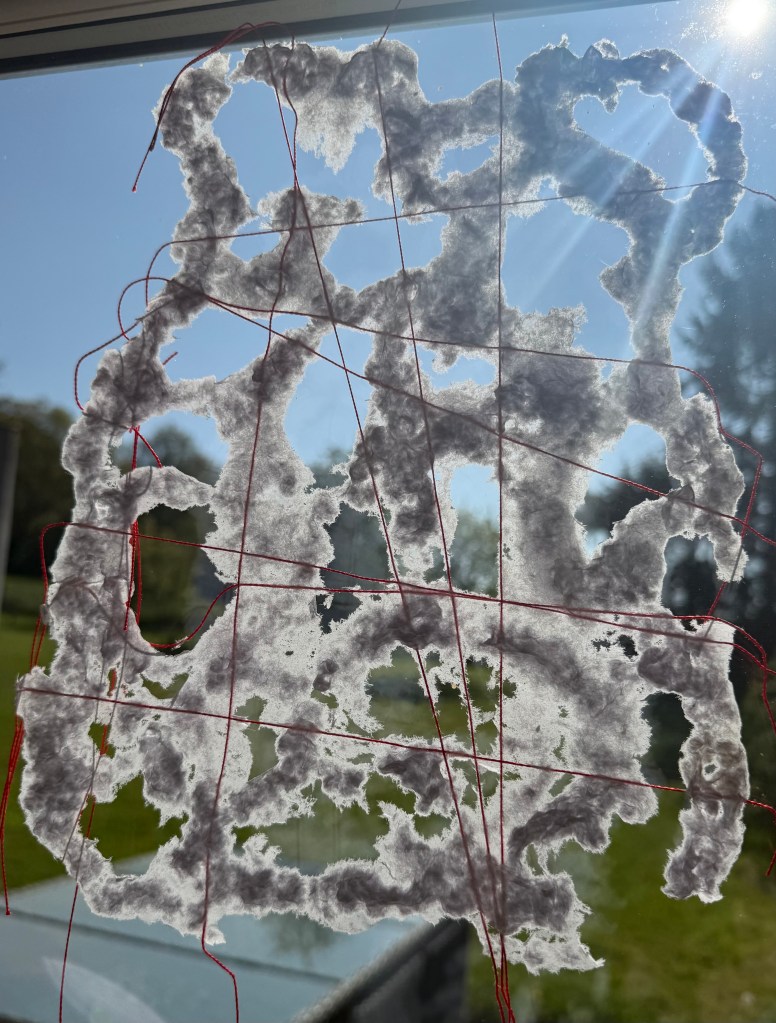
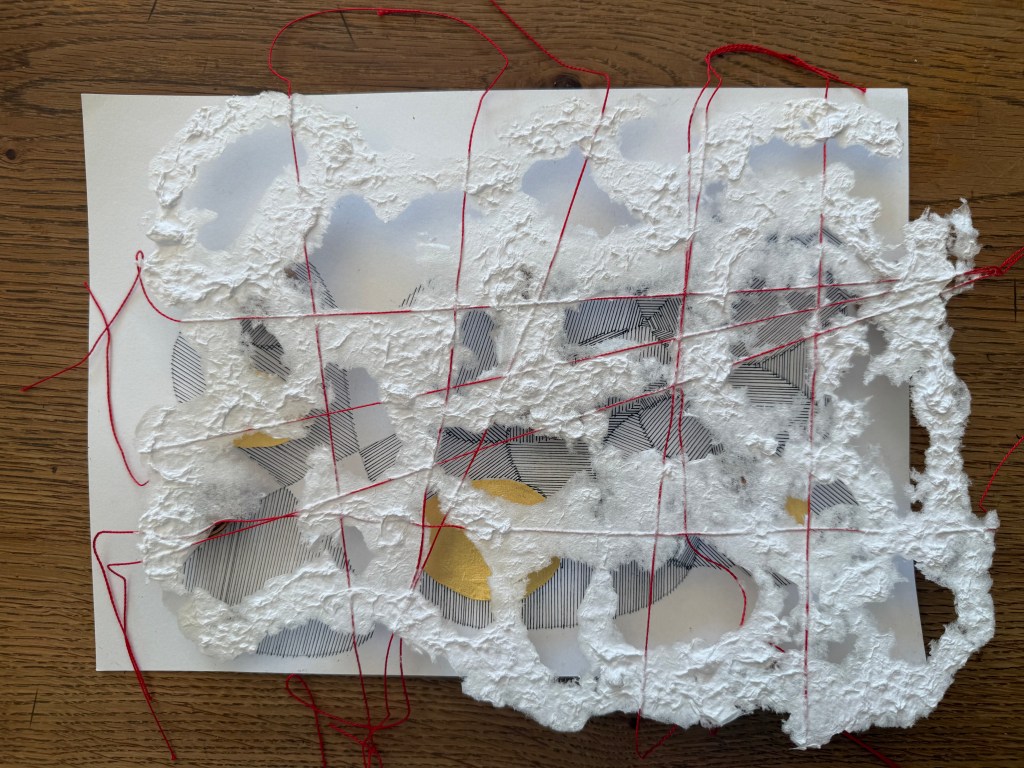
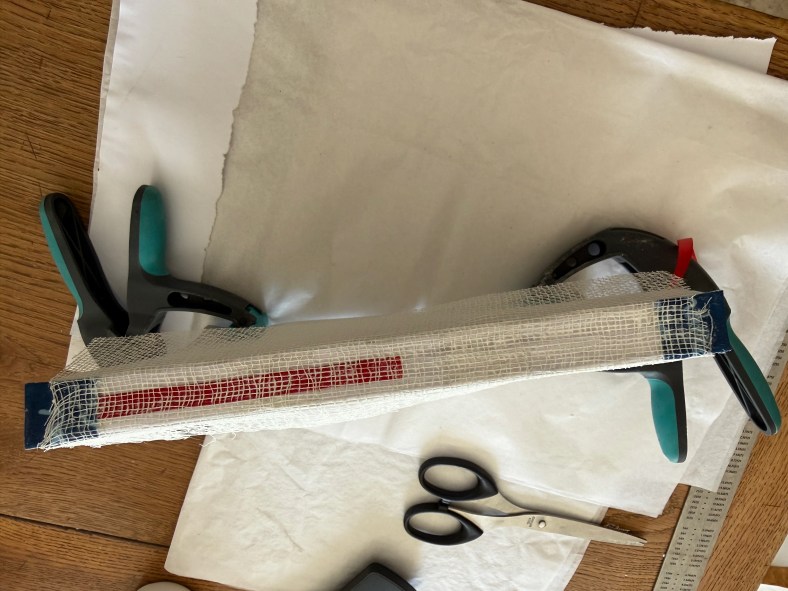
I made a mould out of some stretcher bars and some mesh, wrapped some thread around it and then squirted on the paper pulp. Removing it from the mould when it was dry was satisfying.
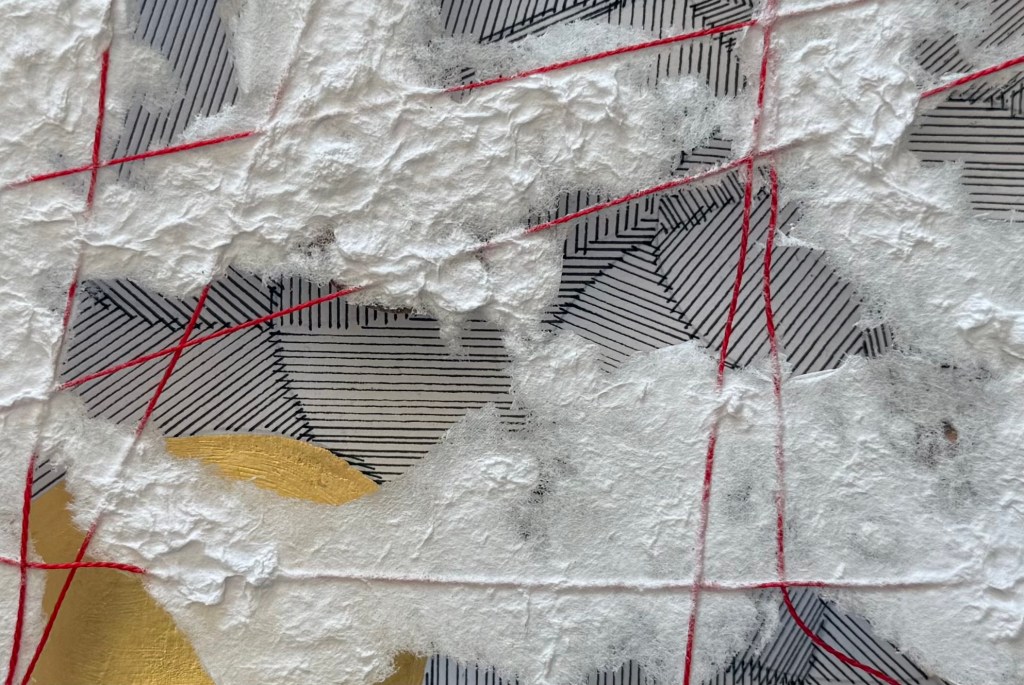
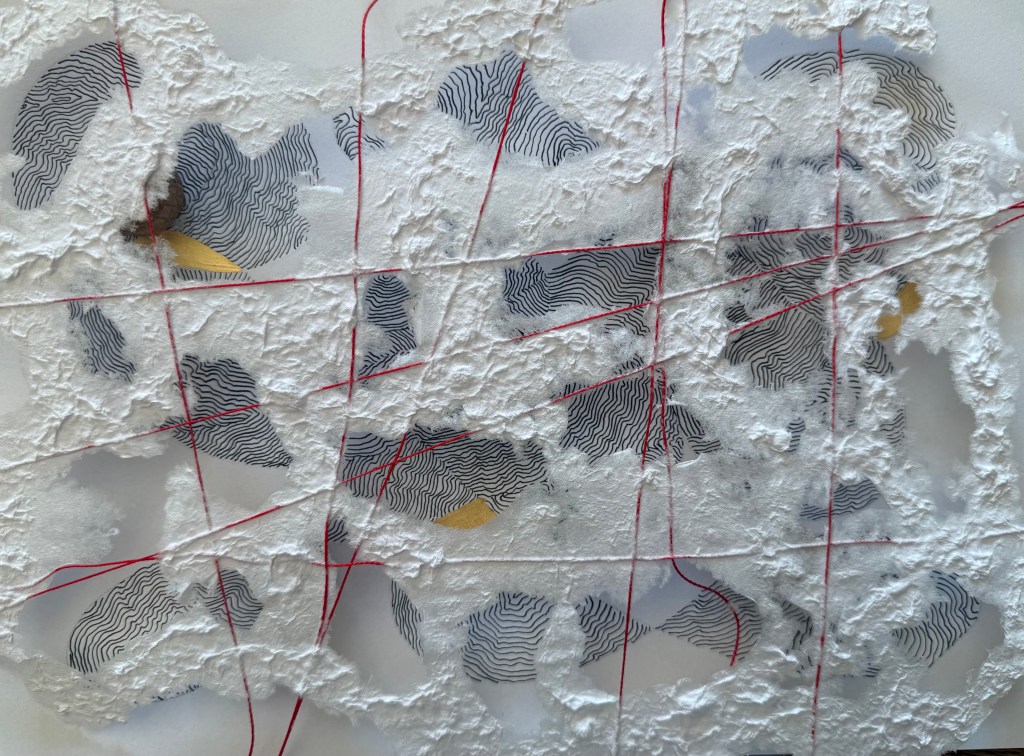
I took whatever images were close to hand to see how layering might look using some bits of cork as temporary spacers.
It was a really interesting exercise. I find myself drawn more towards the burnt paper than the thread and paper pulp. Maybe I need to try the paper pulp on different images, but my initial thought is that I don’t like the combination with the thread, although the thread does allow it to be suspended, rather than lying flat. I think that I much prefer it when I made the paper with the thread embroidery in a whole sheet. The paper pulp might look better without the thread, with the thread incorporated into a different layer.
I think that I’ll just start making the piece and experiment and make decisions in the moment.
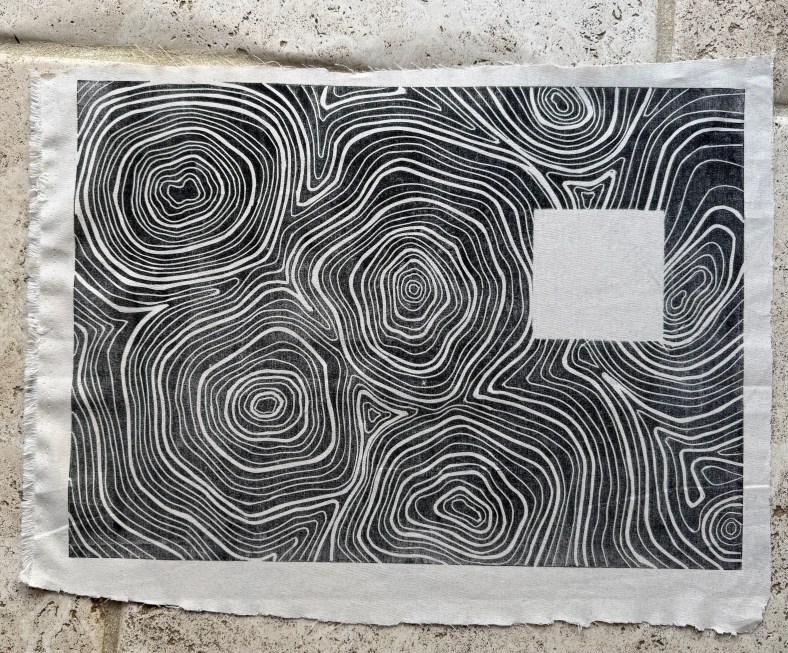
I’ve been making the book cloth for the second book. This time I lino printed onto a sheer fabric and a plain cotton.
I need to sharpen my cutting tools – there was slip on the left side. I’ll be able to cover it up with the mask for the title block.
Overprinting on paper
Print on sheer fabric
Print on cotton fabric
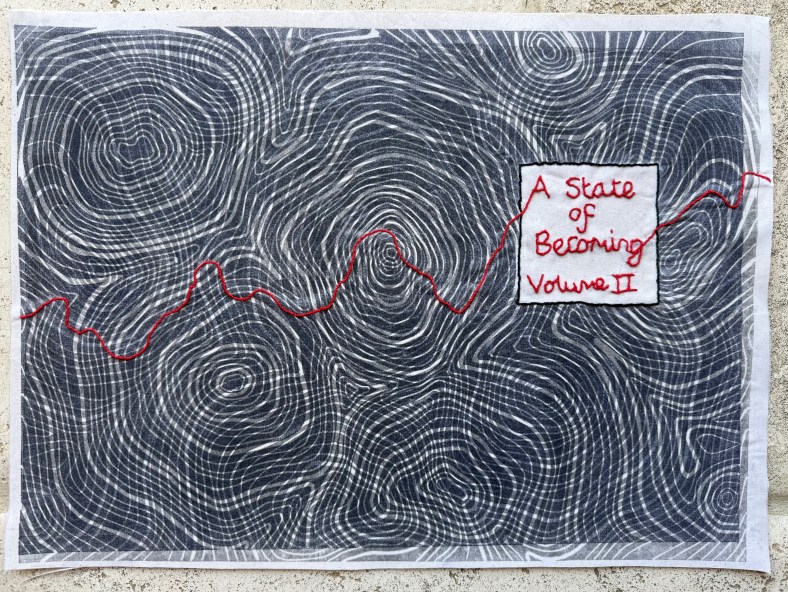
Fabrics bonded together and backed with mulberry paper and addition of title.
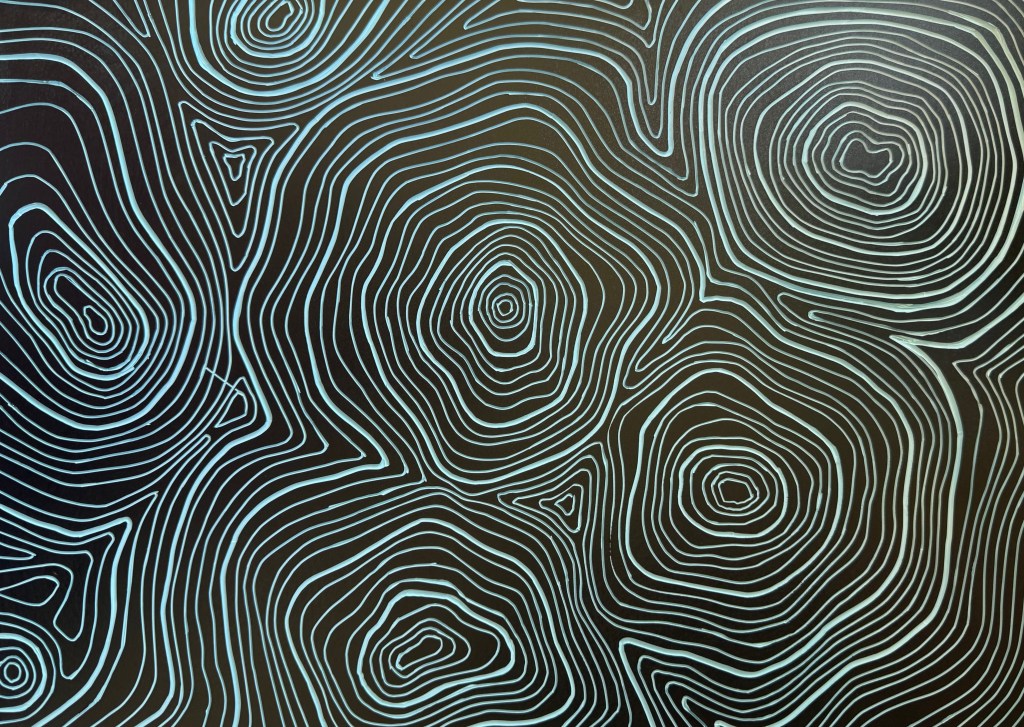
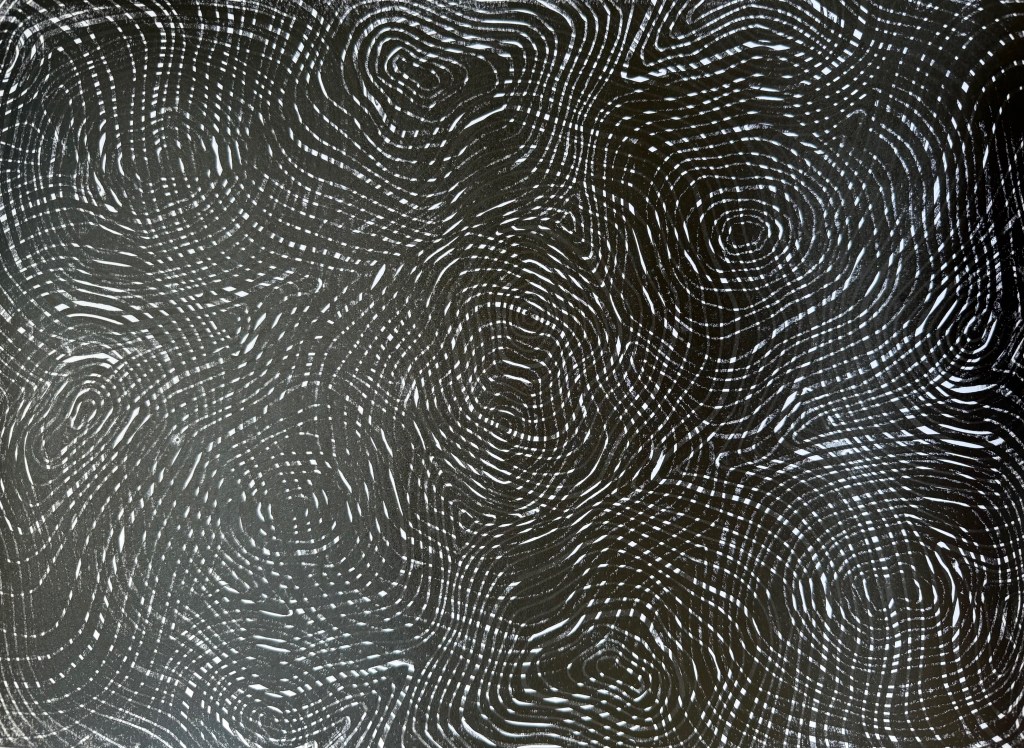
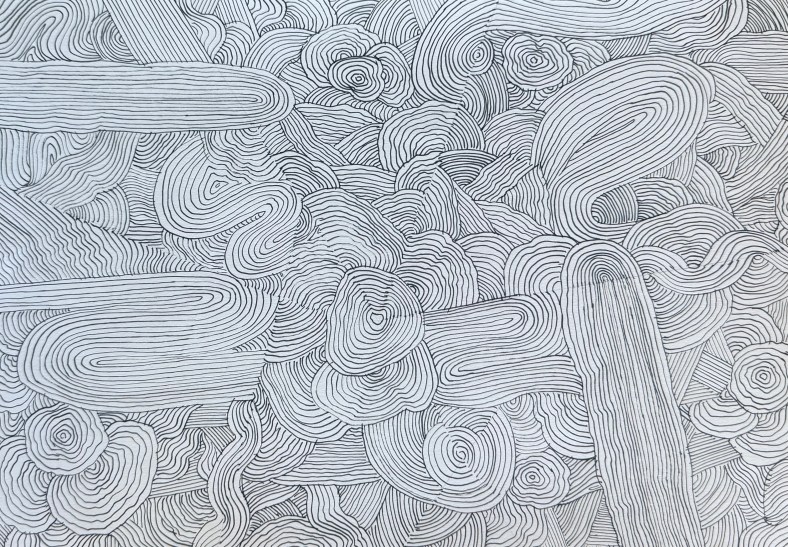
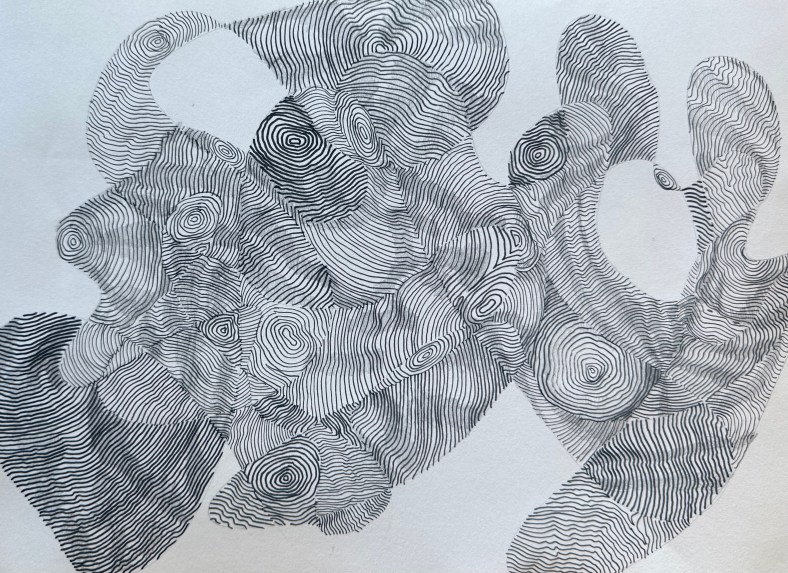
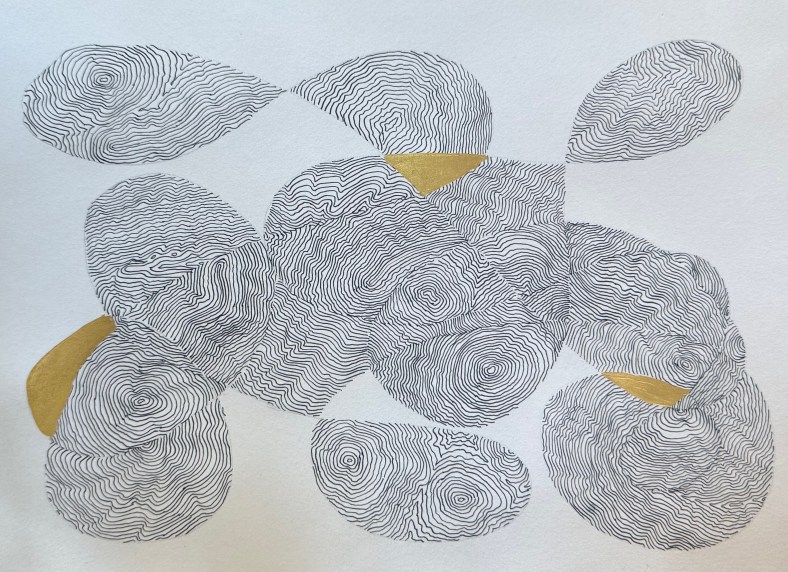
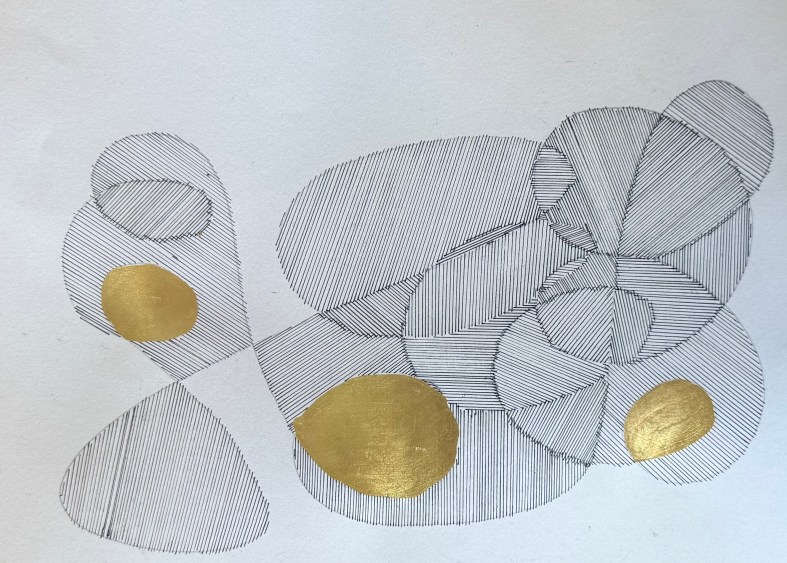
For the end papers I asked my husband and daughter to draw some more outlines for me to fill. I’d been experimenting with not using straight lines.
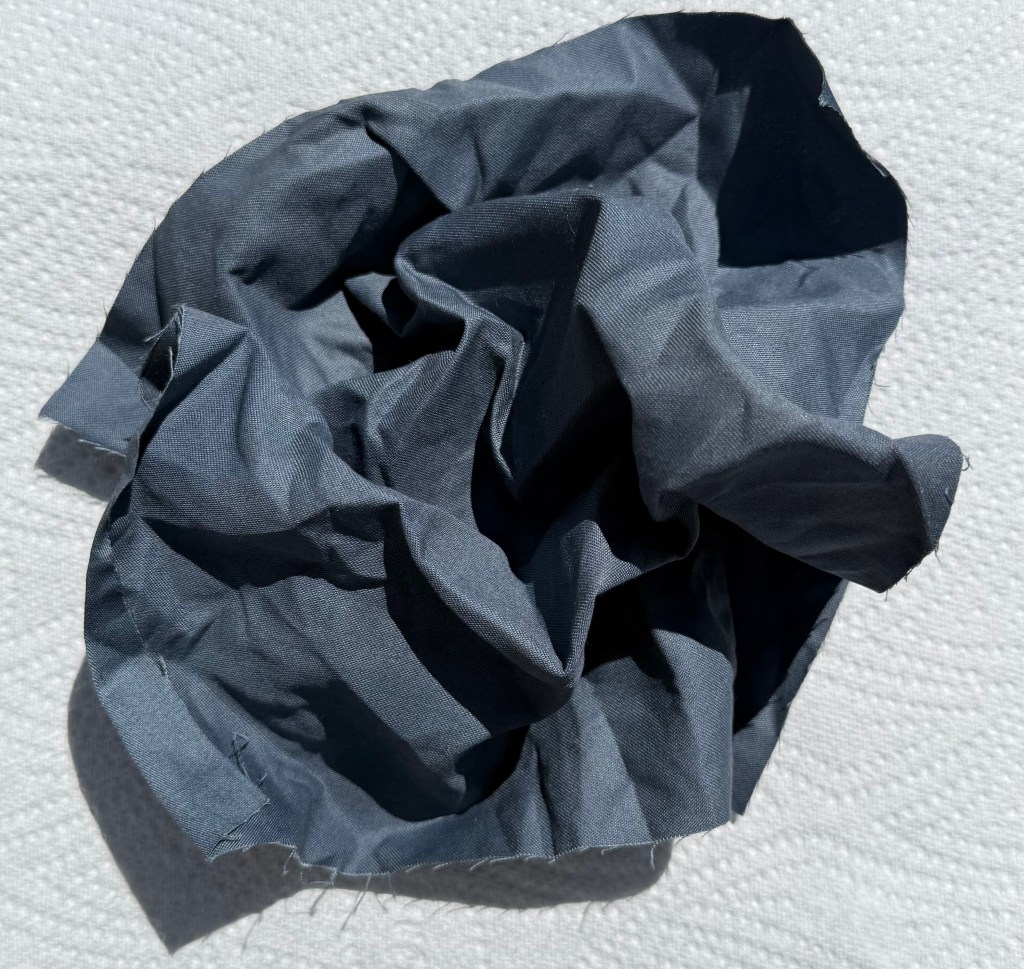
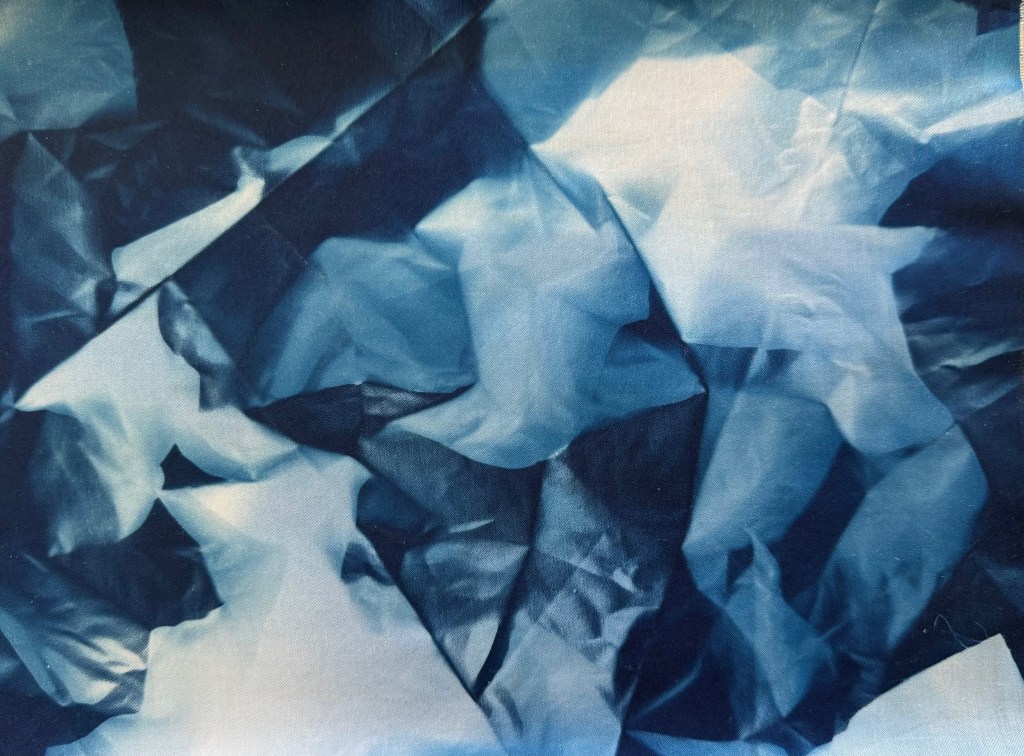
I then redid the cyantotype for the remake of Volume I. Whilst I was waiting for it to develop, I scrunched a piece of fabric up and left it outside. I was pleasantly surprised by the result.
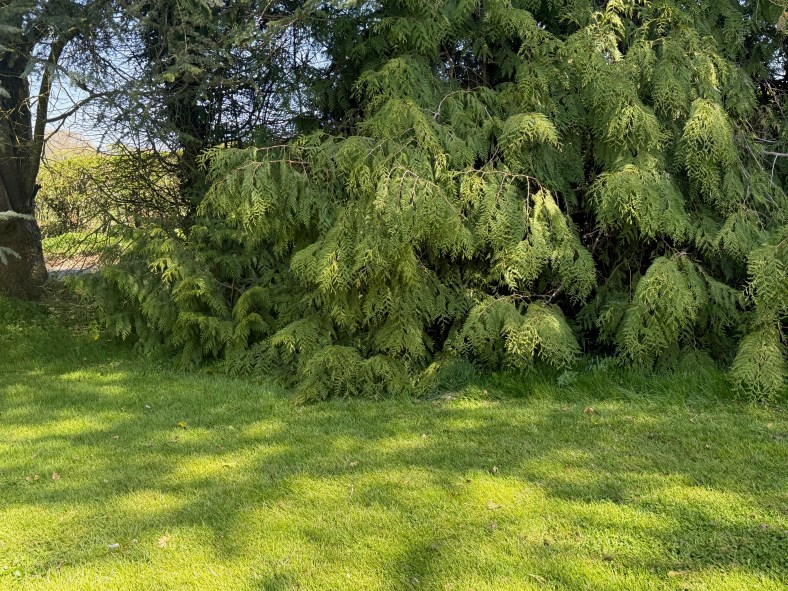
I went out into the garden this morning. Of course I had noticed it before now, but I hadn’t acknowledged it. The path has gone, the grass has regrown and the trace of his physical existence is no longer there. It left me feeling sad. He would run from one end of the trees to the other barking at the cyclists who would greet him as they passed. The path embodied his physical presence.
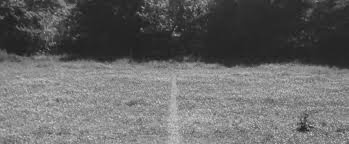
The line in Richard Long’s A Line Made By Walking (1967), embodied his physical presence in the act of walking and questioned which part is the art, the walking, the line, or the photograph documenting it?
I then started thinking about how dogs see the world and about colour, about whether colour only exists because we perceive it and what the world would ‘look’ like if we didn’t. It took me to the classic question of whether a falling tree makes a sound if no-one is there to hear it. From a scientific perspective it does, because it still creates the sound waves. But what about a banana in a dark room? It still exists even though we can’t perceive it, but is it still yellow? My initial thought was no, because there are no light waves to be reflected or absorbed.
I think that I prefer the scientific view to Berkeley’s idea that ‘to exist is to be perceived‘ in which neither the tree nor the banana exist until we perceive them. But that led me to thinking about whether my work is art when only I perceive it or whether it needs to be perceived by others as being art. I think Merleau-Ponty would say that it is enough that I experience it as art because our perception is embodied in our experience of being in the world. It is art because I declare it to be, the perception of others enhances it and adds to its meaning.
Rightly or wrongly, some rambling thoughts when I’m supposed to be getting on with something else.
Our first two sessions since we’ve been back have made me think – a lot.
This week’s session was about our artistic identity and how to answer the question – what is your work about?
It’s a difficult question to answer. I don’t want to be pigeonholed and I don’t want to be pinned down, which is why I deleted the contents of the ‘About’ page on this blog because it didn’t relate to me anymore, and I’ve been struggling since to think of what to say. I couldn’t think of a way to encapsulate how I see my practice and my work.
But this session has helped me in finding a way forward.
Jonathan showed us a quote by Robert Henri:
‘The object isn’t to make art, it’s to be in that wonderful state which makes art inevitable.’
It resonates with me as I interpret it as meaning that art comes out of a way of being, and that artists should focus on the process rather than the making of a product.
We considered the 6 prompts: idea, material, process, context, identity, and mood.
My responses:
Identity:
A woman who feels like she’s on the back nine of life who has been trying to find herself by reflecting on all that has been, is and will be. After Fatemeh mentioned the Iranian philosopher who said that his identity was a lover and his job was to love, I think I’ll change mine to a living maker who lives and makes.
Context:
My lived experience
Process:
Drawing, painting, photography, video, printing, sewing, paper-making, mark-making, playing, whatever feels right in the moment.
Material:
ink, pencil, paint, fabric, paper, canvas, paper, thread, charcoal, pastel, whatever feels right in the moment
Mood:
Exploratory, experimental, fluid, reflective
Idea:
The reiteration of shaping what I make and in turn being shaped by what I make.
A possible short answer: My work is an exploration of becoming; how I shape what I make and how it shapes me in return. I work fluidly across a range of materials and processes from print and drawing to video and photography allowing each piece of work to evolve naturally through experimentation. My work is rooted in my lived experience both past and present, reflecting on an ongoing shifting sense of self.
I like the reference to fluidity, it reminds me of my earlier thoughts and videos about flow and flux. It needs further work, but will do for the time being.
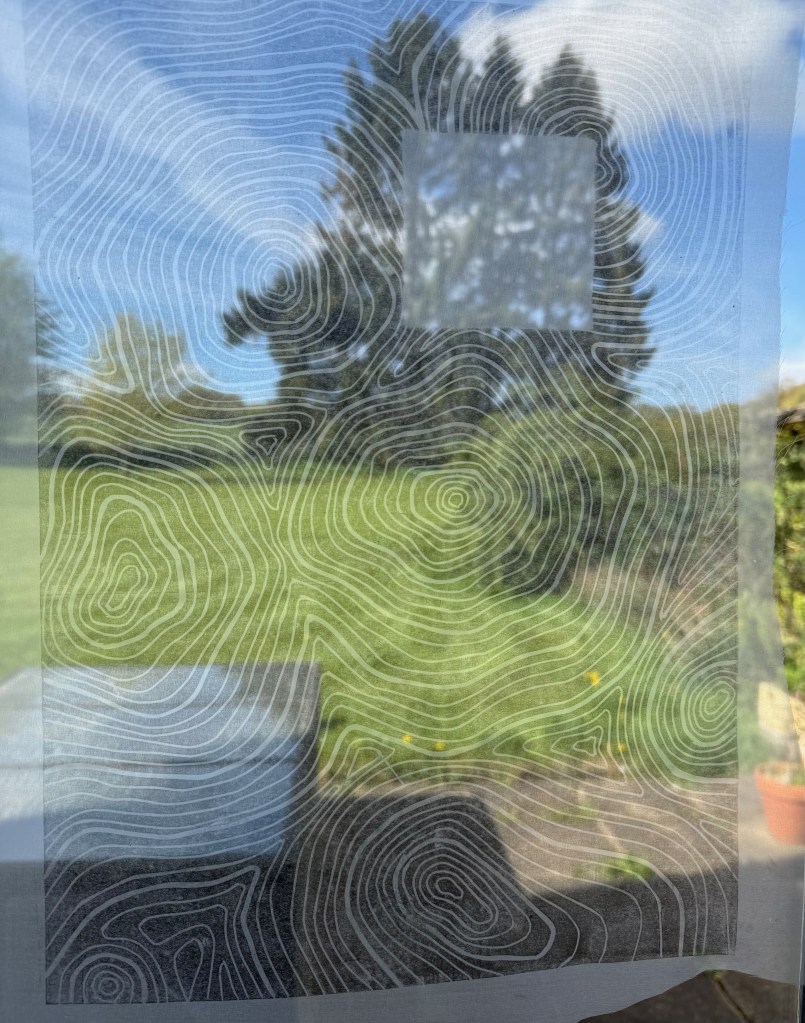
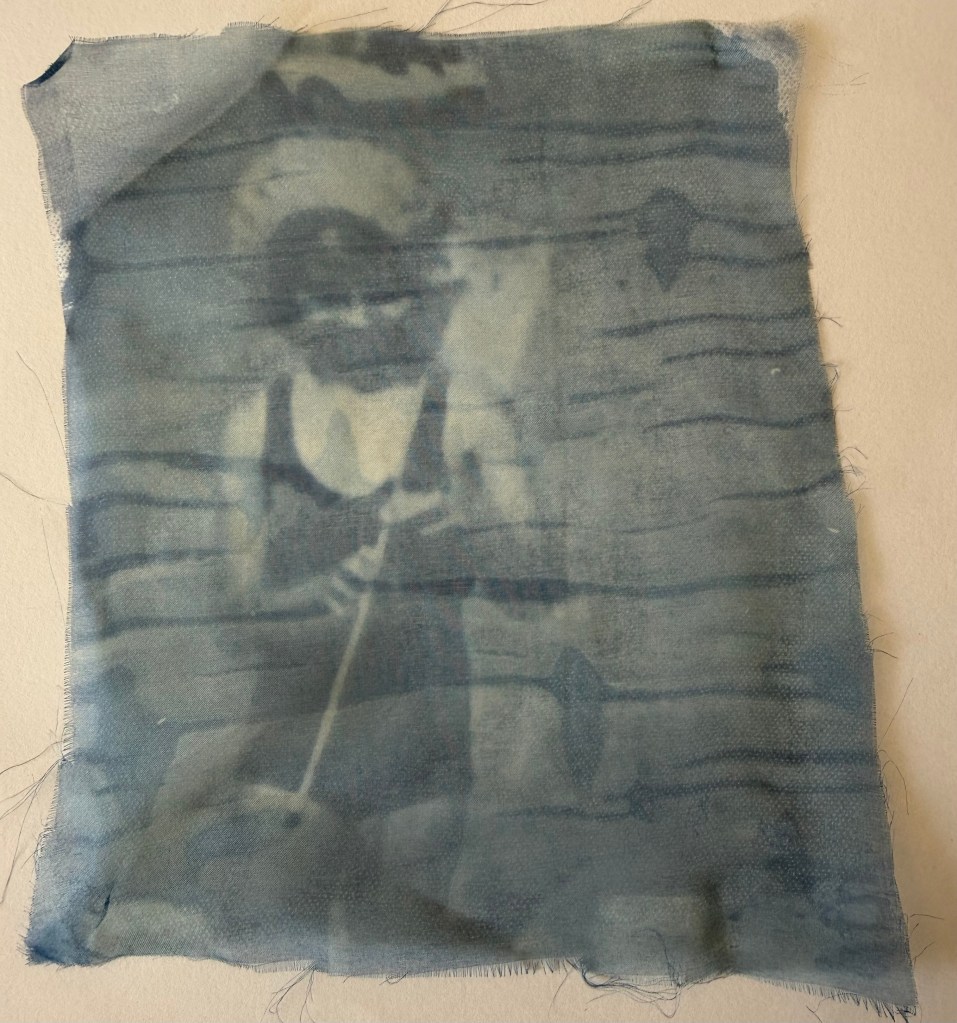
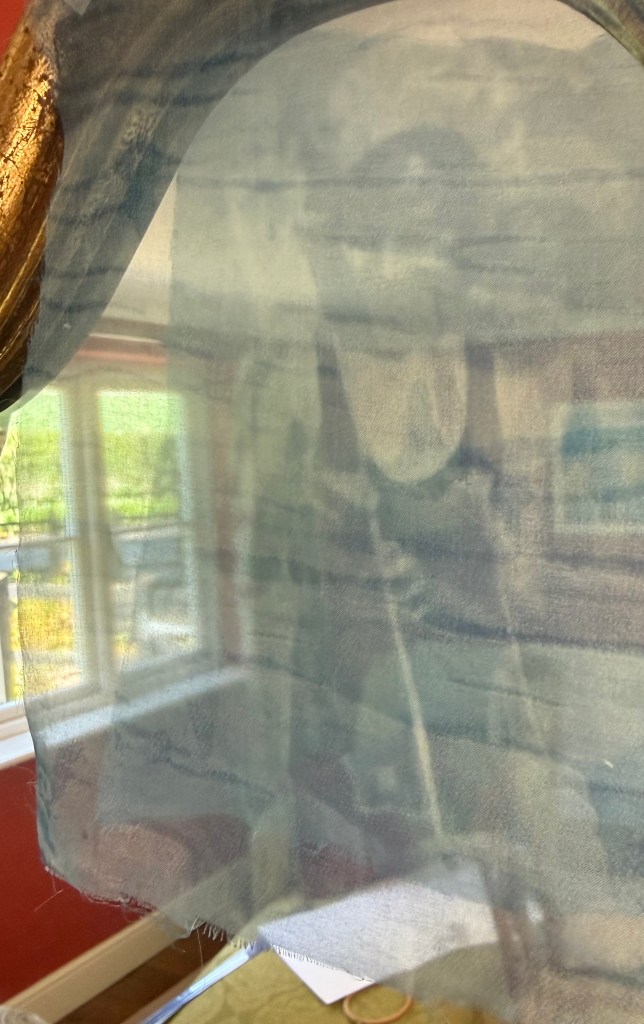
Whilst I’ve been contemplating the book cloth that I might make for the second volume of the book, I cyanotyped an image onto some sheer fabric. Cyanotyping onto fabric is something that I’ve been attracted to and tried, somewhat unsuccessfully, over the last couple of years. As early as the Interim Show I had visions of long billowing swathes of fabric.
But what caught my attention was the effect when I held it in front of a mirror, almost like the effect of the 3D printed images you get on postcards and bookmarks. I’ve still got a sheet of mirrored acrylic from my ‘A Die and A Log’ and I thought it would be interesting to experiment with layering images over each other on top of a mirrored surface. I toned the image with coffee to see what it would like other than in blue. I also wondered about using a different process – solar plate printing is something that’s been on my radar for a while, but I think that it can be quite tricky and it’s probably something best learnt in a workshop setting – again something to think about for the future.
It’s impossible for a photo to convey what the eye can see, and also I may need a better image.You can just about make out the reflection of the second head.
I need a space of my own, a place where it takes positive effort to find me. I have such a space and at the beginning of the course I said that I would sort it out, in the third post on this blog, embarrassing, but not surprising – That Sunday Feeling…
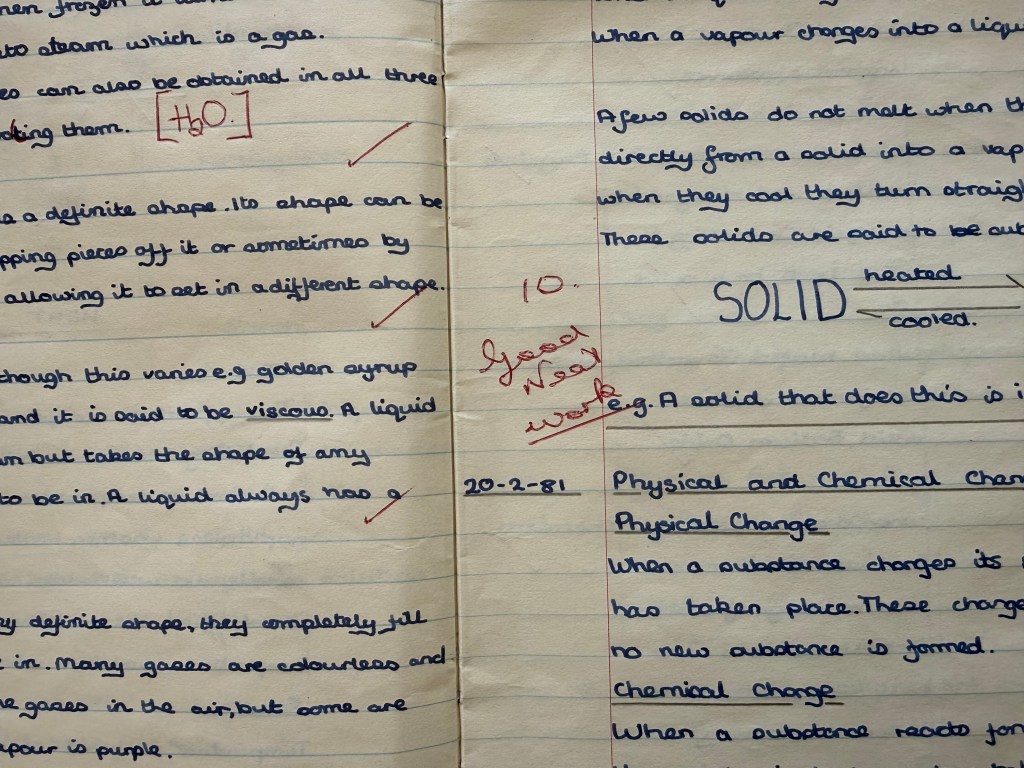
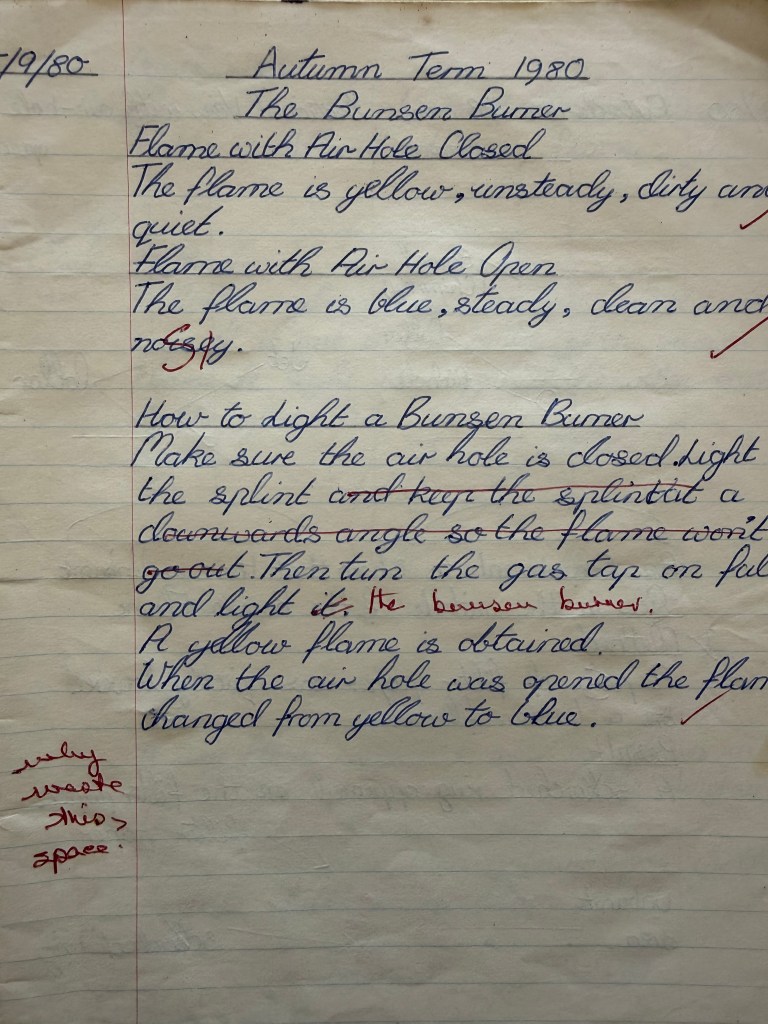
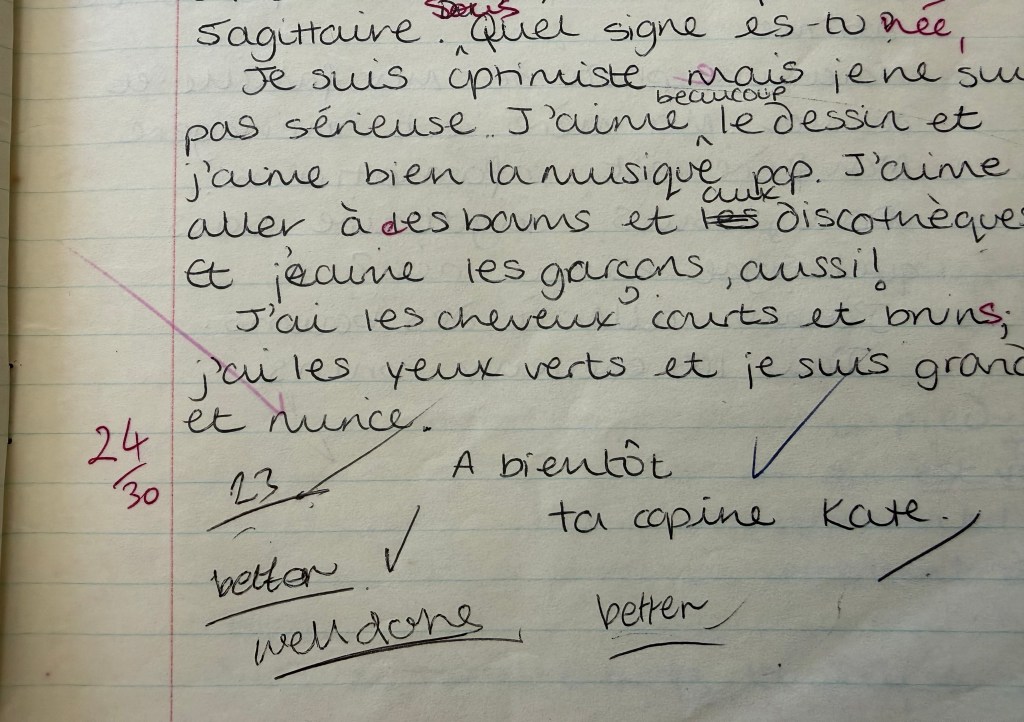
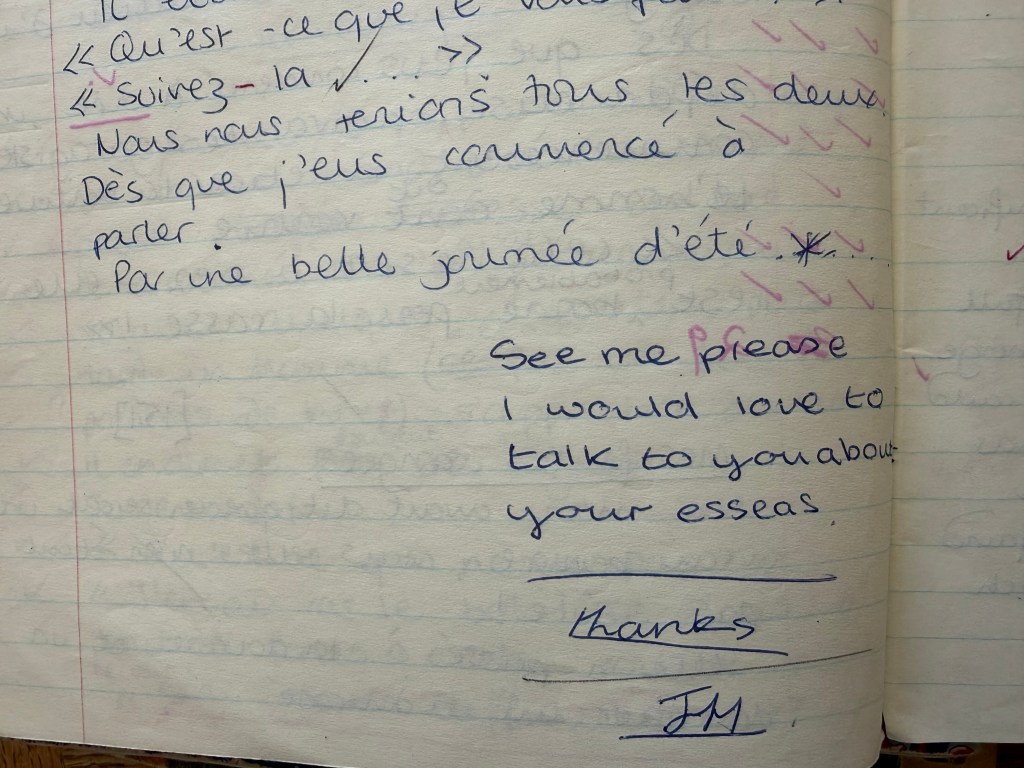
That is what I will do. In fact, I have recently started trying to sort out the stuff which currently inhabits the space – a collection of this and that from our past and our parents’ past. I came across some of my old exercise books from school, covered in pages from Smash Hits magazine, which my mother would buy me on Fridays, which was shopping day, together with a yoghurt and a chocolate bar. I also had several pieces of fruit that were to last me the week, and which sat in the fruit bowl on the dining table, slowly decomposing.
My daughter couldn’t get over how neat my handwriting was. My handwriting is a standing joke in our family – I should have been a doctor, apparently. What I noticed was the frequency with which it changed – experiments in mark-making.
Neatness was something which was commented on and leaving space for your work to breathe wasn’t encouraged.
My sister had obviously got her hands on them when she was a child living out her dreams of becoming a teacher. She even gave me a lower mark than the teacher. But I’m glad to see that I had my priorities right at that age: I liked drawing, pop music, going to parties and discos, and also boys.
I suspect that I will discover a wealth of material to prompt further work.
‘…the sane human being is satisfied that the best he/she can do at any given moment is the best he/she can do at any given moment…’ Art & Fear.
A question I’ve been asking myself recently is whether I have done my best over the last two years. Yes, I think I have. Yes, I could have spent more time making, but even if I had, I don’t think that I would be in any different position than I am now. What I have done has been enough to enable me to see that I have discovered my way of thinking, seeing and making. There are things that I had hoped to explore within the structure of the course, such as my childhood in my grandmother’s village, but circumstances have not allowed me the time to do so. No matter – it is a project for the future, something to look forward to.
I never used to have this attitude. I always had to do my absolute best, I had to fix everything and in my head I was the only person who could do it. I decided to become a parent and so I would be the best mother that I could be. Fortunately, (or maybe not), I was able to give up work and stay at home, devote all my time and energy to my new job. I tried all sorts of things from puréeing superfoods to baby Beethoven dvds and playing educationally stimulating cds in the car which used to drive me round the bend. I kept up to date with all the new advice being dished out by ‘professionals’ as to how to be a good parent.
And I put my hands up to having been a helicoptering mother who carried out her own 360 appraisals as to how well she was doing as a mother by looking at the success of her daughter – how well is she doing at school, how many friends does she have etc.? I’m not entirely sure how it all came about – maybe because I was brought up with the belief that if a job’s worth doing, it’s worth doing well. I stopped being that parent years ago, but I wish that I’d done it sooner.
Some might say that having given up work, I was somehow validating myself through my daughter and there might be a small element of truth in that but, with hindsight, I can now see it for what it really was – a coping mechanism – a practical way to try and deal with a situation which was emotionally overwhelming. And that’s what I do when I feel that way – I try to exert some control. If you were to ask me what the most momentous events in my life have been, my answer would probably be having a child and experiencing the possibility of losing her, and the death of my parents. In both instances I felt overwhelmed, by responsibility, fear, vulnerability and grief. Not having fully processed those feelings of overwhelm has affected how I have related and responded to circumstances since.
This course has given me the time and space to come to that realisation and to begin to process. One might argue that all I needed was a break from everyday life or therapy, but there is something intrinsic within this course and the making process that has brought me the clarity I needed – the process within which I felt able to relinquish control; to experiment and to accept where the process led me, to lean into the uncertainty and not to resist it.
Often as I’m scrolling through Instagram I’ll save posts which interest me, that create effects or demonstrate processes which I want to try out. I get inspiration from a whole range of sources and often this includes other people’s thoughts, writings or art work. I suppose this goes back to Will Gompertz’s view that there is no such thing as an original idea (Part One: Think Like An Artist), but even so where I know that I have been directly influenced by someone I do acknowledge it – Do Ho Suh, Shiota, Rebecca…
But then what about situations where the influence is subconscious? I was listening to the radio on the way home the other day and an author was being interviewed about one of his novels. The interviewer asked whether it had been written as an homage to a film made by one of his favourite directors and which shared a very similar plot line. The author’s response was awkward. He acknowledged that he knew of the film and thought highly of it, but that he hadn’t written the novel as a direct homage, although he had possibly been indirectly influenced by it. I wondered afterwards why the exchange had seemed, to me at least, a tad uncomfortable.
When considering an issue it is often helpful to turn the tables, so, what would I do if someone took an idea of mine and made it their own? I suppose that I should feel flattered but I’d probably feel irritated. Would I feel any better if my influence was acknowledged? Most definitely. But why is this? Shouldn’t I just accept that once it is out there it is anyone’s, part of Brian Eno’s scenius? After all, there is no property in an idea as an abstract form.
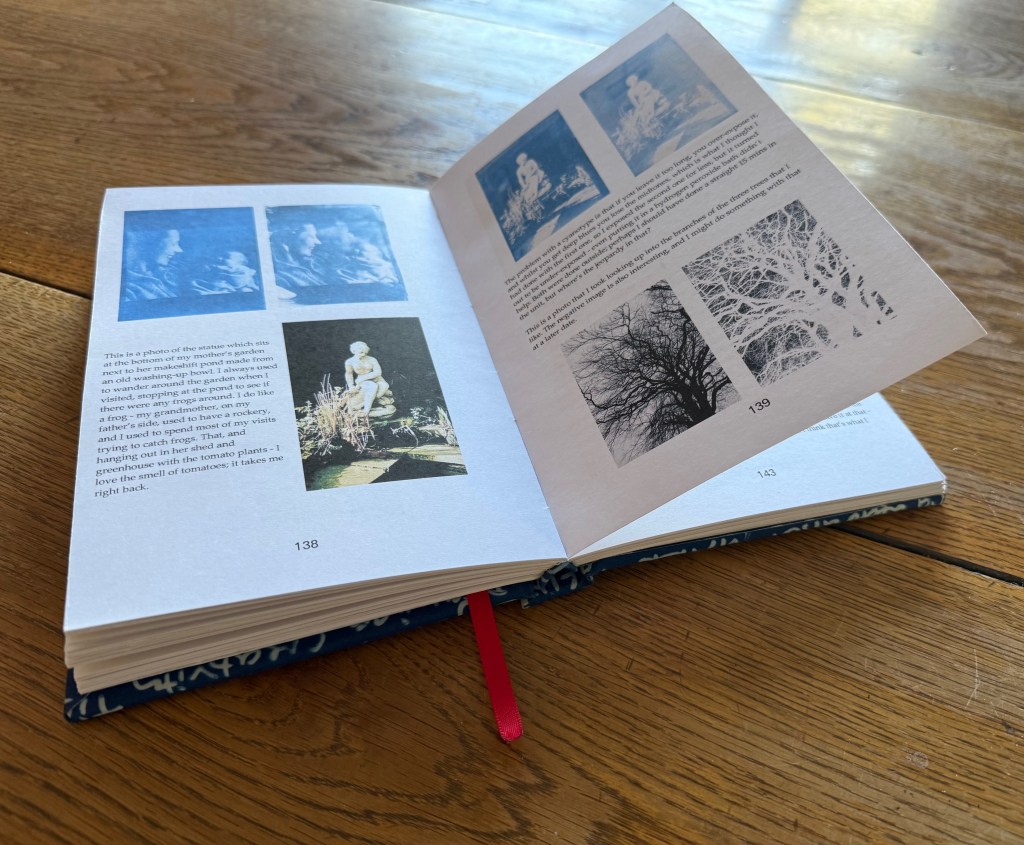
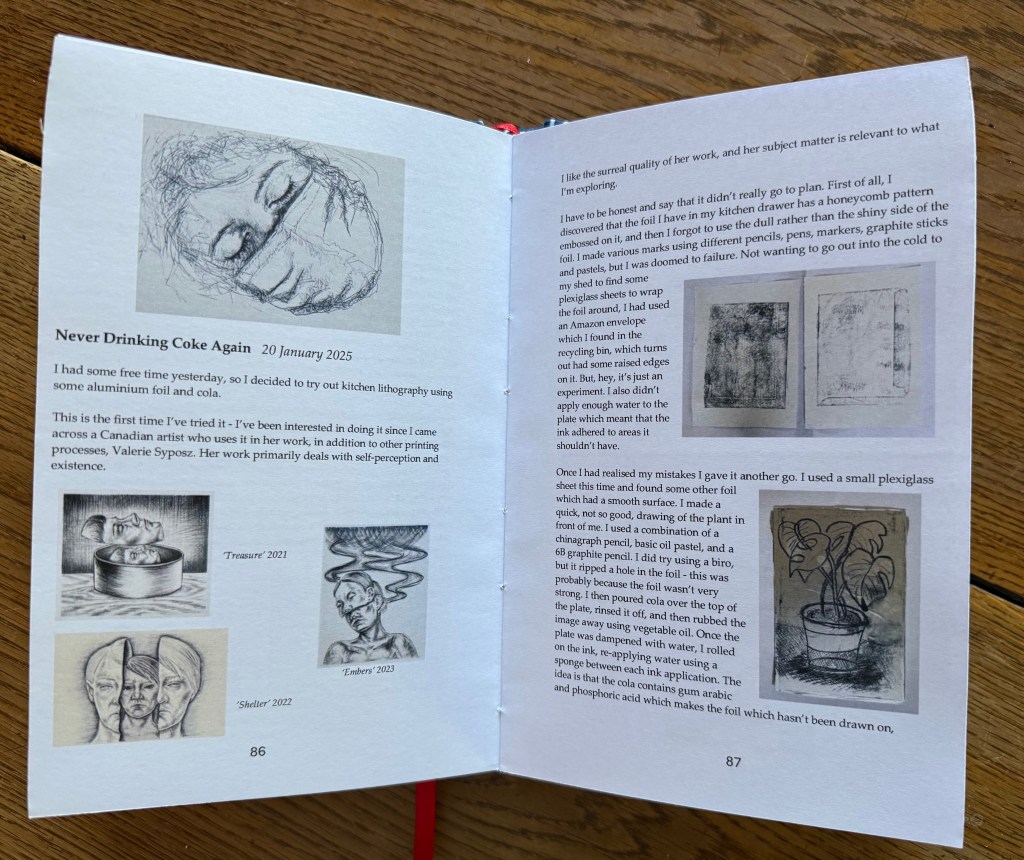
I haven’t made a book before. I’ve watched a couple of YouTube videos. I told myself not to have any expectations.
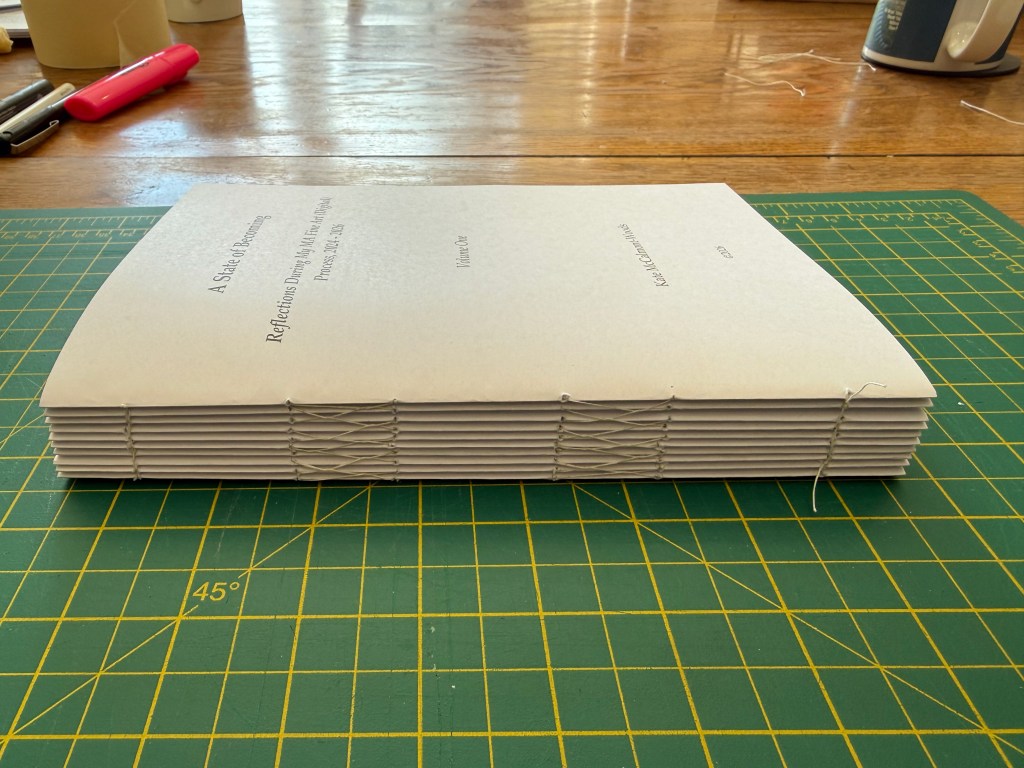
I copy and pasted my blog posts into Word booklets. Each booklet is 5 A4 sheets which is 10 sides and therefore 20 A5 pages amounting to 1 signature. The book will have 10 signatures (totalling 200 pages) and already I know that there will be more than one volume.
It was a laborious task of formatting, copying and resizing the images and creating QR codes for the videos.
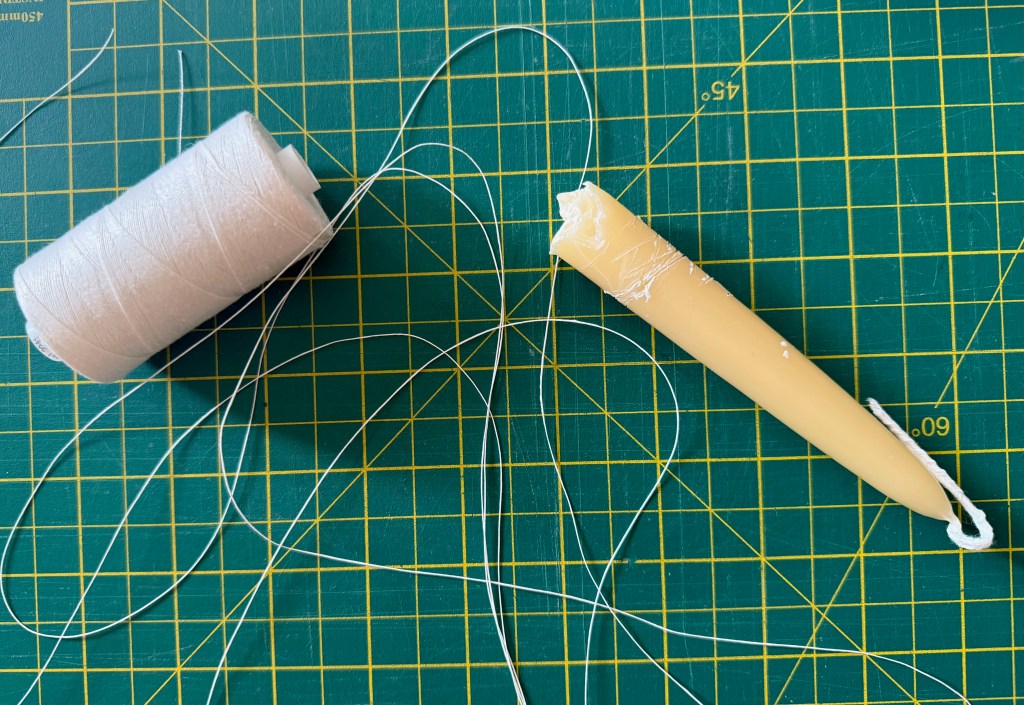
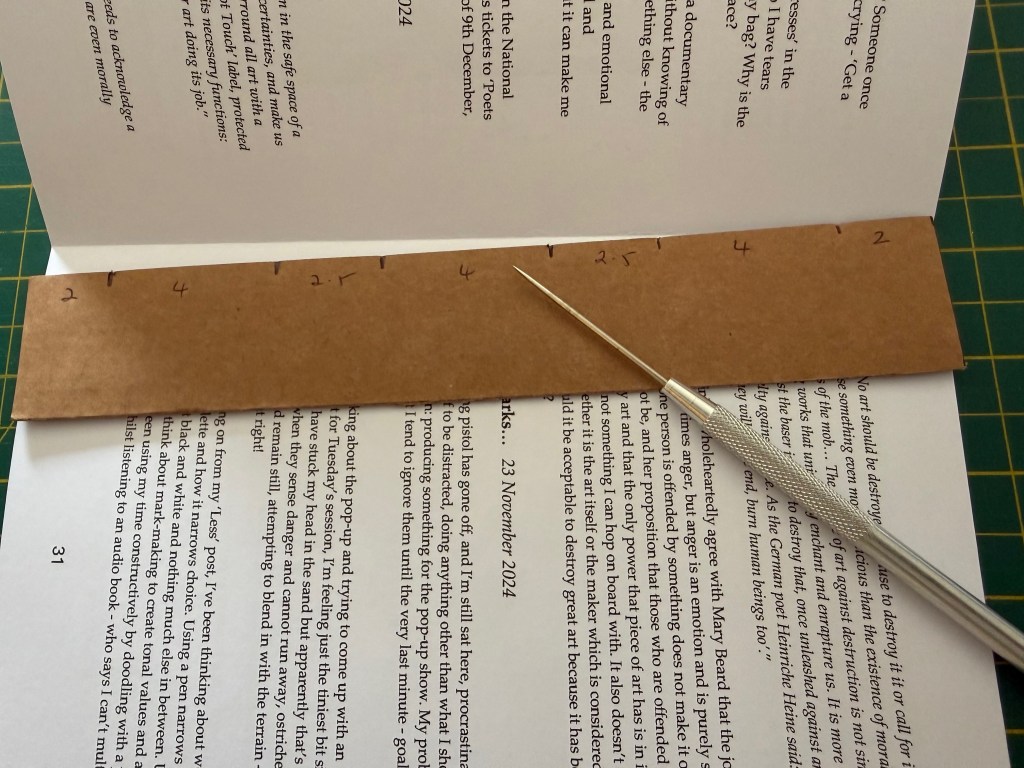
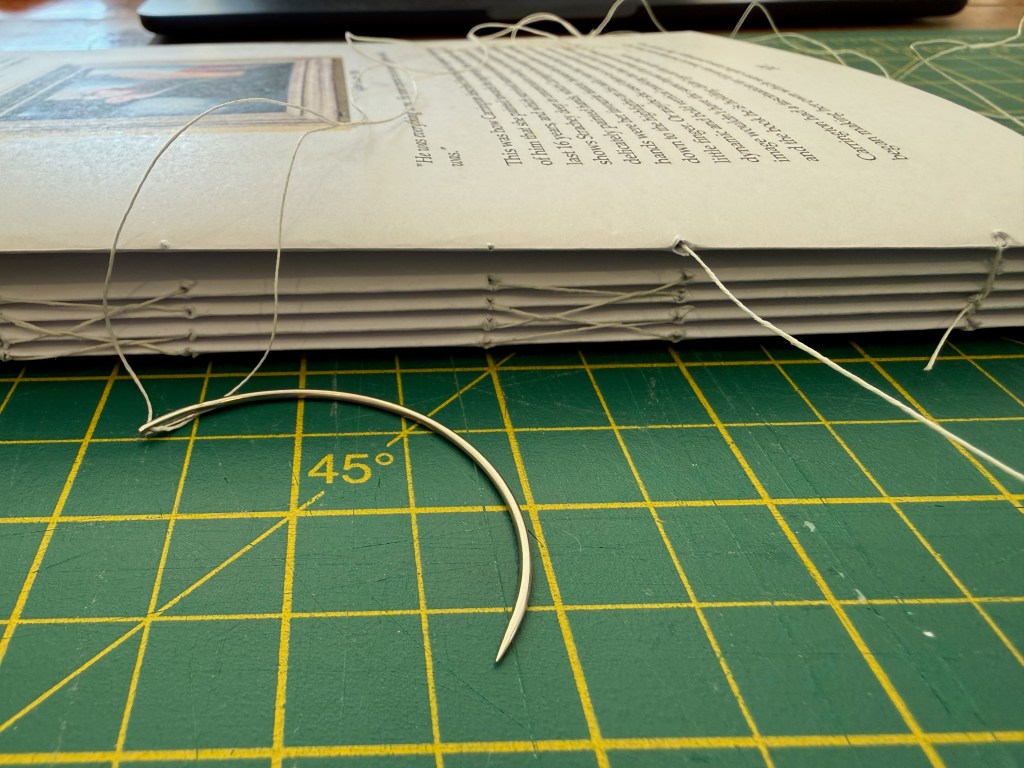
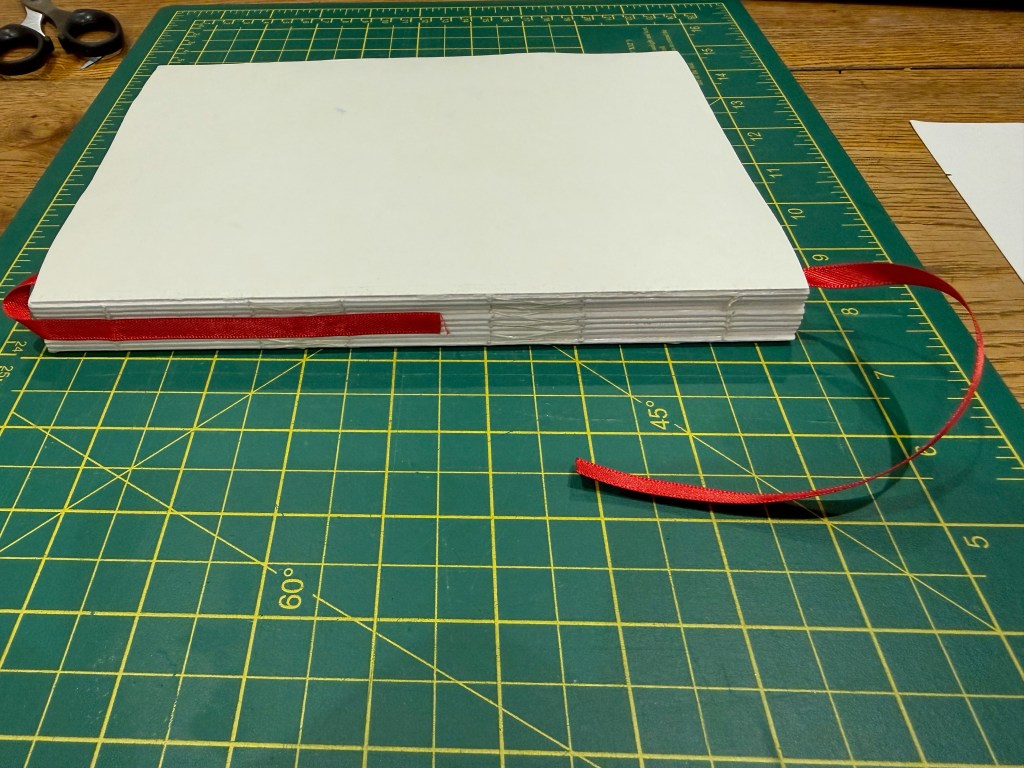
Having printed each of the signatures and folded them, I set about sewing them together using linen thread, which I waxed using a beeswax candle, and an upholstery needle. The wax helps prevent the thread from fraying and tangling. First, I had to use an awl to puncture the holes.
Then I applied two layers of archival PVA glue to the spine and attached the ribbon.
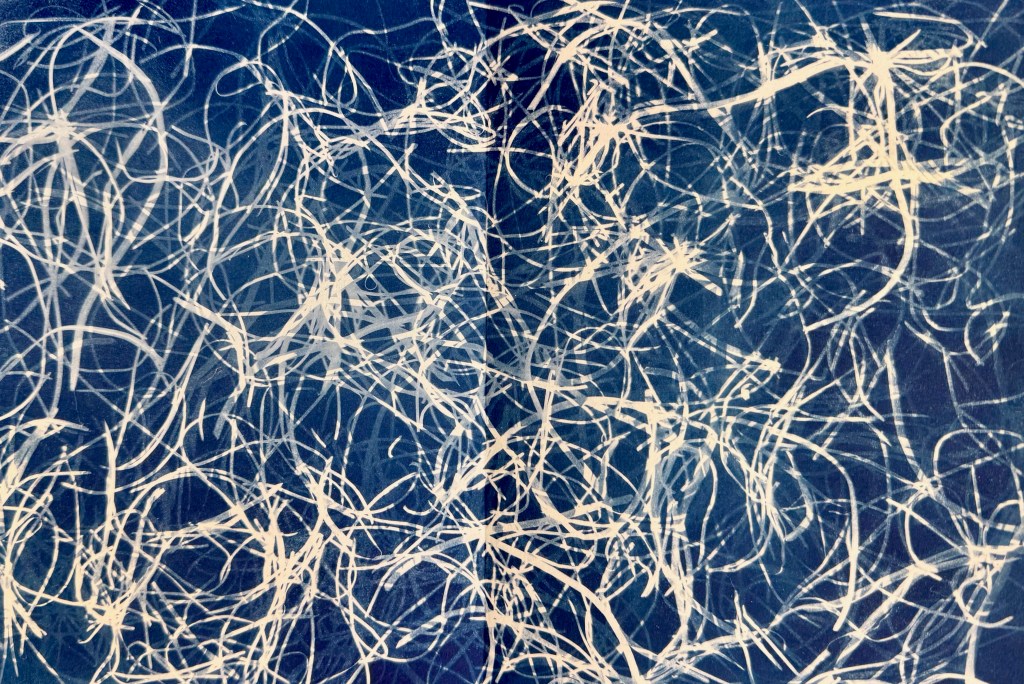
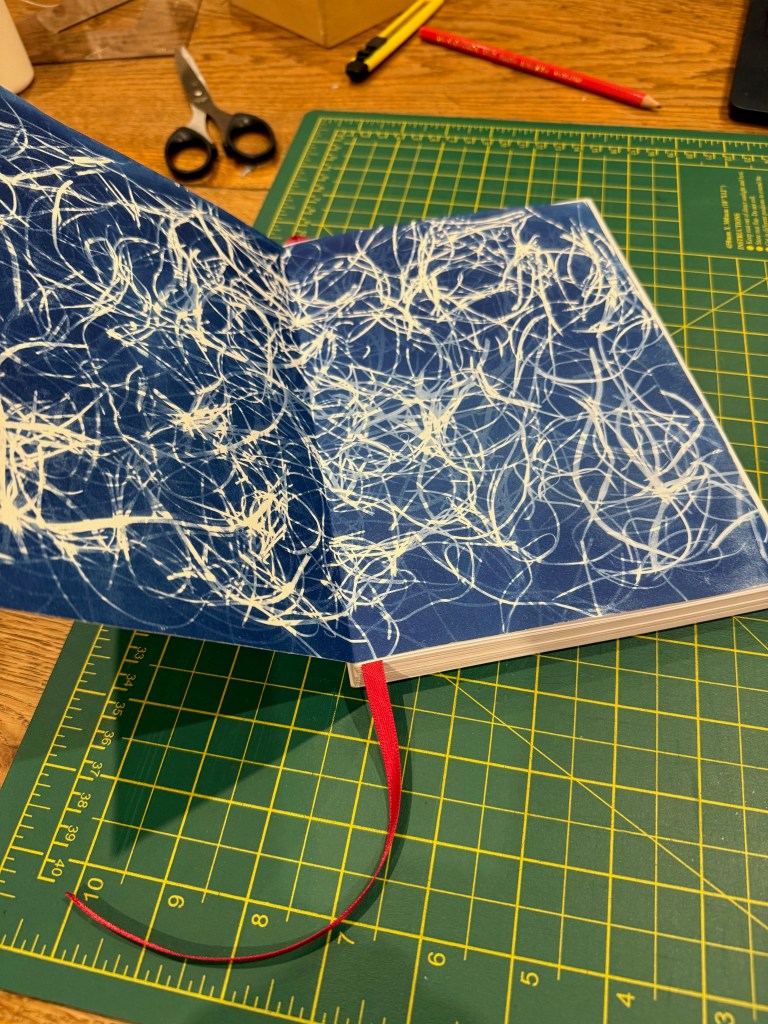
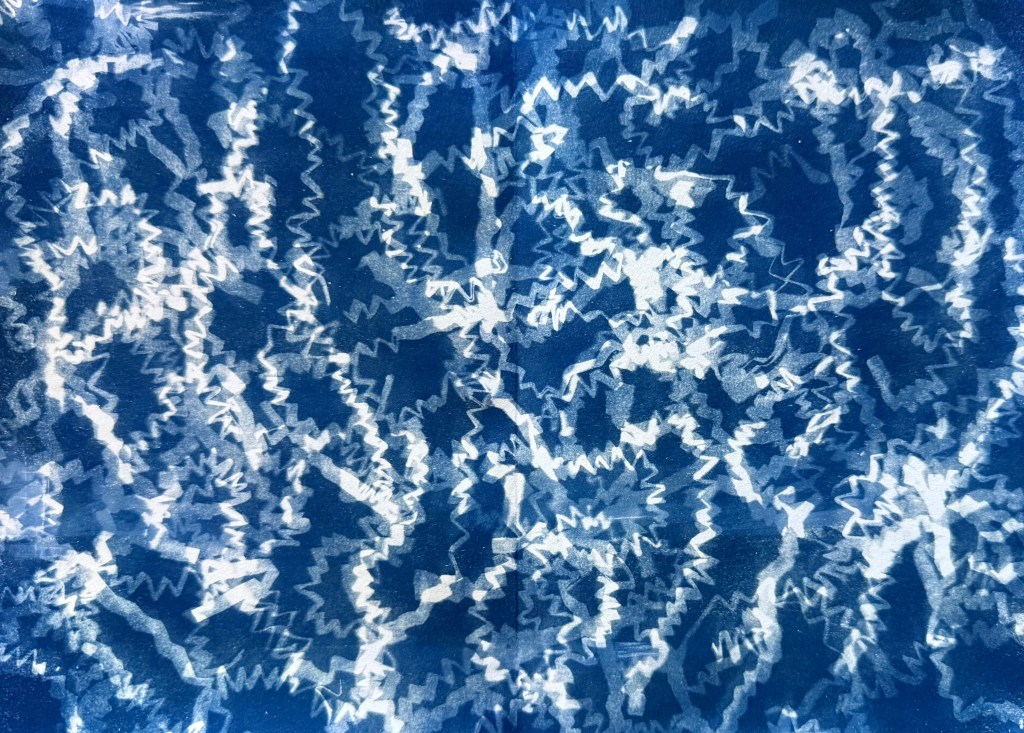
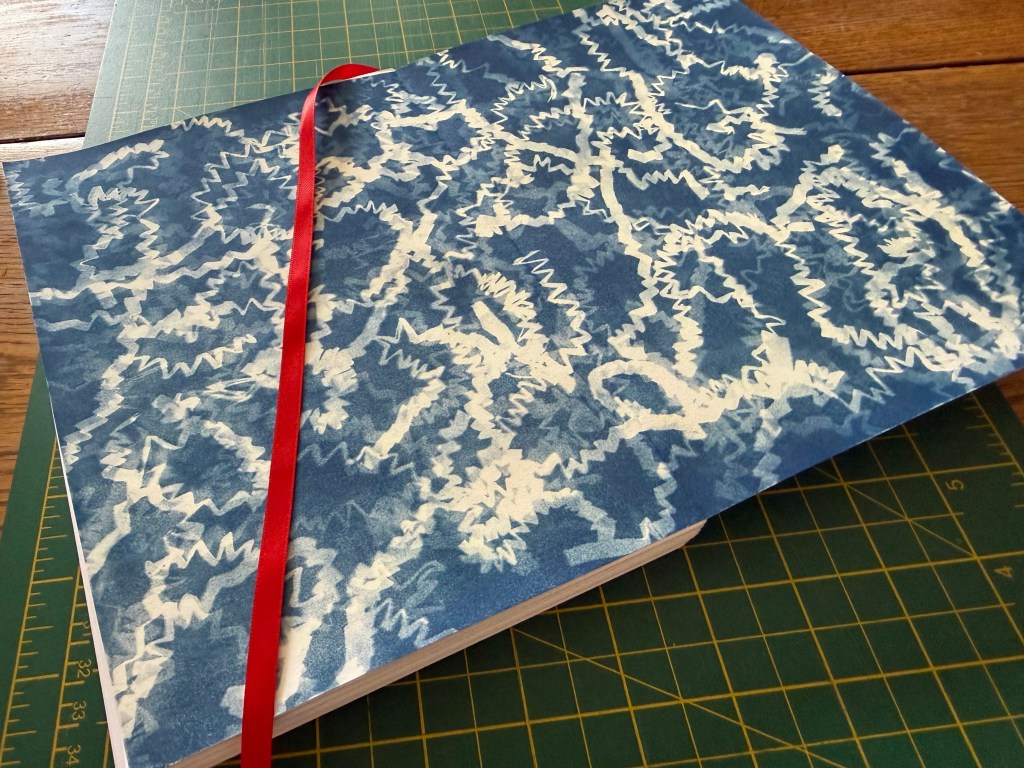
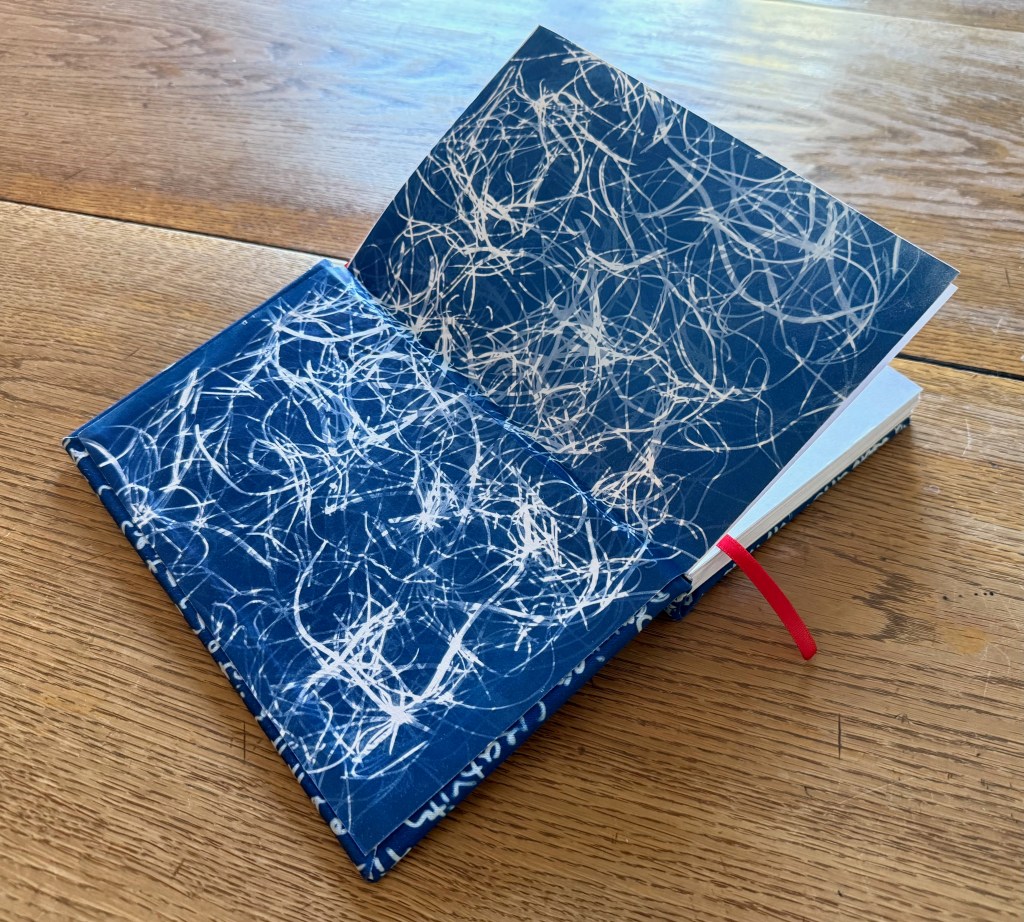
Next I had to attach the end papers. I decided to use a couple of cyanotype prints that I had made using the lino cuttings and the shredded cardboard.
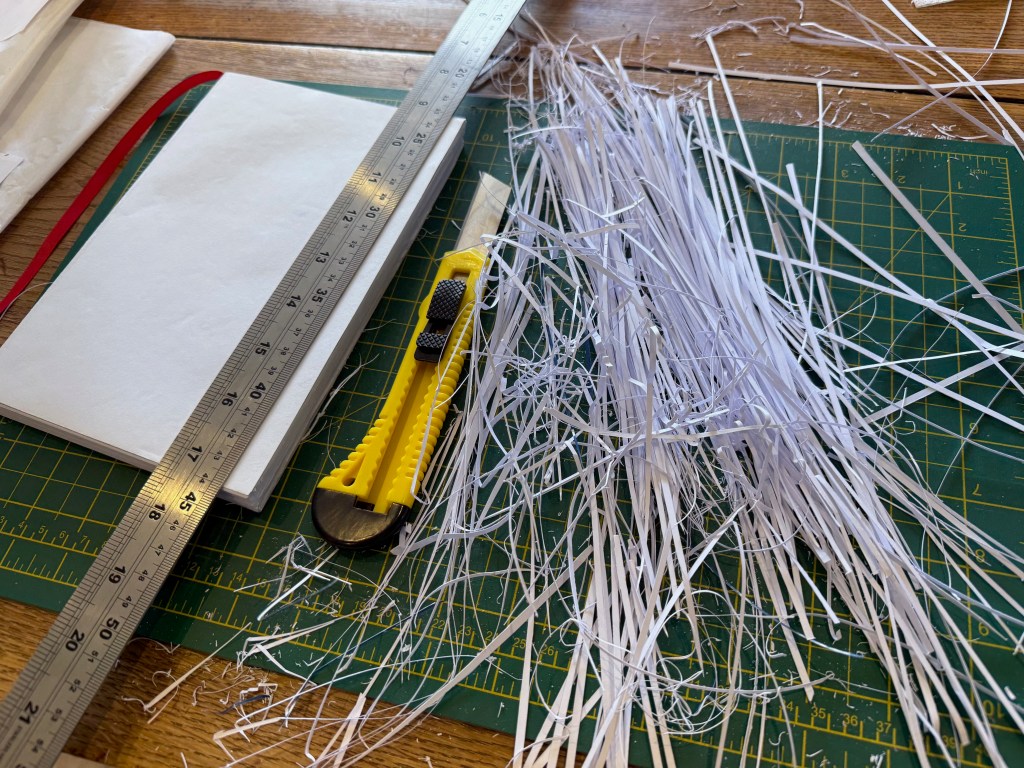
The next step was to trim the edge of the text block. When the paper is folded into signatures the outside sheets have further to wrap around and so protrude less than the inner pages. When they are sewn together it creates a zig zag effect down the edge of the pages and so this needs to be tidied up. A stack paper cutter would be ideal in this situation but the woman in the video successfully used a metal ruler and a craft knife.
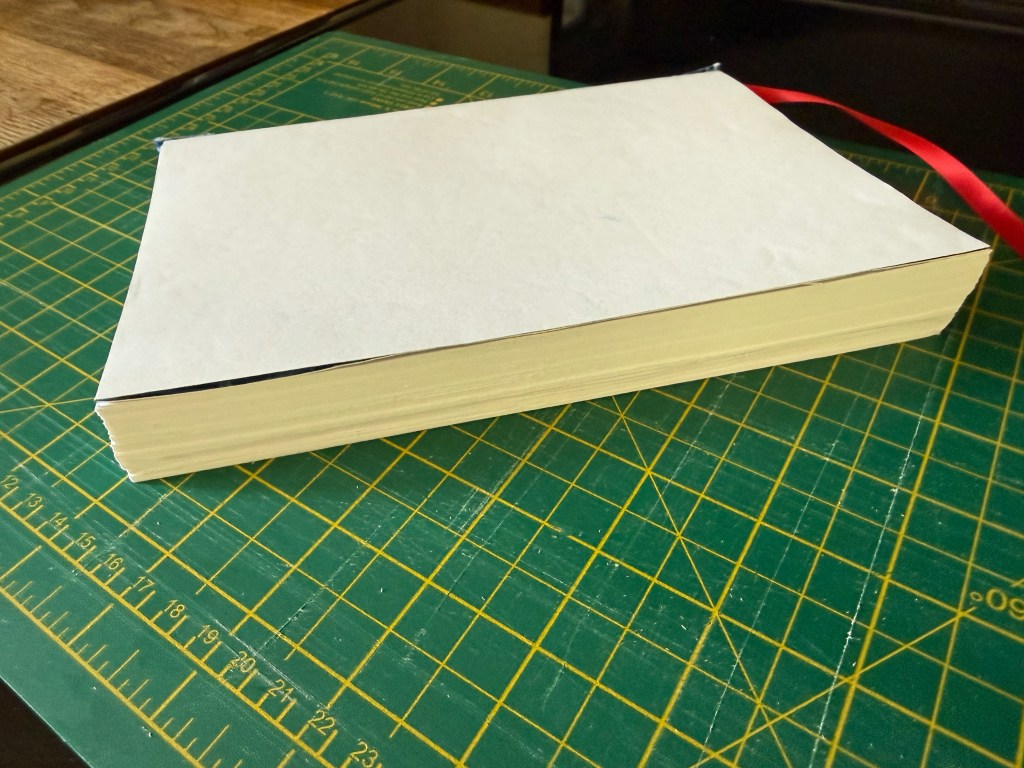
This is where it all started to go wrong. I think that the craft knife I used was too lightweight and the blade flexed so that the cut edge was all over the place. I tried to remedy it by re-trimming and unfortunately it turned into something akin to the time I trimmed my daughter’s fringe and in repeated efforts to level it out had to resort to taking her to the local hairdresser to get it fixed – ok, made to look less awful.
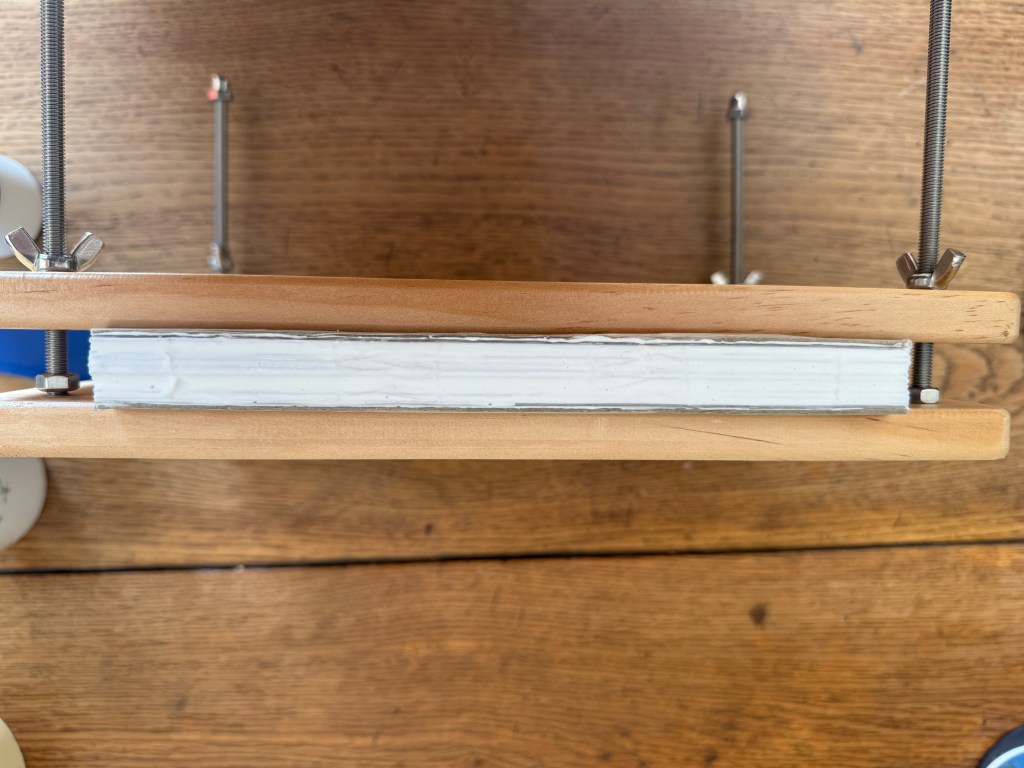
In an effort to straighten things up I clamped the text block between two pieces of grey card and used 220 grit sand paper to smooth down the edges, which seemed to make it a bit better. I appeared to be back on track.
The next stage was to make and attach the head and tail bands, and the mull.
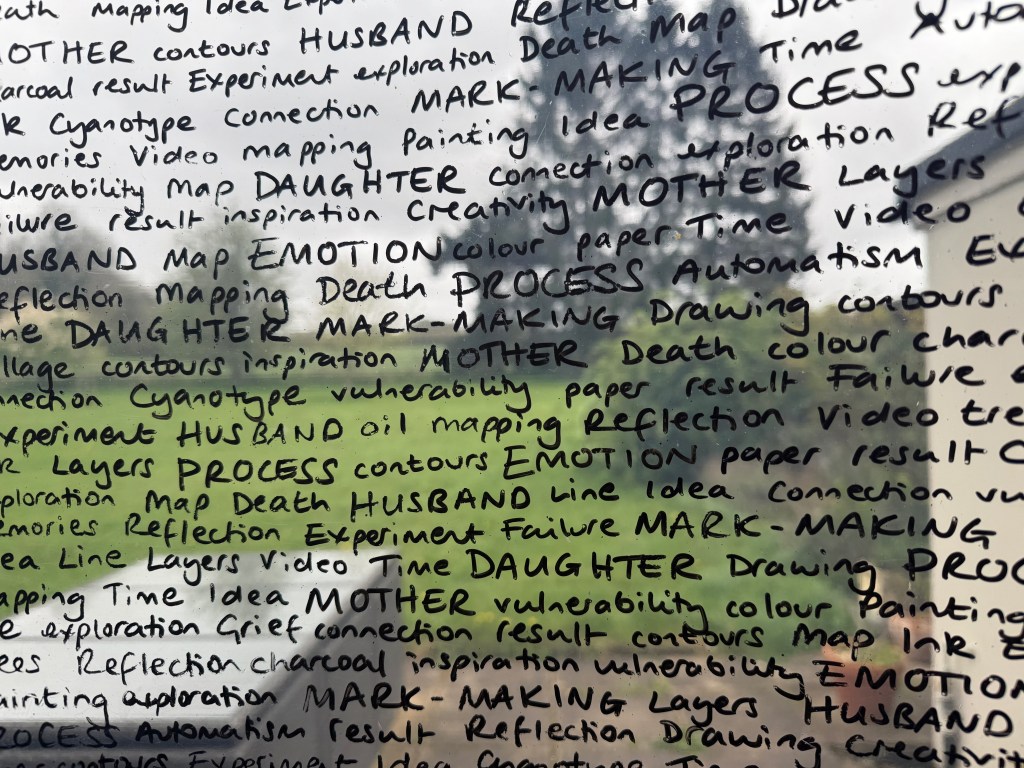
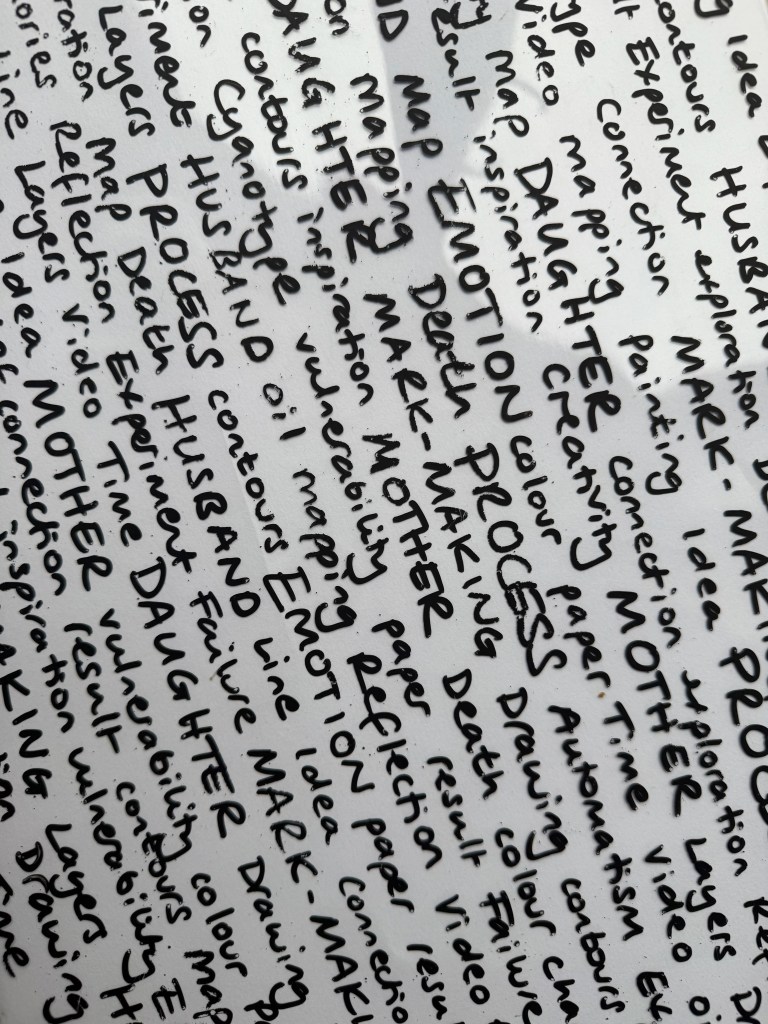
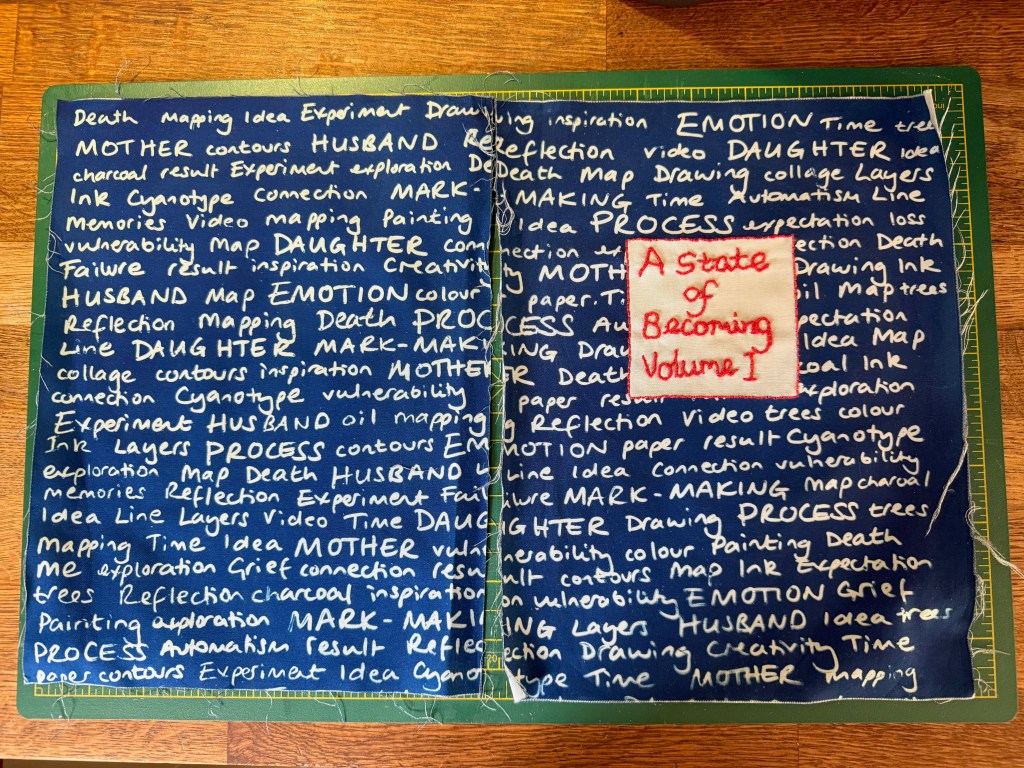
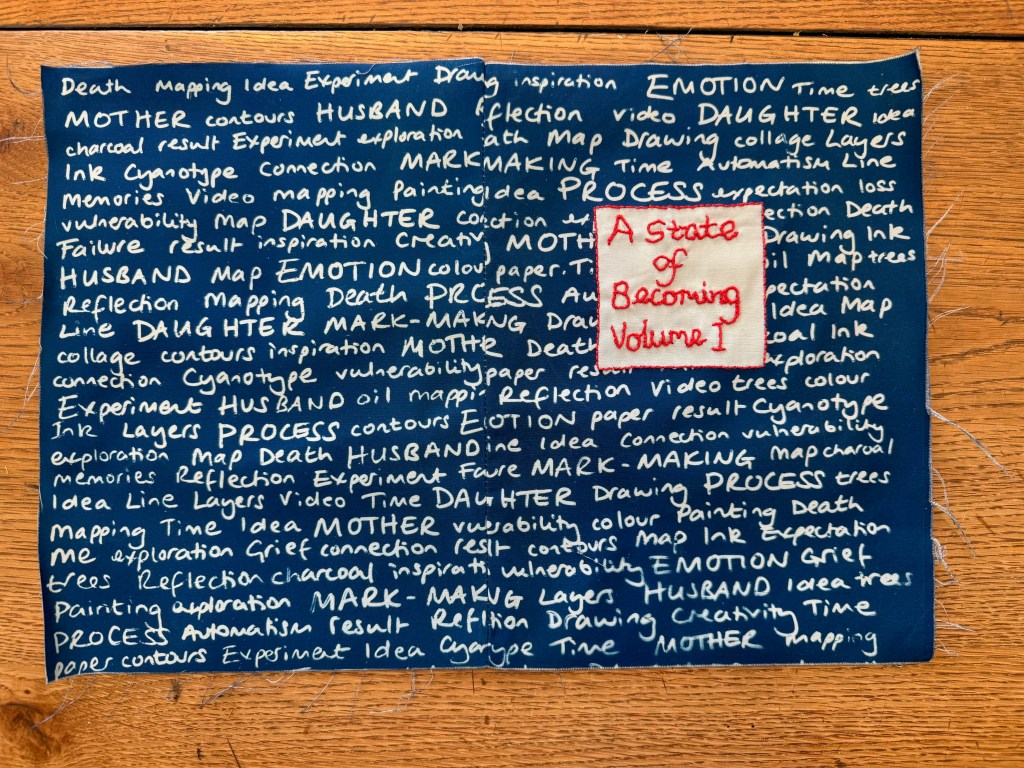
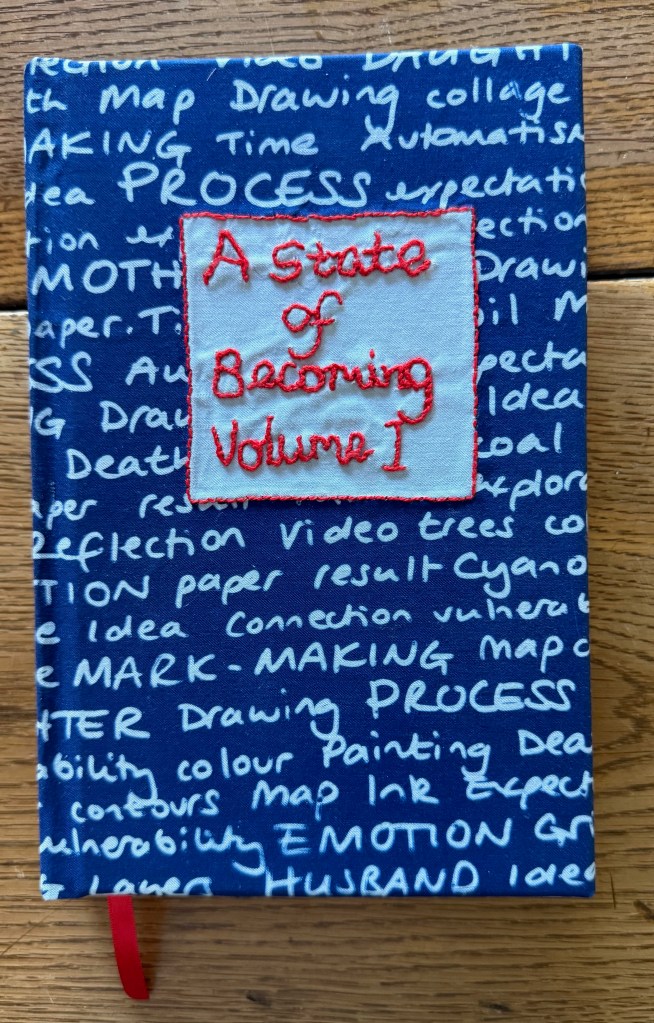
I then had to start thinking about the cover. I decided to make my own book cloth and made a cyanotype using some of the main words from my blog’s tag cloud. I wrote them onto an A3 plastic sheet and used some pretreated fabric, which unfortunately only came in A4. I masked out an area onto which I then ’embroidered’ the title.
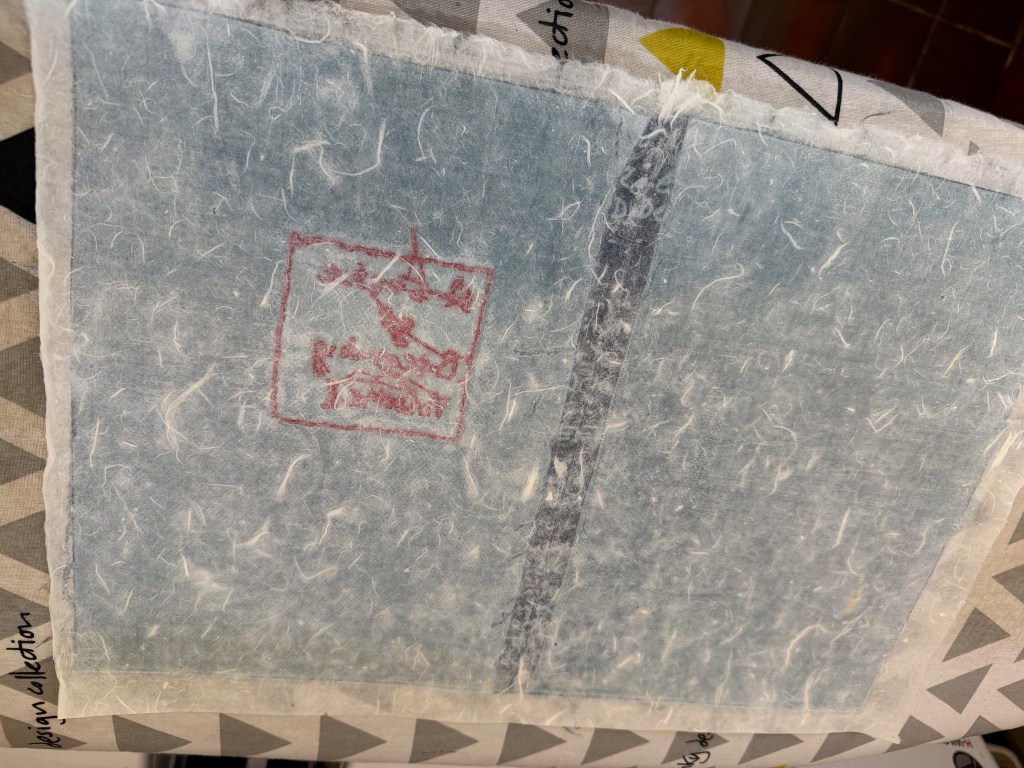
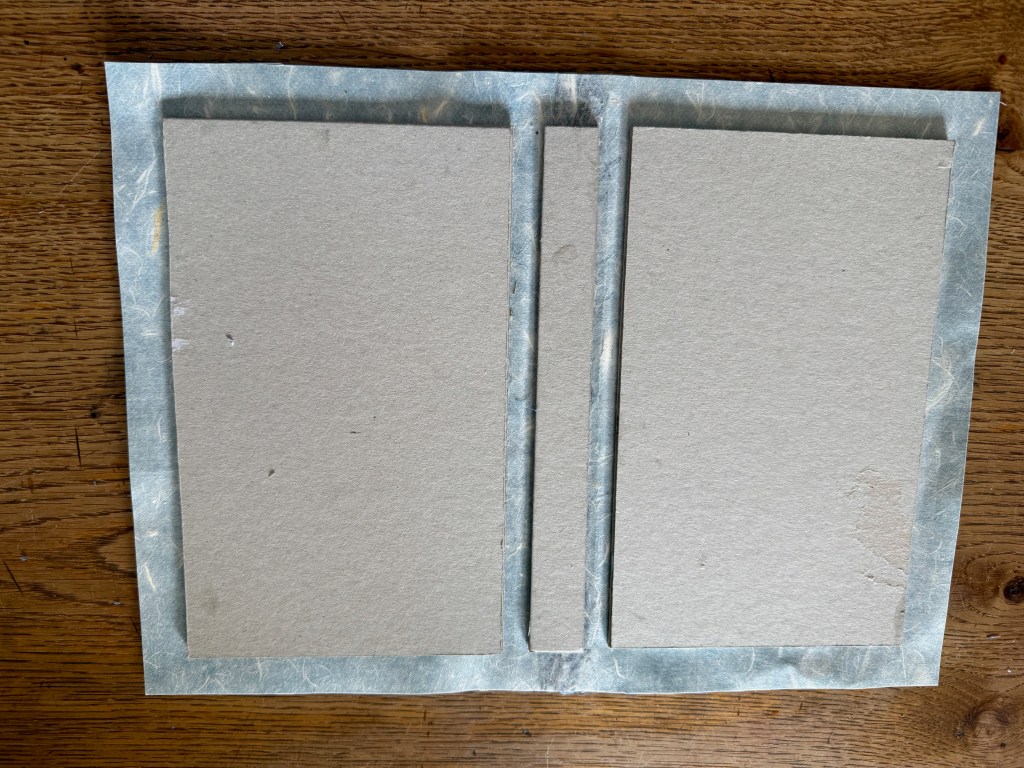
To make it into book cloth I sewed it together in such a way that the seam would run down the middle of the spine – unfortunately because of the measurements I couldn’t do it so that the words matched up. I attached some Japanese mulberry paper to the reverse using Heat and Bond.
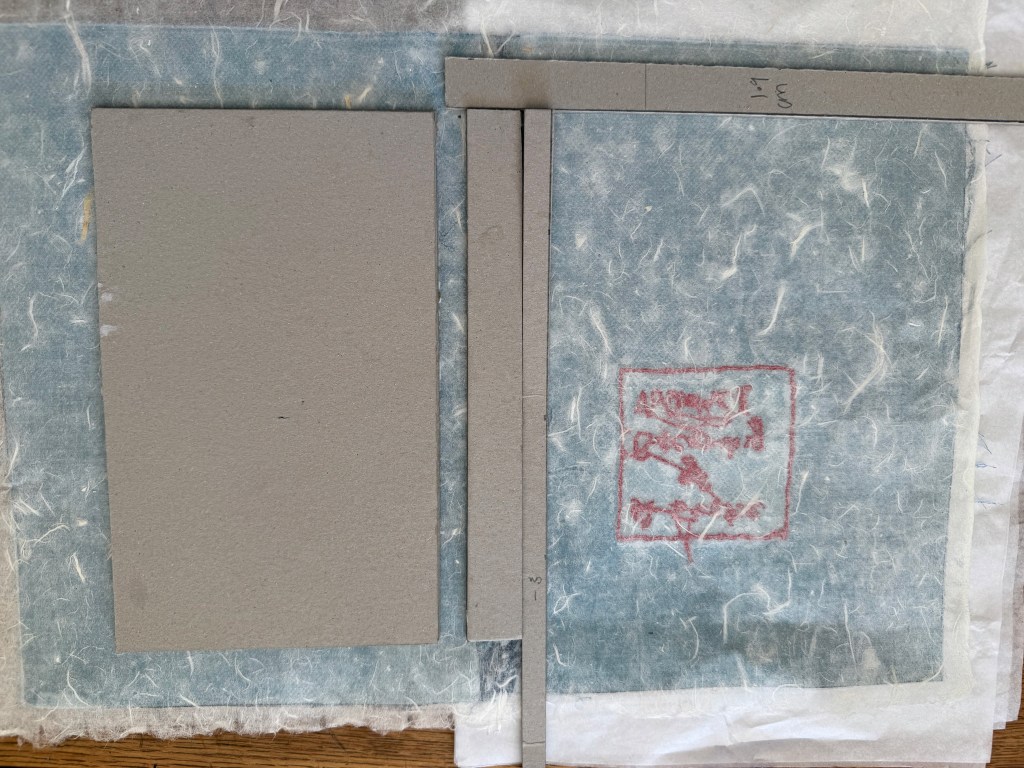
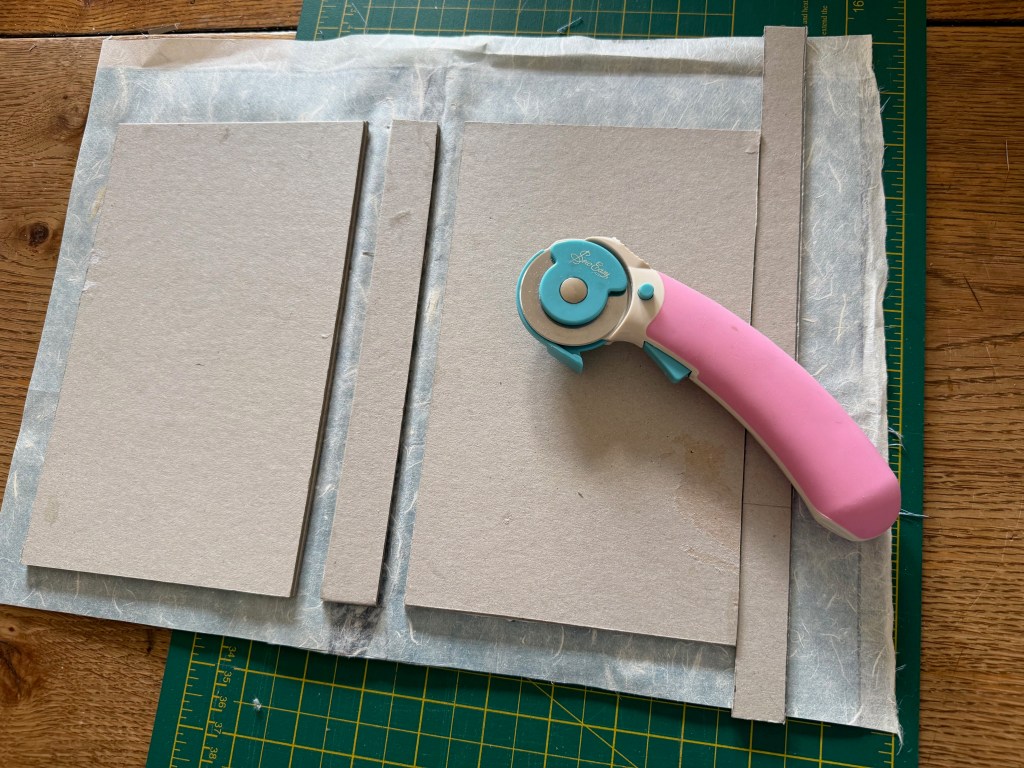
I then measured and cut the front and back boards and the spine, and then taped them together to see how they fitted the text block. The idea was to trim the long edge of the front and back boards so that they overhung the text block by 3mm. And this is where it went irretrievably wrong. I’m not quite sure what happened.
I don’t usually do fiddly and I thought that I was being extra careful in my measuring and cutting but something went wrong somewhere and 3mm doesn’t leave a lot of wiggle room. When I had folded over and glued down the edges of the book cloth I tried putting the text block inside only to find that not only was there no overhang but that the paper protruded beyond the edge of the cover in some places.
I tried removing the spine board and replacing it with thinner card and sanding down the edge of the paper. Eventually it fitted so that there was a miniscule amount of overhang but the price was that the text was very close to the edge of the page. Nevertheless, I carried on because I wanted to complete the process.
So there we have it.
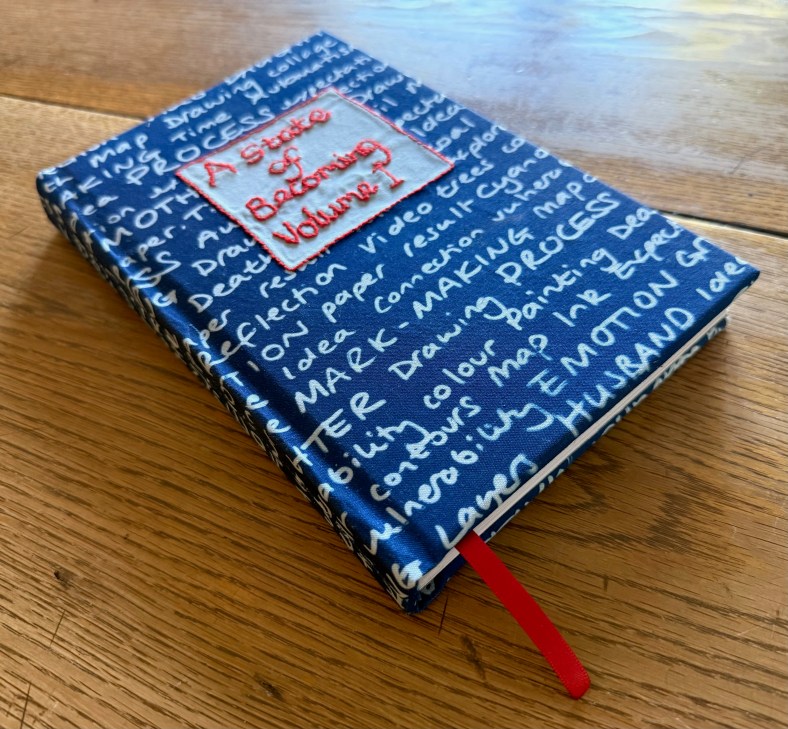
What do I think? I’m amazed that I’ve managed to produce something that looks like a book. For a first effort I’m pretty pleased with it. I feel like it’s a real achievement. Obviously there are some major issues with it but on the whole apart from the last stage I think it went quite well. I really like the cover and the end papers – I think that they work really well. I clearly didn’t set out thinking that it wouldn’t work, otherwise perhaps I would have used substitutes as I’m now going to have to make them all over again. But now that I know what I’m doing and where to be careful, it won’t take as long.
I will remake this book, but not yet. I need to feel like I’m making some progress so I will get going on volume 2, which will hopefully go a bit better, and then come back to it.
On the whole it was an enjoyable process – I enjoyed learning something new. What will I do differently next time? Oh, quite a bit! It was a great exercise from which I learnt:
accuracy in measuring and cutting is crucial
I need to get a more robust craft knife or alterrnatively contact my local printers to see if they can do the trimming for me.
The paper used for the end papers was cut from larger sheets and either wasn’t truly A4 in size or had shrunk after the cyanotyping process as they turned out to be slightly too small, but as usual I thought that I might be able to get away with it. I didn’t. Next time I should make them larger and cut down to size before attaching them to the text block.
Change the font and size of the page numbers
Think about where the thread is on the reverse of the title – connecting threads can cause lumps and bumps once the mulberry paper is bonded to the fabric
I need to adjust the margin settings – I allowed for an inside margin of 1.5cm plus a 0.5cm gutter and an outside margin of 1.5cm. Once the book was put together the inside margin turned out to be quite generous whereas the outside margin turned out to be problematical after my attempts at trimming. I think next time I will reduce the inside by 0.5cm and increase the outer by 0.5cm.
What I find intriguing is that the act of researching and making this book to document my becoming, is itself part of the process of becoming.