Life

As I sit here looking out of the window in need of a good clean, my husband is cutting the overgrown grass. The glass table has turned opaque with dust and the dog is giving off an overly ripe odour (well, at least I think it’s the dog).

And this is how I know that the way I have been working, particularly recently, is not sustainable. The ‘it’s for my course’ has been both a blessing and a curse. It has validated me spending time making art but on the other hand, as usual, I have gone all in and seen it as a permission to be totally selfish and to allow my head to be somewhere else for most of the time and, to be fair, I did warn them that this would be the case. There have been times when I’ve been so caught up in the intensity of making that I’ve emerged at the other end feeling like I’ve binge-watched a box set or had one too many chunky Kit Kats. I’ve needed a break after such episodes, which probably explains why my rhythm of making is not consistent but in sporadic bursts.

Everything in moderation – isn’t that the key? Well, perhaps not necessarily in moderation, but certainly with more attention on life in general. It’s getting to the stage where I’m finding it difficult to hold more than one thought in my head at a time – road taxing the car and whether I should try cyanotyping on tracing paper. I used to think that I should allow myself to be submerged in the making process for as long as I need to, at the expense of whatever else was going on; to seize the inspiration and run with it. But that’s not the way forward. Once this course is over I won’t be able to say that ‘it’s for my course’.

I’ve been thinking about this a lot recently and I have recognised that I need a little structure, nothing too rigid but with enough strength to support my practice in how, when and where I make. For the first part of this course I went full on into experimenting to try and rid myself of the product driven perfectionist self. This approach worked as I immersed myself in the process not worrying about results but simply making and responding, although I realise that I can never be truly free from that side of myself. It felt so liberating, but having broken out there was so much out there for me to try and I suddenly felt the urge to try everything. But I don’t do well with overwhelm – even the process of deciding on a research question overwhelmed and subsequently paralysed me. In the past I have reacted to overwhelm by going to the extreme of trying to take control. In retrospect, I now see that didn’t work either, so there must be a half-way house.

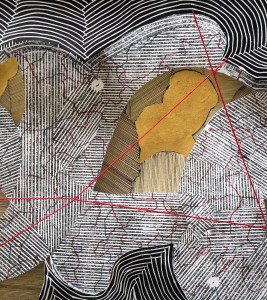
Because of the contentment that I felt when I started making the line drawings at the beginning of the last term, I now realise that whilst I my practice is still very firmly rooted in the experimental and the process, I do need some soft structure to keep my perfectionist goal-driven self, quiet. This soft structure in how I make takes the form of repetitive mark-making, using the same patterns and motifs such as the contour lines, my father’s silhouette, automatic line drawings etc. Just recently I’ve also found that working on more than one thing at once has also been beneficial. When I get fed up of formatting the blog for the book, I go and do something else and whilst that is drying I move on to another. I also think that the concept of soft structure will also enable me to make work which is capable of fulfilling a brief as opposed to being solely the result of experimentation, which has been a concern of mine in looking towards the future.

In terms of where I make, I am in the process of sorting out an outbuilding where I will be working. I have been sorting it out for the last two years, but up until now I haven’t really needed it. I need it now to create a separate physical space to work where it will be more difficult for everyday life to encroach. Getting a studio somewhere would probably be the cleanest solution, but then what about those days when I’m not really in the mood? At least this way I’ve only a short walk.

As for when I make, the making the most of the moment approach will have to change because of its impact on everyday life. I need to decide how much of my time is to be spent on my practice and when. Making a rigid timetable won’t work – my work plan to my Study Statement proves that. Maybe a general aim to spend x hours a week, or a number of half days. I think that’s something which will emerge in practice. So, from now on, as an experiment, I will spend my mornings during the week on art making and course related activities. After lunch I will then concentrate on everyday tasks and once they have been completed, I’m free to return to art. Obviously, I’ll have to fit in other activities so there will have to be some adjustments.

The irony of having to separate my everyday life from my art practice which is grounded in everyday life, doesn’t escape me.

A Light Bulb Moment, Or Is It?

In last week’s session we thought about ideas.

Where do my ideas come from?

From my lived experience; my past, my present, my interactions with the world and the people in it, a moment in time, what I read, hear, see, feel, smell and taste.

What do they look like?

A network or web where they interconnect, or wait to be connected.

What kind of a web is it?

A spider’s web. Some ideas are fleeting and wispy and drift away, whilst others are more robust and have some form.

Other’s ideas are like seeds which grow over time (akin to Bateson’s ecology of the mind in which, like organisms, ideas grow and flourish whilst others become extinct) which need to be cared for and nurtured, or a breeze or mist, pre-existing ideas waiting to be received.

Maybe the source of the idea depends on what interests you at any point in time. I’m interested in my experience of living in the world, and so I don’t think that my ideas pre-exist because they are bespoke to my unique lived experience. Often they are triggered by something, a reaction to something, and so they don’t often come to me out of the blue. They are a combination of everything and anything, but at their very basic I believe that they are a matter of neuroscience; the complex neural interactions between knowledge, memory, emotions, and experience, all being broken down and continuously recombined in infinitesimal permutations, consciously and subconsciously in dreams, flow states, and acts of automatism.

Just because they are bespoke to me doesn’t necessarily mean that they are original. Gompertz doesn’t think that originality in a completely pure form actually exists and that all ideas are additional links in an existing chain (Part One: Think Like An Artist). There are numerous quotes from creatives who have built on the ideas of others: Newton and the shoulders of giants; Jobs and stealing great ideas; Twain who said that all ideas are secondhand, consciously or unconsciously drawn from a million outside sources.

We then considered Brian Eno’s concept of the ‘scenius’ (a creative co-operative of intelligence) and the articulation of the ideas of the scenius by an individual who is then held up by society as being a genius. On reflection, I think that he is right to the extent that the genius is just the tip of the scenius iceberg, but that both should be equally celebrated, and the attribution of the idea should be shared. It’s not enough to have an idea – it needs to be acted upon and often this involves elements of risk, courage and persistence.

Undoubtedly, collective recognition encourages greater sharing of ideas and increased creativity. In this respect, the existence of a scientific scenius goes some way to explaining why two different people can come up with same idea at the same time eg Bell and Gray, who both came up with same idea of the telephone. But, the idea didn’t come from nowhere – the circumstances at the time were demanding a solution to an existing problem, and the latest scientific developments and knowledge in the field, which were needed to devise the solution, were already widely known and shared amongst the scientific community, to the extent that Gray and Bell had detailed knowledge of each other’s work. So really, it was just a matter of time before someone came up with it. Maybe to that extent, it could be said that the idea was in the ether waiting to be received by someone who was attuned and had the requisite knowledge to implement it.

It’s All Part Of The Process

I’ve been doing quite a bit of thinking this week.

The first time, as a result of our weekly session, unprofessional v professional. We considered all that is implicit in the terms professional and unprofessional, and then read and discussed an article ‘How to be an Unprofessional Artist’ by Andrew Berardini, 23 March 2016, MOMUS.

I came away from the session feeling confused, and no longer having a clear sense of direction. My aims in my Study Statement are designed to help me fulfil my aspiration of becoming a practising professional artist. I’m now questioning what I even mean when I use the term ‘professional’. If it means losing creative autonomy, losing the love of creating because it has become an expectation or much worse, a chore; having to repeatedly make things because they are popular or asked for, then, no, I don’t think that’s what I want. But what is the alternative, just to carry on as I am now, making art for me and leave it at that – be a hobbyist like my mother said; be an amateur? I don’t think that’s what I want either. That’s not why I’m here.

Maybe when I get there, if I ever do, the answer will become clear. Perhaps the best course of action is to aspire to be a practising artist for the time being, making more time for creating. There’s no point trying to run before I can even walk.

I then spent some time reflecting on the cyanotypes I made, and all the possible further paths that I could go down. I started thinking about processes and re-processing. How you can take a painting, for example, take a photo of it, digitally alter that photo, incorporate other elements, say, by way of collage, print it out, print on top of it, paint on it, photograph it, keep changing it, keep re-processing it.

It then occurred to me that I’m just one big walking process made up innumerable smaller processes – breathing, talking, thinking, digesting, and on and on. Not just that, but that life is a process with all its constituent processes. Growing, having children, loving, caring, grieving, healing, dying are all processes by which we are, ourselves, processed.

So, I think that I’ve reached a point where I’m thinking about the reprocessing of art and the reprocessing of me. It’s probably because I’ve been thinking a lot about process recently, writing the word goodness knows how many times in Doing Lines, and reading ‘Ultra-Processed People’ by Chris van Tulleken. But it does occur to me that I have led most of my life too focused on the product, and not really living in the process.

Something for me to think about.

A Brainstorm In A Coffee Cup

I’ve been thinking about my discussion with Jonathan; about the ideas I have, and his advice that I should record them in this blog to remind me of them in the future. I find it easier to scroll quickly through the blog than sift through bits of paper, or flick through sketchbooks trying to find them.

I had an unexpected opportunity to start the process this morning. One of the good things about getting older is that you start being called in for regular tests and health reviews. I’m in the process of one such MOT – I have had my bloods done; liver function OK I noted from my NHS app (which seems to be filling up with more and more of my records everyday) and Type II Diabetes is still a way away so that’s good news for both my gin collection and my stash of chocolate. Cholesterol is a bit on the high side, but then it always has been – it’s all that good cholesterol, or so I keep telling myself – but there’s no getting away from the fact that women of my age are at an increased risk of heart attack. I’m starting to think that I’m a hypochondriac who is obsessed with death, but really I think that I have quite a positive outlook on life.

Anyway, for some reason I got a message on my phone yesterday notifying me of an appointment this morning for an ECG. Maybe it was a follow up to my cholesterol levels? They don’t even phone you nowadays I thought to myself – imagine if I hadn’t seen the notification? Anyway, long story short, when I arrived at the surgery after having rushed because I thought that I would be late, heart pumping a bit too quickly just before an ECG I thought to myself, it turns out that it was an admin error and it had been meant for someone else. I was out of bed now, so I might as well go and have a quiet stimulating coffee before heading back home.

So I did, and I did some thinking, made some notes and made a quick mind scribble when I got back home. It feels a bit like just having put the children to bed – I know where they are, and they’re safe.

Reflecting on Resentment II

I’ve rewritten this post so many times. It has become progressively shorter. Sitting back and reflecting, I can see what is important. The first version was just a rant.

In late 2022, my mother was diagnosed with oesophageal cancer. No treatment was offered. At best she had 6 months left. Her GP had messed up. The hospital messed up. My sister and I cared for her full-time. It was the worst, and darkest period of my life.

This wasn’t how it was supposed to be. Six months to live? Well, we could go places and make the most of it, create some new memories. But she was already too weak. Instead, the memories I have of that time seep into my mind when it’s not thinking of something else, usually before I go to sleep; then I can’t go to sleep and I sit up alone in the kitchen turning it all over, reliving it. Nothing makes it feel any better.

My mother died at home in the spring of 2023, three days before her 85th birthday. I cannot say with any honesty that she experienced quality of life in those last months. She was waiting to die, and I was just watching her gradually turn into a skeleton.

I resent that medical professionals have failed my family, not just in respect of my mother, but also my father – I made formal complaints in both instances – lessons will be learnt, apparently – but this has done nothing to ease my resentment.

I resent that because she was old, my mother was effectively written off.

I resent that everything was such a battle and I had to spend so much time chasing and making sure things were done.

I resent that there are old people in hospital who are overlooked, and who don’t have a voice or someone to speak up for them.

I resent that my sister and I were left to deal with everything, both before and after my mother’s death.

I resent that in the last few months of my mother’s life the days were short, and the nights were long.

I resent that those last few precious months were stolen from me.

I resent that the last words my mother spoke to me were when she wasn’t herself.

But, most of all, I resent the resentment that I feel: it’s preventing me from moving on.