As I sit here looking out of the window in need of a good clean, my husband is cutting the overgrown grass. The glass table has turned opaque with dust and the dog is giving off an overly ripe odour (well, at least I think it’s the dog).
And this is how I know that the way I have been working, particularly recently, is not sustainable. The ‘it’s for my course’ has been both a blessing and a curse. It has validated me spending time making art but on the other hand, as usual, I have gone all in and seen it as a permission to be totally selfish and to allow my head to be somewhere else for most of the time and, to be fair, I did warn them that this would be the case. There have been times when I’ve been so caught up in the intensity of making that I’ve emerged at the other end feeling like I’ve binge-watched a box set or had one too many chunky Kit Kats. I’ve needed a break after such episodes, which probably explains why my rhythm of making is not consistent but in sporadic bursts.
Everything in moderation – isn’t that the key? Well, perhaps not necessarily in moderation, but certainly with more attention on life in general. It’s getting to the stage where I’m finding it difficult to hold more than one thought in my head at a time – road taxing the car and whether I should try cyanotyping on tracing paper. I used to think that I should allow myself to be submerged in the making process for as long as I need to, at the expense of whatever else was going on; to seize the inspiration and run with it. But that’s not the way forward. Once this course is over I won’t be able to say that ‘it’s for my course’.
I’ve been thinking about this a lot recently and I have recognised that I need a little structure, nothing too rigid but with enough strength to support my practice in how, when and where I make. For the first part of this course I went full on into experimenting to try and rid myself of the product driven perfectionist self. This approach worked as I immersed myself in the process not worrying about results but simply making and responding, although I realise that I can never be truly free from that side of myself. It felt so liberating, but having broken out there was so much out there for me to try and I suddenly felt the urge to try everything. But I don’t do well with overwhelm – even the process of deciding on a research question overwhelmed and subsequently paralysed me. In the past I have reacted to overwhelm by going to the extreme of trying to take control. In retrospect, I now see that didn’t work either, so there must be a half-way house.
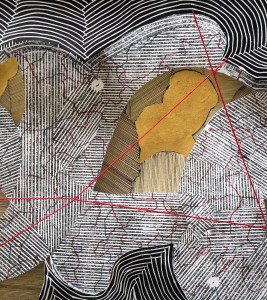
Because of the contentment that I felt when I started making the line drawings at the beginning of the last term, I now realise that whilst I my practice is still very firmly rooted in the experimental and the process, I do need some soft structure to keep my perfectionist goal-driven self, quiet. This soft structure in how I make takes the form of repetitive mark-making, using the same patterns and motifs such as the contour lines, my father’s silhouette, automatic line drawings etc. Just recently I’ve also found that working on more than one thing at once has also been beneficial. When I get fed up of formatting the blog for the book, I go and do something else and whilst that is drying I move on to another. I also think that the concept of soft structure will also enable me to make work which is capable of fulfilling a brief as opposed to being solely the result of experimentation, which has been a concern of mine in looking towards the future.
In terms of where I make, I am in the process of sorting out an outbuilding where I will be working. I have been sorting it out for the last two years, but up until now I haven’t really needed it. I need it now to create a separate physical space to work where it will be more difficult for everyday life to encroach. Getting a studio somewhere would probably be the cleanest solution, but then what about those days when I’m not really in the mood? At least this way I’ve only a short walk.
As for when I make, the making the most of the moment approach will have to change because of its impact on everyday life. I need to decide how much of my time is to be spent on my practice and when. Making a rigid timetable won’t work – my work plan to my Study Statement proves that. Maybe a general aim to spend x hours a week, or a number of half days. I think that’s something which will emerge in practice. So, from now on, as an experiment, I will spend my mornings during the week on art making and course related activities. After lunch I will then concentrate on everyday tasks and once they have been completed, I’m free to return to art. Obviously, I’ll have to fit in other activities so there will have to be some adjustments.
The irony of having to separate my everyday life from my art practice which is grounded in everyday life, doesn’t escape me.
 Kate McCalmont-Woods