A Wobble

I’ve often suffered from buyer’s remorse; the last time it happened was when I bought my new rug in Marrakech. Did I just buy it in the fervour of the moment? Would it actually fit in at home? How was I going to get it back home on the plane? Would it fit in my suitcase? Did I pay too much? I did haggle for it, but did I haggle enough? Had someone else bought something similar and paid a lot less? If they had, how would that make me feel? Whilst I appreciate that the worth of something is what someone is prepared to pay for it, everything is so much simpler and fairer when there is a fixed price.

I experienced a new feeling recently – blogger’s remorse. Should I have posted ‘Three Conversations With My Mother’? In the moment it felt right, but as is always the case with me, the doubt started to creep in. The phrase ‘act in haste, repent at leisure’ could have been coined for me.

I’ve already mentioned that I seem to be a person of extremes – I’m either very guarded or a total oversharer, particularly after a couple, after which I’m plagued by cringe inducing thoughts. I had one such cringe whilst having a shower the other morning. I suddenly thought, everyone who sees my blog (I’m not kidding myself – it’s not that many!) now knows the most personal information about my relationship with my mother in her last days. Also, how would I feel if I saw my images elsewhere in the public domain? In all honesty, I felt a bit panicky and decided just not to think about it.

But not thinking about things and hoping they will just go away is not an answer. So, later that day I decided that I would process this sudden feeling of regret. I’ve always known, in the back of my mind, that I have to deal with that period of my life in order to move forward. Memories of it have taken my head hostage and I needed to offer a swap – somewhere else for them to inhabit, to free up my mind so that I have the space to remember all that was good. In essence, I have emotionally vomitted the negative and harmful feelings onto the page, and I can now look at them and still feel the way I did, but when I put them away, hopefully, they will stay away.

This course is a once in a lifetime opportunity for me, and I need to wring everything I possibly can out of it. I’m trying to find out who I am, and in so doing I need to be fully committed to the process. To avoid sharing parts of my life because they are too personal would be to cheat myself, and so, I’m all in.

Reflecting on Resentment I

During the last session we considered the premise that resentment blocks creativity.

Resentment is a feeling of anger or unhappiness about something that you have been forced to accept and you don’t like, or think is unfair. It comes from the Latin verb sentire, and so it is an emotion which is ‘re-sensed’ time after time, perhaps even increasing in intensity. Perhaps we feel resentment that other artists are better than us, or that they have works accepted in exhibitions and we don’t.

As I get older, I try as best I can to keep as much negativity out of my life as possible. I may initially feel it, but then I try to process it by turning it on its head, or actively dealing with it. I can’t feel resentment (in the sense of it being a recurring emotion) that other artists are better than me or are more successful – instead I use the initial negative feeling (which is probably more envy than anything else) to spur me on to try again, to fail again and to fail better, because inherent in that form of resentment is the feeling of failure.

For the last few years I have submitted work to the RA Summer Exhibition but I have never made it to the next round of judging. Each year I experience a moment of crushing disappointment and vow never to do it again, but then January comes around and off I go again. I’m clearly looking for validation, but I often think to myself that if ever I do get in I’ll probably never submit again, and maybe it won’t even make me happy.

My husband confessed to me that he had always wanted to paint. Why don’t you just do it, I asked him. He started with watercolours and over time became good at it. I suggested that he try oils as they are far more forgiving and I thought he might enjoy the freedom of using them. I bought him some as a gift along with some boards and brushes. He signed up to an oil painting class and shortly afterwards submitted one of his oil paintings to the Summer Exhibition. He made it through to the last 4,000 out of 16,000 entries on his first attempt. Did I feel resentment? No – I felt proud, with a strong sense of irony. He felt ecstatic with a strong sense of embarrassment.

If someone treats me badly I tend to think that it is more about them rather than me, but if it is something that I know will eat away at me and become a resentment I try to deal with it head on, unless doing so will cause irreparable harm. But, there is one particular instance of resentment which I haven’t been able to let go of no matter what I do, and I feel it as strongly today as the day I first felt it.

Caught In A Paradox

I’m typing this just as I’ve finished my tutorial with Jonathan, whilst I can still remember what we discussed – I did start taking notes at the beginning but ditched them as the act of note-taking became too intrusive. Consequently, I will probably forget bits, but this is the gist.

I explained that I’m feeling really positive about the course – just to be in the process is enough, and anything over and above is a bonus. Jonathan asked me what I wanted to get out of the course. What I would like is to find out who I am, which is a bit of a cliché, and to develop a rhythm of working so that art becomes a major part of my life: up until now I have had to carve out time to spend making art.

Jonathan asked me what my life is like in terms of whether it is ordered: no, it’s totally disordered with no real routine, fire-fighting issues and dealing with lots of things at the same time. Jonathan commented that the idea of spinning plates has its own rhythm. It has, but I feel that I need to develop a discipline in my artistic practice – I have no real self-discipline in many areas of my life.

Jonathan then asked me what my strength is. It’s getting things done: I can be determined, persistent and I don’t give up. The downside to this is that I’m goal driven (which causes issues in terms of concentrating on the end product, rather than the process), and I tend to jump right in. Thinking about it now as I write, not giving up can result in me being relentless and not knowing when to walk away and leave something – my mother used to describe me as a terrier.

Jonathan mentioned the story on my blog about my shopping habits: the act of wandering from shop to shop contradicts the idea of jumping in. I agreed that actually I should shop more like my husband in terms of reaching a goal, and that the act of wandering is not enjoyable but full of pressure: to find something which meets the criteria by the deadline. Not buying the first thing I see which would suffice, may indicate a reluctance to commit before exploring all the options.

What does it feel like to be working at my best? I lose all sense of time. I’m lost in time. Nothing else matters. I can look up and find that it’s dark and it’s 9.30pm and the dogs and my family haven’t eaten. But then I can look at what I’ve done and, if I’m not happy with it , think how I’ve wasted those hours of my life which I’ll never get back and which I could have spent doing something more productive. Jonathan commented that there was a paradox in terms of being lost in time and losing time. He asked me to describe the sense of loss of time: it’s huge and full of resentment in the moment, but then dissipates as everyday life starts to take over again, until it eventually disappears.

We talked about some of the things that I’ve been trying out, and I explained that I’ve been purposely not viewing things as good or bad (although I did on my last post!) or as a success or failure. You can only fail if you have an expectation and that every experience, whether good or bad, is a valuable learning experience. Jonathan agreed and commented that the purpose of the act of mark-making is to tell us what to do next and if it does this, then it’s done its job, even if it is to tell us not to carry on. He sensed a real frustration in my experiments with the iPad. I did feel frustrated but even though I had reached the view that it wasn’t something for me in terms of producing a final piece of work, I did appreciate its usefulness for preparatory work. Jonathan mentioned that a lot of artists use it for this purpose in terms of working things out, like composition, and referred to Justin Mortimer who produces large oil paintings.

I explained that I have been doing a lot of thinking recently and have a lot of ideas inside my head – In fact, I can’t stop thinking about it. I’ve also been getting a lot of inspiration as to how to express these ideas in terms of producing work. If we had had this tutorial a few days ago I would have been excited and energised, but I now seem to be less so, as I feel a resistance to attempt to translate the ideas into actual work. It’s not a fear of failure as such, but a reluctance, or maybe a fear that once I try to capture the idea it won’t be as good as it is in my head. I would usually jump straight in and, more often than not, end up feeling frustrated or disappointed. I’ve recently found that thinking about and planning a work results in less dissatisfaction in the end result, but it seems that the act of stopping and thinking creates a barrier, an inertia, to moving forward. It’s a bit like how I would imagine doing a parachute jump: I check that I have everything I need in order to jump safely, but I still can’t get myself out of the plane. The other side of me would just jump. I mentioned the blog: I’m not on social media and I like to keep myself to myself and fly under the radar, yet I enjoy the process of writing the blog and this is fine as long as I don’t think too much about it ie that it’s public (as an aside whilst I’m writing this, I have actually searched for it on Google and it doesn’t come up so that makes me feel better!).

I then told Jonathan about a proof-reading distance learning course I signed up for many years ago, as I thought it could be something I could do whilst my daughter was young. I received the first couple of modules in the post and did the first assignment. The feedback was good but finished with a reminder that the marks from all subsequent assignments would count towards the final mark. That was it for me, I couldn’t carry on. We discussed why this might have been the case. I think it was because I hadn’t done perfectly on my first assignment and that I might not even do as well in future assignments. When I was young I would come home from school eager to tell my mother how I had done in a test – then she would ask me how everyone else had done – I didn’t understand at the time, why she couldn’t just be pleased with my result, like I was. I grew up to be a perfectionist, with a view that if you are going to do something, you should do it to the best of your abilities – I have since realised that what is your best can be influenced by the circumstances at the time. Jonathan reassured me that that is why the course is the way it is – there is no assessment of a final work or comparative approach for the very reason that it would cause students to freeze up.

Jonathan commented that my perceived weaknesses are actually also strengths in that the tendency to rush in, would deal with this issue. He observed that I had mentioned the word ‘fear’ quite a lot and asked me to describe the fear. It’s like a barrier in front of me but it’s not insurmountable and it’s transparent in that I can see beyond it, to where I need to get to. Having said that it clearly wasn’t insurmountable in terms of the proof-reading episode, but that was a long time ago! To get past it I need to act, and in this respect, Jonathan said that’s where I need to draw on my strength of jumping right in without thinking about it.

We concluded that there were many paradoxes in what we had discussed and that perhaps the solution is to try and combine the two sides of me in terms of moving forward in my art practice. I commented that perhaps the paradoxes are caused by me thinking that I’m one version of me when actually the real me is someone else, which is what I want to explore. Is the real me the baby who was born, or the person I now am with all the baggage I’ve collected along the way? I recognise that my strength of getting things done is probably as a result of my career. Jonathan commented that it is the question of nature and nurture and who they are is something artists ask themselves, so it’s far from being a cliché, it is actually what art is all about.

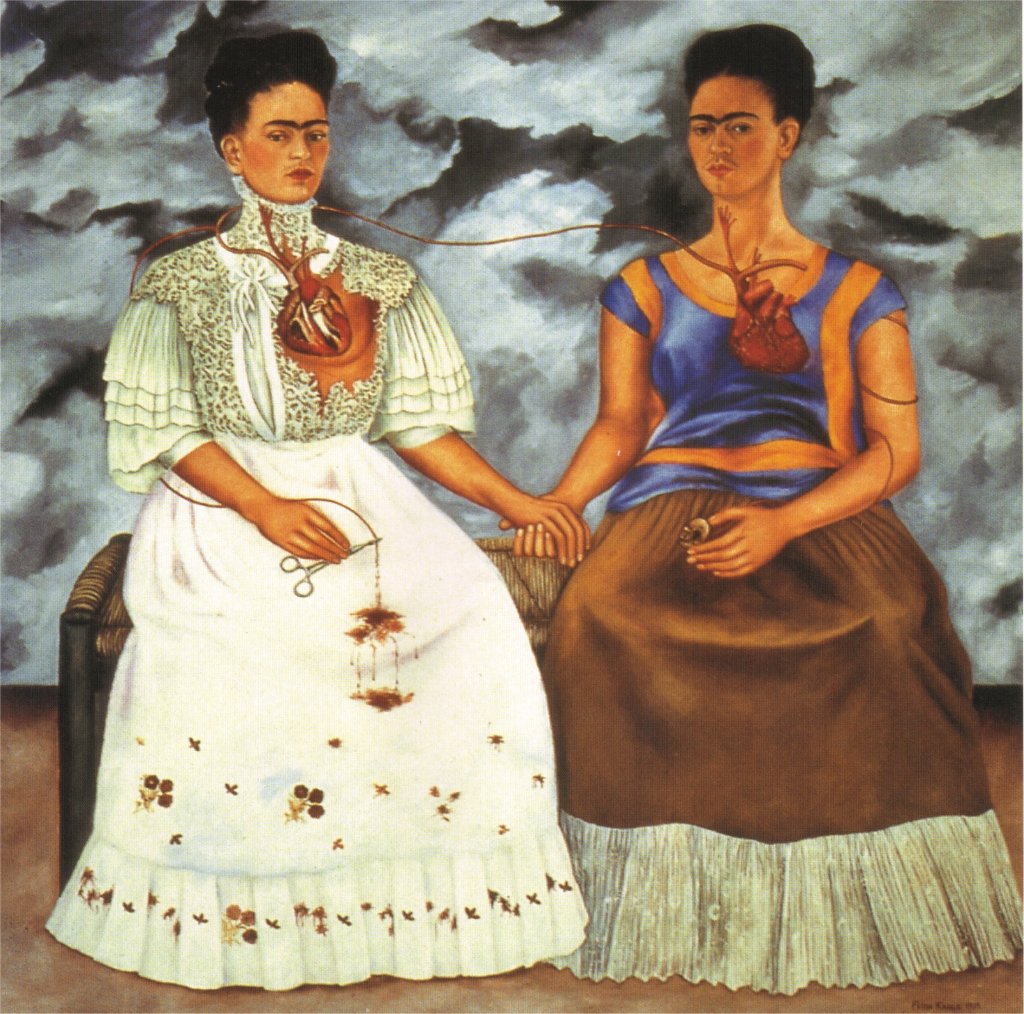
I then asked Jonathan about something which has been niggling at me: I draw inspiration from various sources to help me see ways to express my thoughts in work. I gave the example of the Two Fridas and the passage I had come across in a book I had seen in Waterstones about siblings and the primal connection through umbilical cords. In drawing on these sources, am I creating anything new, unique, or will someone just look at it and think ‘that reminds me of the Two Fridas’? Is it enough that it is coming from me and about how I feel? Jonathan assured me that it is ok to draw inspiration from others – the Two Fridas was personal to Kahlo and painted 80 years ago – I would be making it now, in 2024, and it would be personal to me.

What will I do for the next hour? Go away and write up my note of the tutorial before I forget it, which will be a useful process to consider what we discussed. Jonathan pointed out that at the beginning I had said that I had wanted to make art a bigger part of my life and that during our chat I had said that I couldn’t stop thinking about it, so I’m on my way and I should just keep doing what I’m doing.

I’m still feeling positive, and I would venture to say, even more so. I need to cogitate on what we discussed to move forward, but for the moment, everything is all ok.
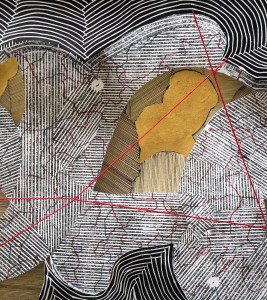
Sisters

“A sister is not a friend. Who can explain the urge to take a relationship as primal and complex as a sibling and reduce it to something as replaceable, as banal as a friend? Yet this status is used again and again to connote the highest intimacy. My mother is my best friend. My husband is my best friend. No. True sisterhood, the kind where you grew fingernails in the same womb, were pushed screaming through identical birth canals, is not the same as friendship. You don’t choose each other, and there’s no furtive period of getting to know the other. You’re part of each other, right from the start. Look at an umbilical cord – tough, sinuous, unlovely, yet essential – and compare it to a friendship bracelet of brightly woven thread. That is the difference between a sister and a friend.”

‘Blue Sisters’, by Coco Mellors

I stumbled across this passage whilst I was having a mooch in Waterstones on Saturday. It cuts right to the heart of what it is to be a sibling. I find the imagery particularly strong – the inhabited space of the womb, growth and development, umbilical cord, connection. Lots of food for thought.

‘The Two Fridas’, Frida Kahlo 1939 (oil on canvas)

On the subject of thinking, this image above has been floating around in the back of my head whilst I’ve been contemplating my role as a sibling, and as a mother, but more on the latter some other time. In this painting, Kahlo’s traditional identity is connected by an artery from her complete heart to the heart of her modern identity which has been torn apart by her divorce from Diego Rivera. I find it a very powerful image: full of pain and conflict, but, at the same time, resilience. It’s already informing some ideas for a piece of work.

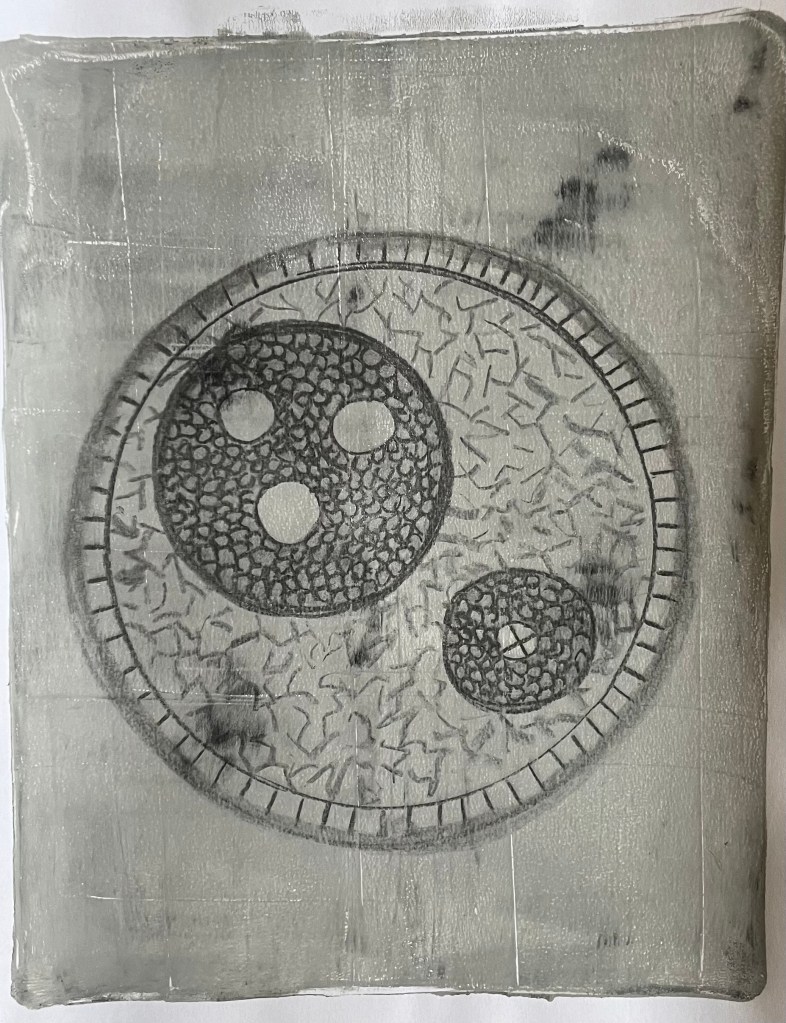
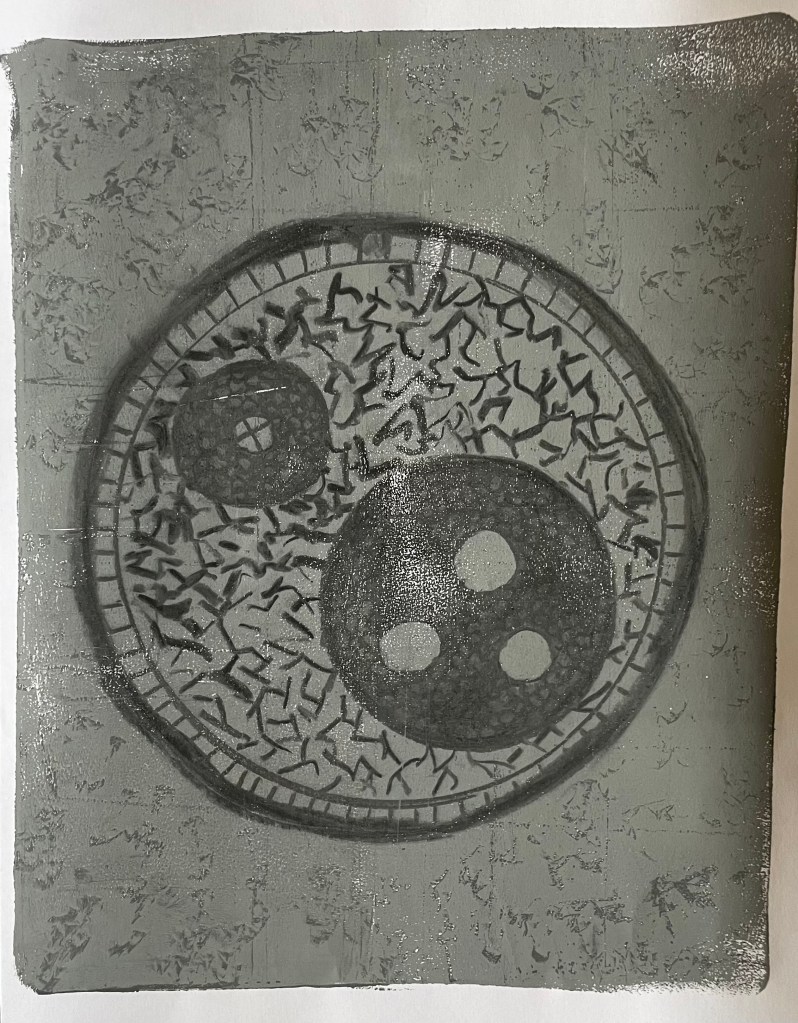
I’ve been experimenting with pressing charcoal drawings onto a gelatine plate and then printing – the archival quality it produces is interesting – and also applying paint onto the plate randomly. It was all done in a bit of a rush as I suddenly thought: less thinking, more doing. I didn’t find the process satisfying: the colours are really unappealing and murky – in fact they are just varying shades of grey. I’ve been meaning to try this process for sometime now, since I saw it on a facebook reel, so I was really quite excited at the outset but I ended up feeling underwhelmed – the subtleties inherent in charcoal are totally lost. Maybe starting with a cross-section of an unlovely umbilical cord inadvertently set the tone, but my quickie self-portrait certainly expresses how I felt!

So, here’s the bad and the ugly…

Miscellany I

I’m conscious that I committed to doing an automatic drawing a day to try and change my mindset. I’m allowing myself the inclusion of exploring Procreate as well!

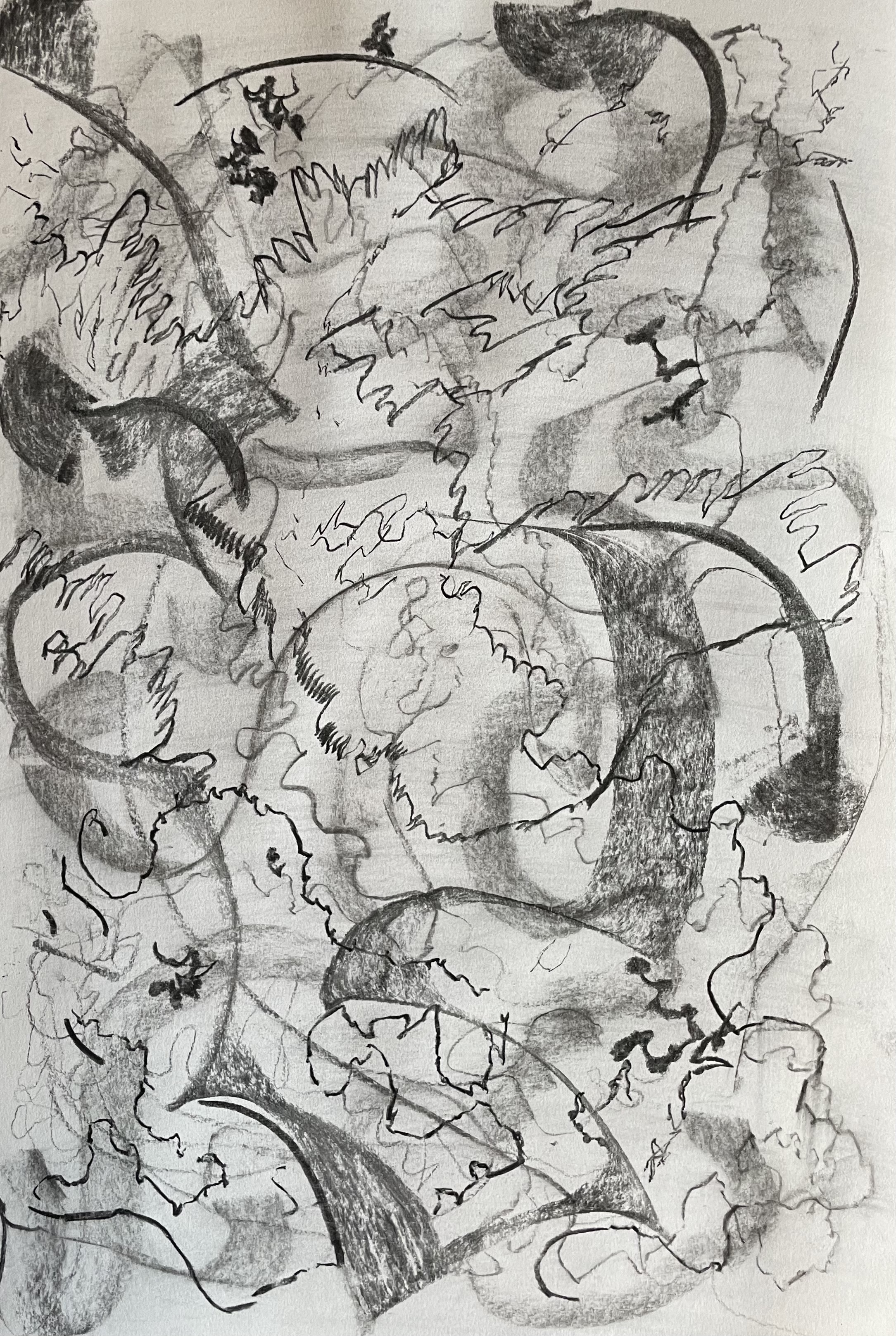
I particularly like the charcoal drawing. I used a piece of compressed charcoal and made swirling marks using it on its narrow edge and full on its side. I then rubbed it out and repeated it but this time playing around with the end and varying the motions. The concept of layers appeals to me (memories, past lives/ identities…) particularly the traces left behind of the first drawing and I was surprised by the range of marks I made depending on how I held the charcoal and the pressure I used. There are some delicate areas, followed by some jagged, harsh marks. Some lines appear to be faltering and hesitant whilst others have more purpose and at times are almost punctuation marks in what would otherwise be a stream of unconsciousness.

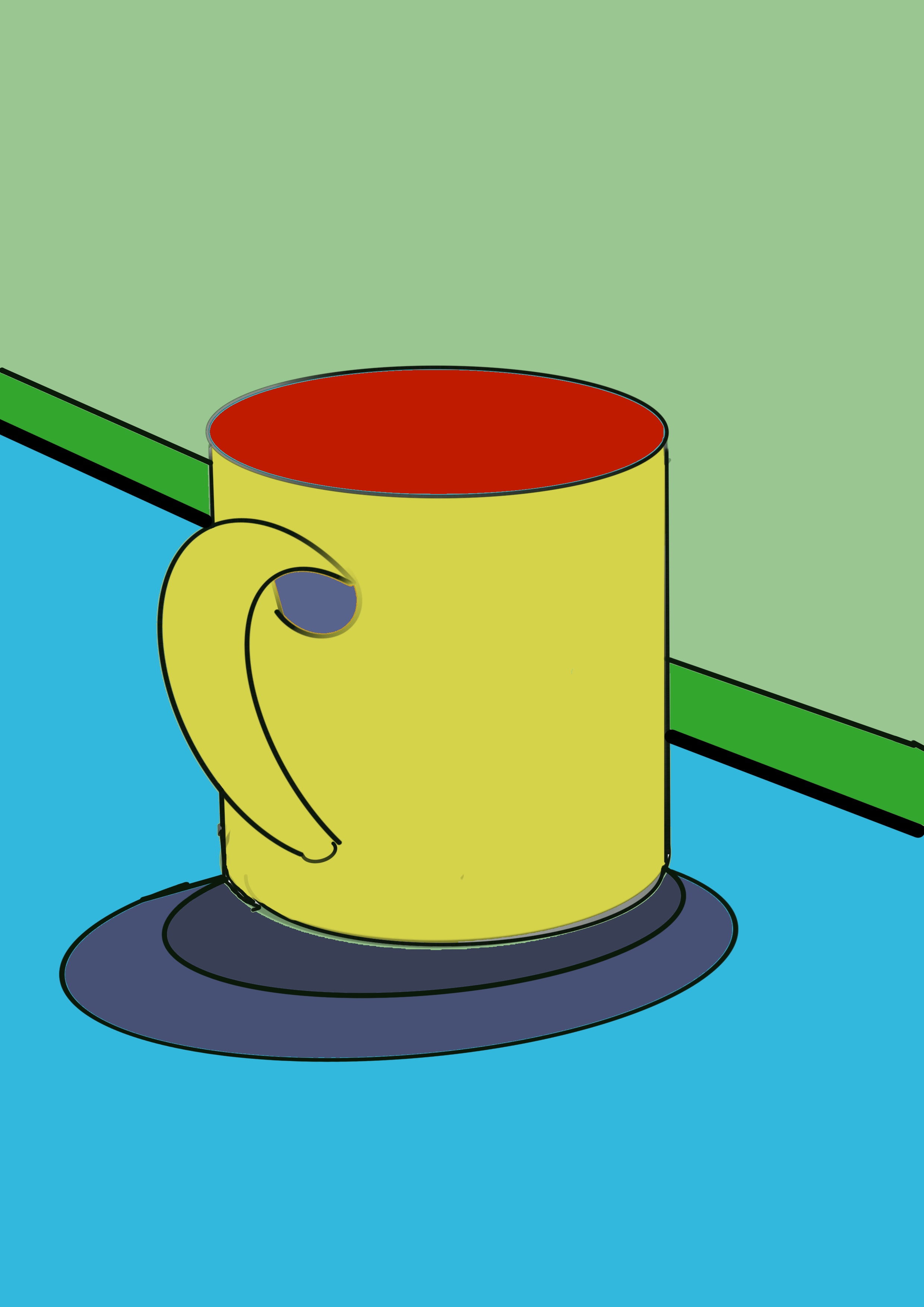
The second image I am treating as an automatic pastel drawing – I randomly chose colours and effects from the Procreate menu and I think the result is interesting, although I miss the haptics and the smell of the real thing as well as the tactile relationship between the medium and support. I’m not sure that I would use it going forward, except maybe as a tool to experiment with, although I have previously decreed that collage is just not my bag – how times change! I might use it if I decided to go down a graphic flat colour route (as in the third image) and digital collage is something I will definitely explore further – no bits on the floor and no need to glue – what’s not to like? I’ve been thinking about how I could incorporate digital collage into a mixed media piece of work – perhaps a giclée print onto a canvas, sealed with medium and then oil paint?

There are lots of thoughts chasing themselves around my head – I’ve been ignoring them in the hope that as and when I consciously acknowledge them they may have already got themselves into some kind of order. Just doing what I’m doing at the moment seems to be creating even more possibilities and permutations which is exciting.

I can sense that I’m feeling a lot more relaxed about making my experimental work ‘public’. I really look forward to starting the day by just letting my hand wander across the page – it’s the only time when there’s no expectation on me to achieve anything – renewing the buildings insurance, fixing the E20 error message on the washing machine – just a moment when I’m at one…

Trying Not To Overthink It

Guilty as charged: I have form for overthinking, overworking, not knowing when to stop and basically bludgeoning a piece until there is no life left in it. My problem is that I have an expectation of how it should be. It’s not even as if I enjoy the process – it makes me frustrated, stressed, and downhearted to the point of threatening to pack it all in. So, to put an end to this way of working I need to adopt a new approach; create a new habit but one which opens up possibilities, as opposed to closing them down. Admittedly, I have already begun to experiment more recently, but it needs to become second nature.

There’s a lot to be said for drawing exercises; I’m a particular fan of continuous line drawing but the drawback (excuse the pun) is that I’m still drawing something, I’m just not allowing myself to draw it as accurately as I might otherwise want to, and so there is still an expectation as to how it should look.

Sometime ago, I watched a documentary about Maggi Hambling. She gets up at 5am every morning and with a cup of coffee and cigarette in hand, she starts her day by making a drawing – she doesn’t like the term sketch – using an ink dropper and, in this particular instance, with her eyes closed. It is a form of automatic drawing, a concept embraced by the surrealists and latterly by the abstract expressionists, which involves the artist making marks without any conscious control.

I think this is for me!

There are numerous possibilities: pencil, charcoal, ink, paint, collage, eyes open, eyes closed, different ways of holding, holding more than one, dominant hand, non-dominant hand and the list goes on.

So this is the first of my daily automatic drawings:

I used a charcoal pencil in my dominant hand and, with my eyes open, I just let it wander over the page without any conscious thought or control. Maintaining the same pressure and manner of mark-making started to become a bit tedious so I almost unconsciously varied the pressure and the way I made the marks, holding the pencil higher up so that there was less control from my hand, rocking it backwards and forwards in my hand, holding it perpendicular to the page and then on its side. It was a sensory experience in that I was aware of the feel and the sound of it: the sound of the charcoal on the paper and the squeaking and stuttering of it on the upward stroke creating broken lines, as opposed to the smooth downward marks. I then randomly smudged and blended some areas.

There are some quite interesting passages and if this is my subconscious expressing itself then I might have cause for concern! All in all, I’m pleased with what I produced because I enjoyed the process – instead of being mindful, it was mindless – and I hope that if I do this often enough I might just free myself up.