I started this post a while ago. The act of going through all of my blog posts for the book and making the 5-minute video has encouraged me to think about the journey that I’ve been on. Sometimes I have so many thoughts in my head that I need to put them into words so that I can get some clarity and order. So, here goes…
I started this course thinking that I was an oil painter who enjoyed working with colour and shape. I’ve been looking back at the work that I was making two years ago. This is an example:
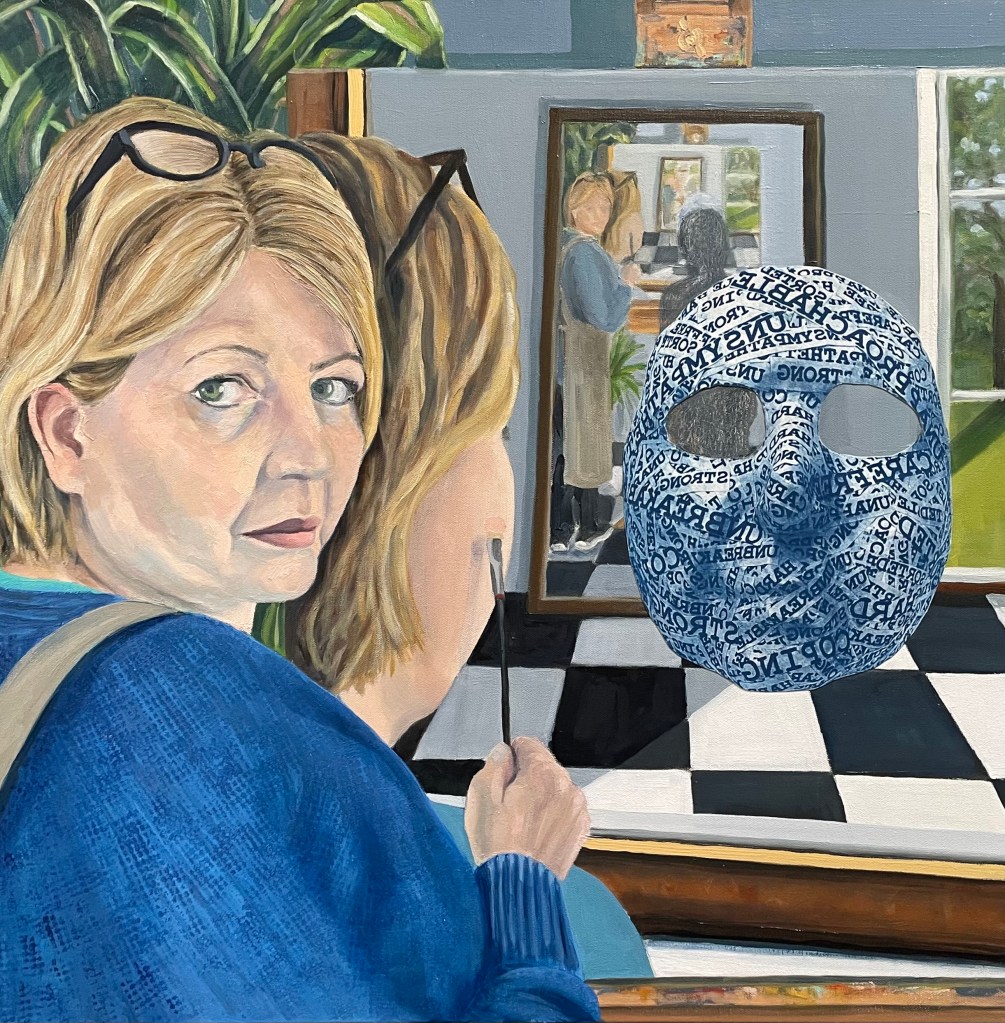
It still appeals to me – I like a narrative. It was made in response to the brief, ‘On Having an Outside’. I like a painting inside a painting, inside a painting and so on, and the use of a mirror, a play on Magritte’s ‘Not To Be Reproduced’. I thought about it a lot – the idea that we wear masks but in this case what you see on my mask is a reflection of you and how you feel about yourself which you then project onto me. It expresses how I felt at the time. I still like looking at it, but it does feel contrived, controlled, and static even though it depicts me turning to look at the viewer. I didn’t enjoy making it. I had a very fixed idea in mind as an end goal and so the process of making it was restrictive and frustrating. I kept at it until it was how I wanted it to be, what I thought was the best that it could be. It was all about the product and I was driven by my controlling perfectionist self. I haven’t painted very much at all over the last two years. I’m wondering why. Maybe I should?
These are screenshots of some of my recent Instagram posts:
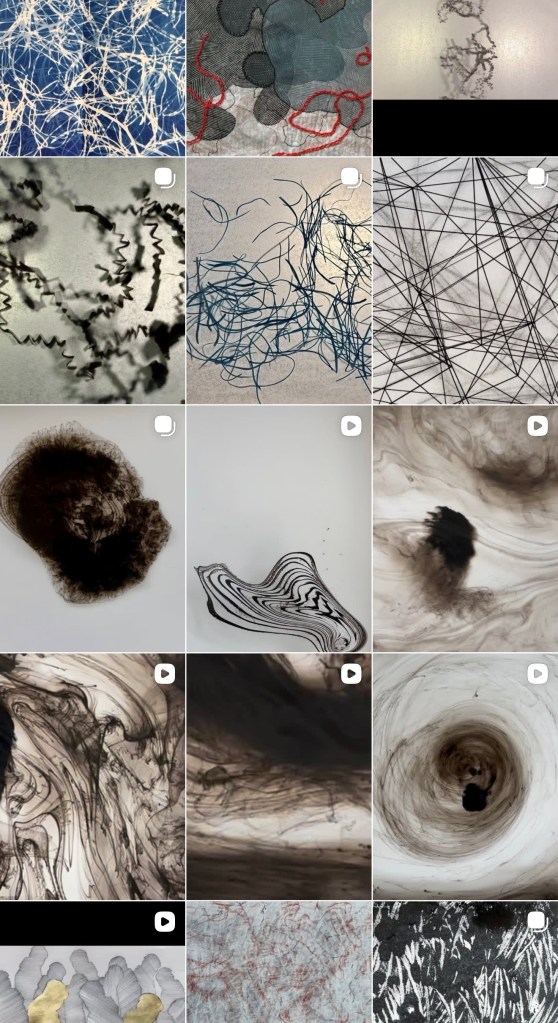
I look at these images and I like what I see, but most importantly I remember how I felt when I made them. I felt free, unencumbered, excited, and intrigued. Interestingly, they are predominantly monochrome, exploring mark-making and movement.
I’ve been wondering what to do. When clothes don’t fit me I sell them or take them to a charity shop. What should I do when my work no longer fits me? Treat it like a photograph of a younger self maybe, a reminder of where I’ve come from?
The last two years have revealed many things to me:
I am happiest in the process
I am at my most productive and enjoy making the most whilst in the process and without a defined end product in mind. One of my mantras used to be that without intention there can be no expectation. I think that was useful in the early days to keep my focus on process, but I’m not sure that it’s strictly true because I experiment and explore with intention. Furthermore, the making of the book is a very intentional act with an end product in mind, but the specifics of how it looks have developed in the process. I think that the difference is that the book itself is not important save to the extent that it is documenting my process and the making of it has allowed me to develop further, as well as to reflect on the last two years.
I don’t need to be in control
Embracing the process has allowed me to give up control and it is now the foundation of my practice. It has helped me better understand myself and has changed me. It has allowed me to see that there is a direct correlation between my behaviour in making and my behaviour in life. It has taught me that in moments of personal overwhelm such as becoming a parent and caring for my mother my instinctive reaction was to try and exert control over circumstances. This behaviour fed through into my making. By allowing myself to give up control by experimentation in making, I now realise that I can deal with uncertainty in life and rather than trying to control it, I should lean into it.
I don’t have to make what I like or like what I make
Just because I love to look at Surrealism, works heavy with narrative or full of colour does not mean that is the kind of art that I should be making. Viewing and making are two entirely separate experiences. Because I am privileging process over product I may not always like what I make – what is most important is what I experience in the process. Just recently, I have been working more with video and I’ve realised that this actually gives me a means of exploring narrative.
The meaning of my work is in the process
As in the example above, I used to start out trying to make work that already had meaning. Now, the meaning comes out through the process of making, and the finished piece embodies it in some way. That doesn’t mean that I begin without any direction—I often still start with a line of enquiry or an idea—but it isn’t fixed. It stays open, changing and developing as I work.
I can embrace both the accidental and the incidental
I now feel more comfortable with accepting responsibility for the accidental within the process, and I actively look for the incidental and often go off on a tangent.
I want to be able to choose whatever process or material seems right in the moment
I don’t want to restrict or pigeonhole myself. I refuse to attach a label to myself either as an artist or as a person. I want to be able to choose whatever process or material is right in the moment. I don’t want to limit my ability to experiment or to discover new languages of expression. I live and I make.
I need some soft structure
I think that there are two distinct areas of my practice – the experimental side which is exciting, uncertain and can be overwhelming, and the side which is more of a structured wandering, for example, repetitive mark-making. I’ve commented previously that the act of drawing line after, or even now more recently, stitch after stitch makes me feel contented – it’s as if there is just enough structure to provide a frame for my attention yet loose enough to allow for response. I’ve also been using motifs such as contour lines, automatic drawing, my father’s silhouette etc. throughout the course, and it is really only recently that I understand why that is a feature of my practice. I have accepted that I can never rid myself of the perfectionist self and the soft structure provided by the repetition keeps that part of myself happy.
And my Study Statement?
Since the first year I have thought from time to time that I need to change and update my Study Statement because I’ve wandered off course. In it I was very specific about how I was going to approach things. I had an end product in mind (what a surprise!). Instead of exploring all of the different roles that I’ve had in my life, complying with my detailed workplan and finding out who I am, I naturally deviated from my plan and later made the conscious decision to embark on a dérive contemplating those things which seemed important or of value. To have amended it would be to remove the evidence of my progress and my process. I’m not the person I was back then – I am becoming and the prescriptive framework of the Study Statement would have limited that becoming. Thinking about it even some of the categories on this blog are irrelevant.

